Interpretation of Scenes:
Burmese Andagu 8 Scene Buddhist Stele
The Proper right Register
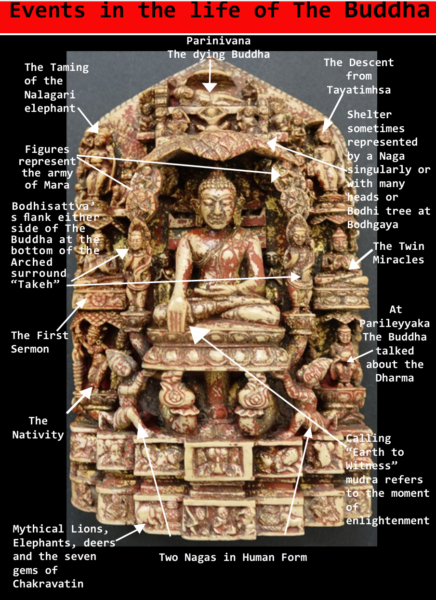
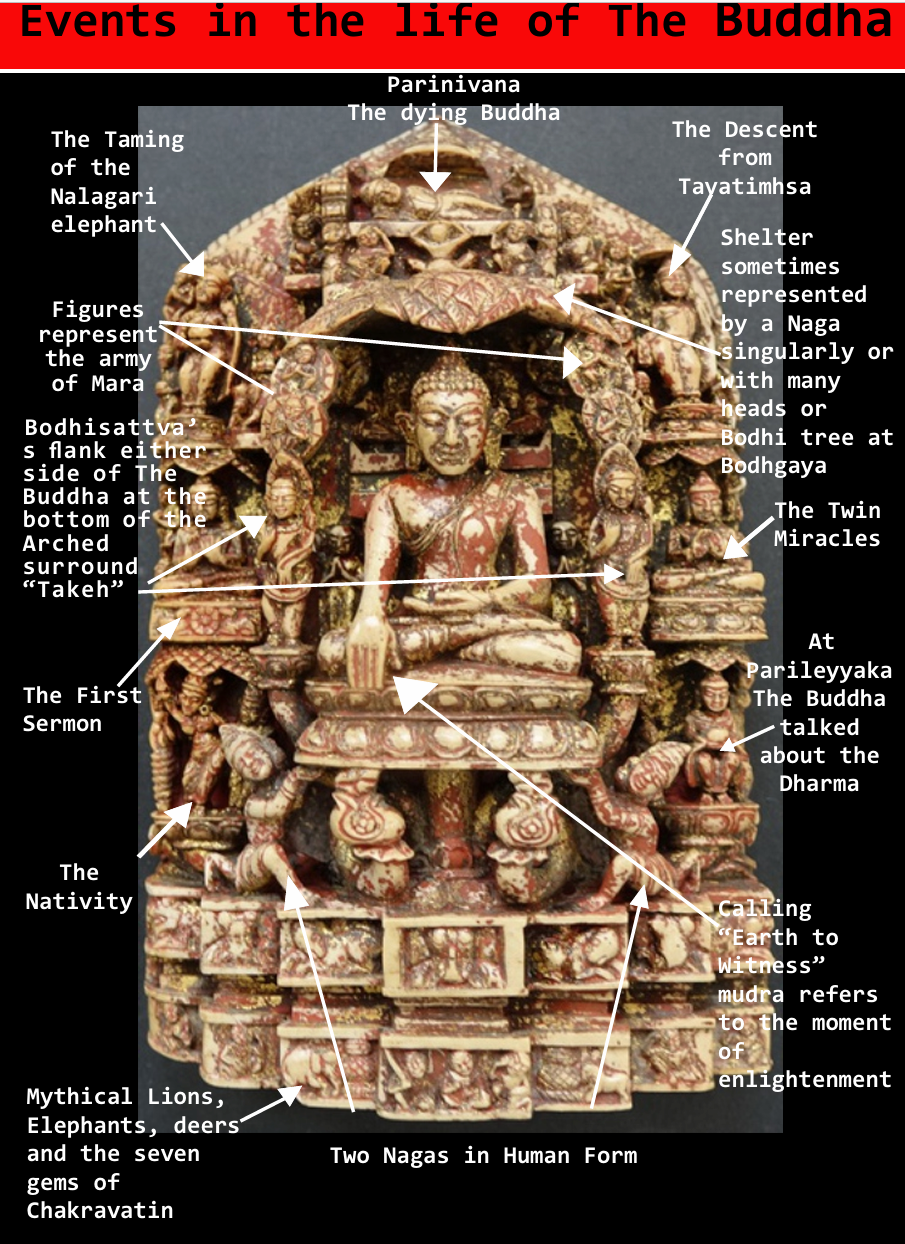
The Nativity Scene
The nativity scene on the bottom proper right register represents the Buddha’s birth when Maya Devi, the mother of Siddhartha Gautama (Buddha), with her arm extended up holds onto the sal-tree branch whilst giving birth with her attendant standing next to her. When the child emerged from Maya’s right side fully formed, he immediately took his first steps, after each step a lotus flower appeared, on his seventh step he stood still and said:
“Foremost am I in the world
Eldest am I in the world
This is the last birth
I am chief of the world
There is now no more coming to be”.
Above the Nativity scene, the Buddha is shown seated in the preaching attitude with his hand gesture in dharmachakra mudra teaching the first sermon in the deer park at Sarnath. The deer’s carved into the pedestal on which he is seated would likely indicate this event.
Above this (top figure) shows a standing Buddha with either the disciple Sariputta or Maudgalyayana standing behind an elephant in miniature on the Buddha’s proper left side and the other disciple standing on his proper right side. Another figure kneeling above the Buddha’s right shoulder is possibly a devotee. This scene likely represents the time when the Buddha went into retreat in the Parileyyaka forest after he told the Sangha to sort out their differences. Whilst in Parileyyaka forest the Buddha received offerings from the Lord of the monkeys and Lord of the elephants after which his chief monks (Sariputta and Maudgalyayana) came to take him back to the monastery.
Proper left Register
The Top left figure shows the Buddha’s descent from Trayastrimsa Heaven (the realm of the Devas) after teaching the dharma to his mother who was reborn in Trayastrimsa Heaven. He is accompanied by Brahma on the right (with three faces) and Indra on his left.
The Scene underneath likely represents the Twin Miracles at Sravasti where he performed two miracles. These miracles preceded the visit of the Buddha to the Trayastrimsa Heaven to teach the dharma to his mother.
The scene underneath this represents the Parileyyaka scene, where the Buddha is seated in pralambanasana, with both legs pendant (European fashion), with an alms bowl in his lap, receiving offerings. The Nalagiri elephant is seen kneeling by his left side. In other Burmese Buddhist iconography showing this scene, the elephant is inter-changeable where a monkey is shown instead of the elephant and can be shown on either side of the Buddha.
THE CENTRAL SCENE ON ALL ANDAGU STONE STELE:
The dominant feature in most andagu stone steles is the central figure of the Buddha seated under the Bodhi tree at the moment of enlightenment, with the fingers of his right hand “touching earth”, crying victory over the demon Mara, other andagu stone steles may show him standing.
Central Scenes the Enlightened Buddha and Pari nirvana
Behind the head of the Enlightened Buddha is a lotus bud-shaped halo carved into the main body of the stele with two hamsa birds perched on either side. Two standing attendants, probably his main disciples Sariputta and Mahamoggallana are seen slightly behind the central figure of the Buddha on either side of the throne.
At the top of the stele, above the central figure, the Buddha is shown at the moment of his death, or Pari nirvana. He rests on a ceremonial couch attended by three kneeling disciples. The figures at the head and foot of the couch are believed to be his chief disciples, Sariputta and Moggallana, while two further devotees look on from above.
Flanking the central Buddha are two standing Bodhisattvas, both traditionally depicted with the right hand raised in Abhaya mudra, the sacred gesture of reassurance and protection. Positioned directly above each Bodhisattva are two Asparas (known in Pali as Acchara), also referred to as celestial beings in prayer, in this instance with bent knees (the tribhanga pose), completing the symmetrical composition.
The lotus pedestal is supported by two Naga kings, a stylistic feature that is uncommon in Bengal stele but bears a striking resemblance to certain Buddhist sculptures from Mahoba in the Bundelkhand region of Central India.
Across the Base
Two rows of Mythological creatures decorate the base on which the running Nagas are kneeling with devotees, lions, elephants, horses, and other creatures that were significant in the life stories of the Buddha.
Beyond the Gallery
For more insights into Burmese antiquities and the stories behind these rare acquisitions, subscribe to my Substack newsletter. [Read more and subscribe here.] More images related to this andagu carving