
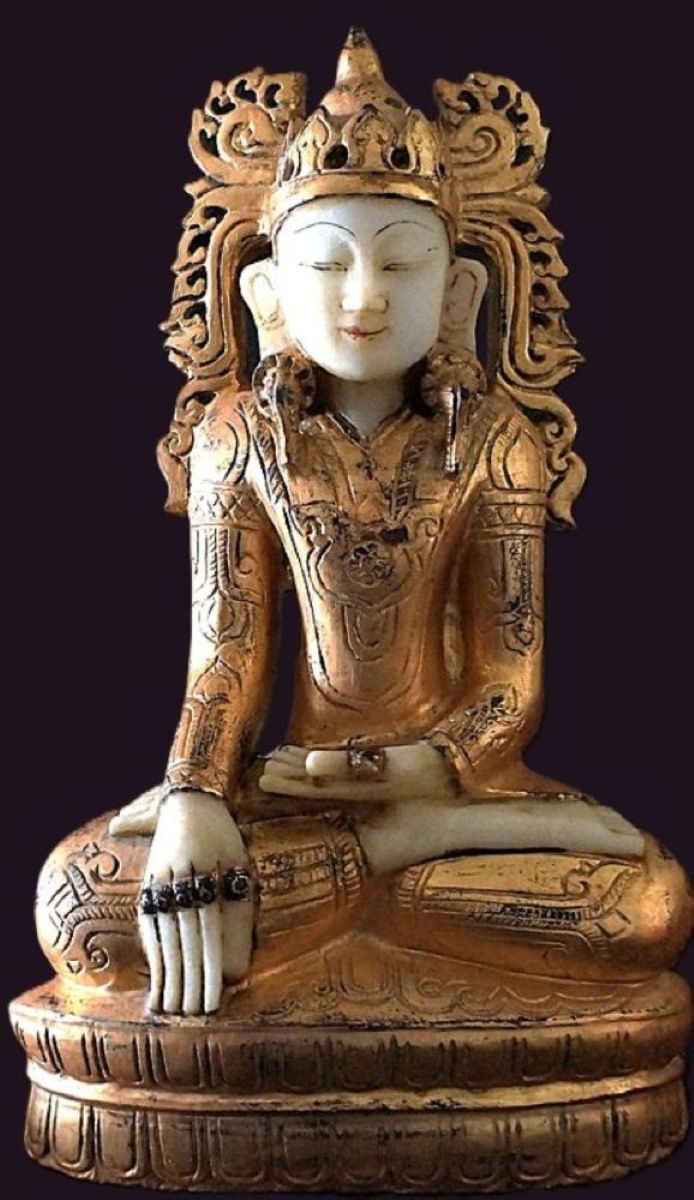
The Burmese Jambhupati King Buddha Statue represents a fascinating intersection of religious devotion and royal power, portraying the Buddha as a Chakravartin or Universal Monarch. This tradition, which spread across Myanmar over several centuries, highlights the diverse ways different regions interpreted the Buddha’s transition from a humble ascetic to a celestial king. The transition from the Indian-influenced bronzes of the west to the lavishly gilded carvings of the central plains, local materials and regional histories shaped one of the most recognizable icons in Southeast Asian art.
Our collection showcases the three primary expressions of this royal iconography: the early, bronze-cast majesty of Rakhine State, the diverse material traditions of the Shan, and the Mandalay period. Whether through the precise incising of alabaster or the intricate layering of thayo lacquer on wood, each statue serves as a testament to the artisan’s skill and the legacy of the King Buddha tradition.
Jambhupati King Buddha statue

Mandalay Period
During the Mandalay period, the Jambhupati King Buddha statue (Crowned) was frequently rendered in wood and characterized by elaborate iconographic details. These figures were typically embellished with glass mosaics (hman-zi-shwe-cha) and sometimes glass beads, set into intricate thayo (lacquer resin) relief work.This lacquer was applied in diverse motifs, most notably the fish-scale (nan-twin) robe pattern or flowing vegetal and floral scrolls. While the primary form was traditionally gilded, composite statues of alabaster and wood often featured distinct metal regalia.
These additions included zinc-plate body armor, prominent lateral flanges, and stupa-shaped crowns. Such regalia were further distinguished by central medallions, prominently positioned on the chest, back, or as a focal point of the metallic adornments.
While the style reached its most opulent, refined peak in the 19th-century royal capital of Mandalay, the concept of the crowned Buddha traveled a long historical road through Burma:
- The Coastal Beginnings (Arakan): The style gained early, widespread prominence between the 15th and 18th centuries in Mrauk-U, the capital of the western coastal Arakan kingdom. Sitting on the Bay of Bengal, Arakan served as a natural gateway for Indian artistic traditions, establishing a distinct regional style of crowned imagery.
- The Central Transition (Ava and Shan States): Over the centuries, central Burmese courts in Ava and the neighboring Shan States adopted and evolved the iconography, experimenting with taller crowns, sweeping ear wings, and deep lacquer work.
- The Aesthetic Zenith: Ultimately, it was the artisans of the Mandalay period who synthesized these centuries of tradition, creating the definitive, highly sought-after aesthetic that pairs pure white alabaster with the brilliant, shimmering relief work of gilded thayo and glass mosaic.
Shan Style Jambhupati Buddha Statue
The Shan Jambhupati King Buddha statue (Crowned) is represented across a diverse material range, including alabaster, marble, wood, and bronze. Wooden examples from this tradition share a high degree of ornamentation with the Mandalay style, featuring intricate thayo lacquer relief, glass mosaics, and gilding aesthetic techniques that parallel the decorative traditions of neighboring Thailand.
These figures are typically characterized by prominent, multi-pronged crowns with expansive lateral flanges. In contrast, the bronze iterations often align with the iconographic conventions of Rakhine style Buddha statues, appearing either as austere, unadorned forms or cast with high-relief motifs.
Such bronze compositions frequently include disciples rendered in the round, positioned in kneeling or standing postures at the base. In alabaster and marble specimens, the royal regalia of the King Buddha is typically integrated directly into the stone through precise incising or relief carving.

Mrauk-U Style Jambhupati Buddha Statues
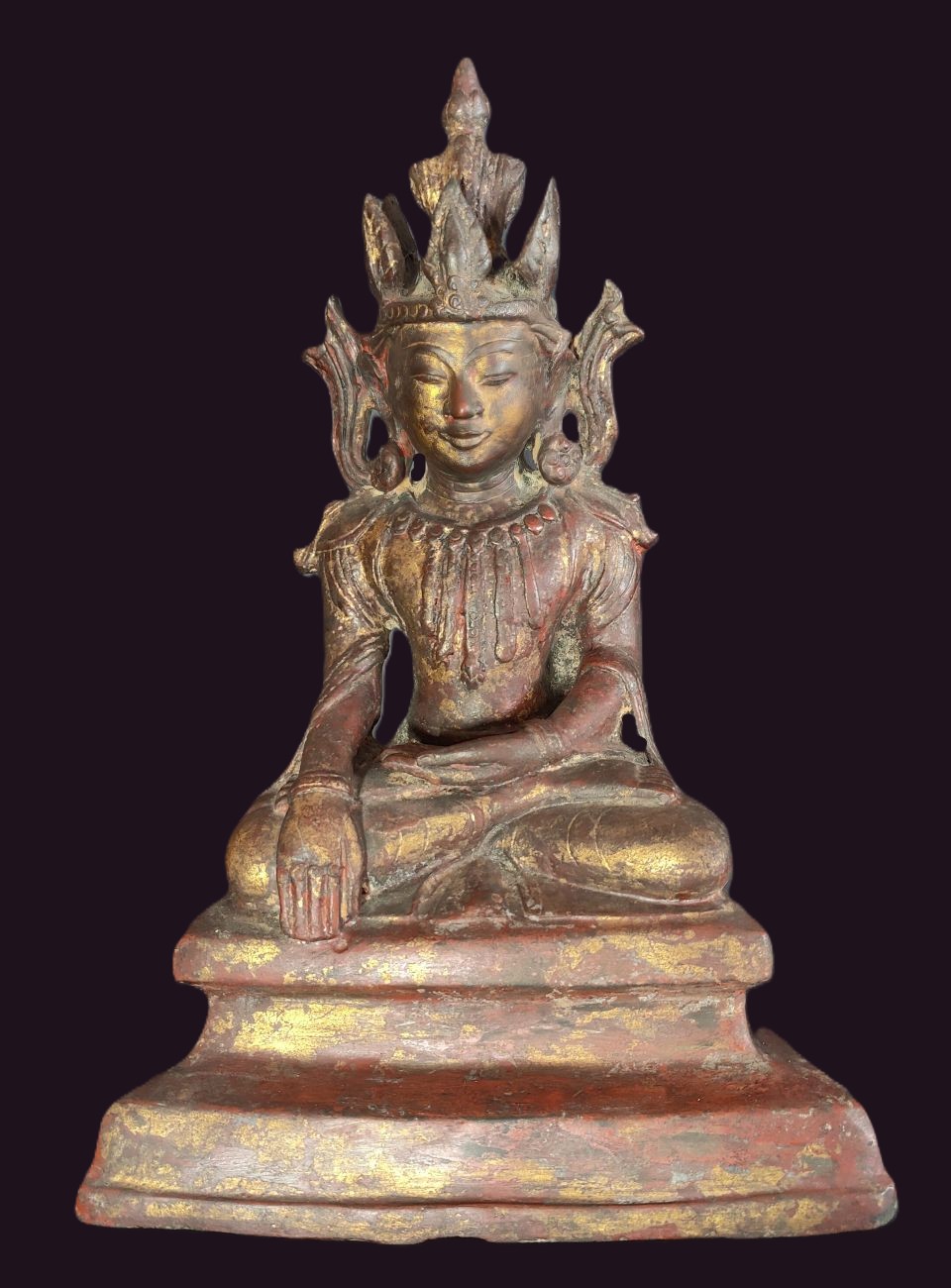
The Jambhupati King Buddha statue style of iconography from Arakan (modern Rakhine State) represents a distinct artistic lineage that predates the decorative traditions of central Myanmar. Emerging from the Mrauk-U period, this style reflects profound aesthetic transmissions from neighboring Pala-period India, integrated several centuries prior to the Mandalay era.
These figures are predominantly cast in bronze and are distinguished by an elaborate crown featuring a high, central usnisa the rounded cranial protuberance or in some cases a hair knot on which an ornate finial is surrounded by multi-pronged elements to indicate royalty and prominent lateral flanges in varying sizes. In a notable departure from later styles, these crowns often mirror the structural height of Western medieval regalia.
The Mrauk-U Jambhupati Buddha is typically adorned with heavy necklaces and armlets, flanked by large earrings and a distinctive, symmetrical lapel that drapes across both forearms.
Almost universally seated in padmasana (lotus position), the figures perform the bhumisparsa mudra, signifying the moment of Enlightenment. The pedestals frequently serve as narrative stages, cast with high-relief depictions of lions (simha) or elephants, symbolizing the Buddha’s spiritual lineage and royal birth, alongside disciples and figures from the Jataka tales.