

Pagan Bronze Buddha – Mara’s Daughters
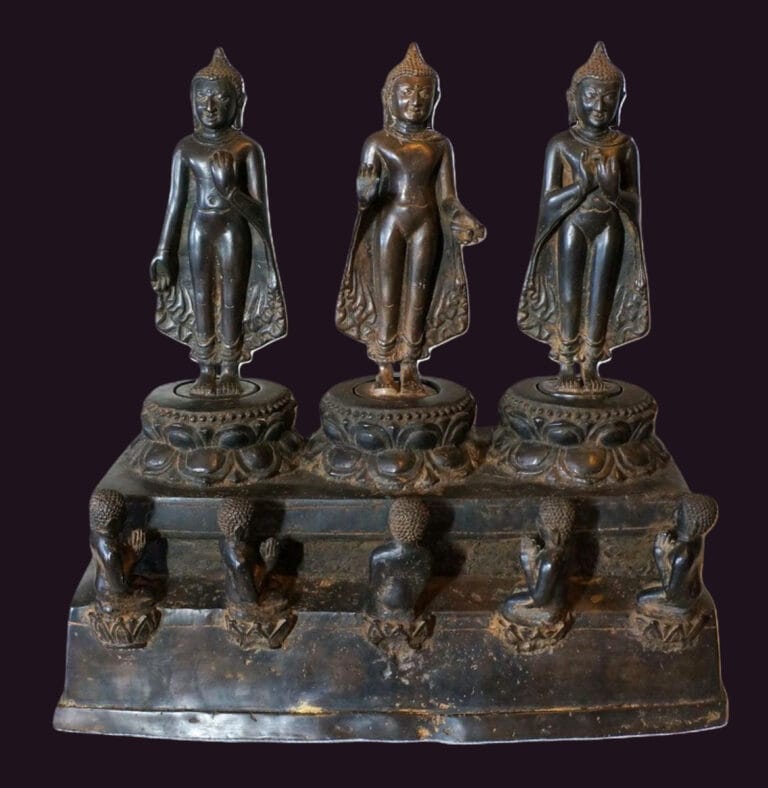
This rare Pagan bronze Buddha with Mara’s daughters depicted across the front of the pedestal captures the pivotal moment just before Siddhartha Gautama’s enlightenment when Mara’s daughters’ endeavours to seduce him failed. According to Buddhist texts, when Mara failed to dislodge the Buddha through the sheer terror of his demon armies, he deployed his three daughters, Tanha (Desire), Raga (Lust), and Arati (Aversion) to divert and distract him. Their objective was to disrupt his concentration and tie his consciousness to the cycle of rebirth (samsara).
Although I have stated this statue as a Pagan style I personally lean more towards Arakan in Rakhine State.
Note: the powerful, squared facial structure and the distinctive continuous brow line, traits that distinguish the Western Rakhine tradition from the central Bagan school, and the flame-like finial (rasmi) with a triangular or notched indent is a classic diagnostic feature often associated with Arakanese (Rakhine) craftsmanship, particularly from the Mrauk-U period.
SPECIFICATIONS:
- AGE: – Pre 16th Century
- CONSTRUCTION: – Bronze
- HEIGHT: – 83cm
- WIDTH: – 42cm
- DEPTH: – 28cm
- WEIGHT: – 39.45 Kg.
- #138KA
Pagan Bronze Buddha – Mara’s Daughters
The confrontation between Siddhartha, Mara and his daughters
The placement of these figures at the foot of the throne emphasizes the contrast between the fleeting, chaotic nature of worldly temptation and the absolute stillness of the Buddha. By touching the earth (Bhumisparsha mudra), the Buddha calls upon the earth goddess to witness his lifetimes of accumulated virtue, instantly dispelling Mara’s illusions. In Pagan art, this specific iconographic inclusion reflects a sophisticated theological understanding, transforming the base of the image into a vivid stage for the ultimate victory over spiritual ignorance.
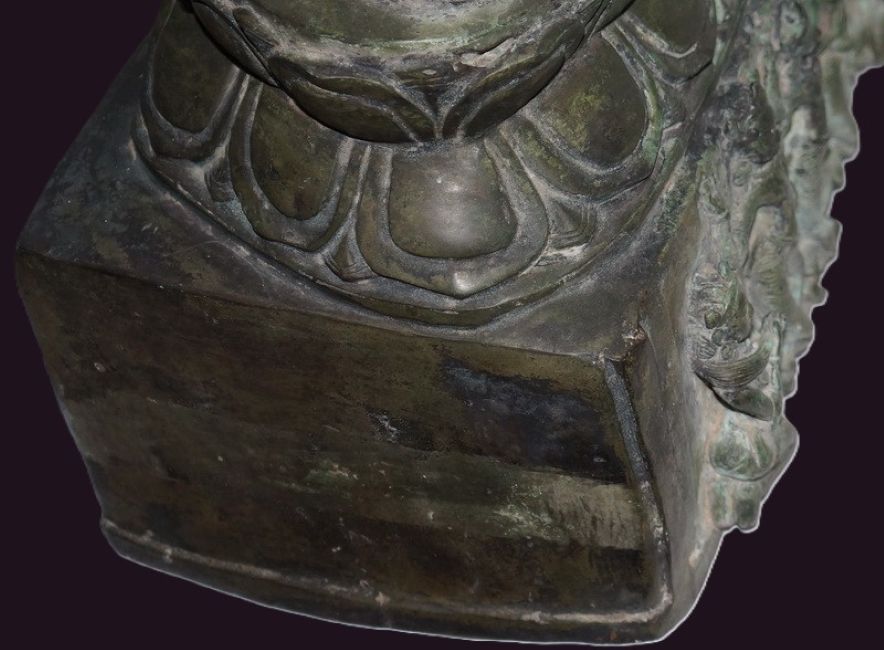
The lower plinth exhibits a clean horizontal transition, indicating the figure was originally designed to be ‘slotted’ into a grander architectural surround, likely a gilded wooden throne or a stone sanctuary niche. This structural feature allowed the bronze to integrate seamlessly with the temple’s larger narrative framework. Other explanations below.
- The Wooden Throne (Samyak): In many Rakhine (Arakan) temples, bronzes were slotted into elaborate, multi-tiered wooden thrones that were often gilded or lacquered. This external “ledge” would have allowed the wooden framing to sit flush against the bronze, creating a seamless transition between the metal figure and its ornate wooden surround.
- A Stone Pedestal: Alternatively, it may have been set into a carved sandstone base. Mrauk-U is famous for its stone architecture (like the Shite-thaung Temple). A bronze “slotting” into a stone cavity would require exactly this kind of clean, external transition line to ensure stability.
- The reverse of the plinth: displays a faint horizontal ‘tide mark,’ a common indicator of historical mounting. This suggests the statue was partially encased in a secondary base, likely carved stone or gilded wood which shielded the lower bronze from the environment for generations.
Within Buddhist hagiography, accounts regarding the timing of Mara’s daughters’ appearance, whether preceding or succeeding the Buddha’s Enlightenment remain varied. Characterized as the “Lord of the Senses” or the “Lord of Death,” Mara is traditionally identified as the earliest non-human entity documented in Buddhist scriptures.
In one prominent narrative iteration, as Siddhartha Gautama approached the threshold of full enlightenment, Mara sought to derail his progress through sensory temptation. He manifested visions of his three daughters “Tanha” (craving), “Arati” (aversion), and “Raga” (passion), who performed provocative dances in an attempt to seduce him.
Siddhartha, however, maintained a state of profound equanimity; his absence of desire rendered him impervious to these distractions. Following the failure of this seductive display, Mara transitioned to a more aggressive tactic, assailing Siddhartha with an infernal host of demons wielding lethal weaponry.
When Siddhartha remained similarly unperturbed by this martial display, Mara shifted to psychological derision. He mocked the ascetic’s pursuit, asserting that his spiritual efforts were futile because no witness existed to validate his achievement. In a definitive response, Siddhartha reached down to touch the ground, calling upon the earth itself as his witness. The subsequent trembling of the earth served as a cosmic confirmation of his merit, prompting the “Prince of Darkness” to retreat in defeat.
The Daughters of Mara
In some Buddhist literature there is mention of five daughters with two lesser known daughters named “Pride” and “Fear”, possibly the scene at the base of this statue shows the three half naked dancing women as Tanha, Arati, and Raga trying to seduce the Buddha with the two seated women being Pride and Faith with their hair in their hands as described by Charles Duroiselle, a French born Burmese historian and archaeologist and co-founder of the Burma Research Society in 1910 as well as a scholar in the Pali language.
Those who see Mara as a personification of our human ego interpret the stories associated with him in a symbolic way. Mara becomes a representation for internal voices. His attack on the Buddha represents internal impulses towards violence and rage that can be overcome by following the Buddha’s teachings of cultivating compassion, detachment and gentleness.
Charles Duroiselle’s Commentary on the “Five Daughters”
Key Insights from Duroiselle’s Research
In his 1916 descriptions of the Bagan temples, Duroiselle noted that while the primary textual sources focus on the three daughters, certain traditions and artistic representations expand this number to five to encapsulate a broader spectrum of human defilements.
The “Shocking” Murals: Duroiselle is famously cited for his reaction to the murals in the Nandamanya Temple. He described the depictions of Mara’s daughters as being “so vulgarly erotic and revolting that they can neither be reproduced nor described. This suggests that in some Burmese traditions, the temptation was depicted with a raw, visceral intensity intended to emphasize the Buddha’s absolute equanimity.
Duroiselle noted that in the Mon tradition (documented at the Ajapala shrine in Pegu), the daughters did not just appear as three distinct women. Instead, they took the form of hundreds of women of varying ages, from virgins to elderly women to “suit any taste” and test the Buddha’s detachment from all stages of life and beauty.
The Ananda Temple Stelae: In his work The Ananda Temple at Pagan (1915), Duroiselle cataloged the stone reliefs depicting the Life of the Buddha. He highlighted that while the daughters are central to the “Temptation” scene, the Burmese interpretation often blends the psychological internal struggle with external demonic forces, sometimes blurring the line between the daughters and the broader “army of Mara
The shift from three to five daughters is generally seen as a transition from the Three Poisons (Lust, Hatred, Delusion) to a more expanded list of the Five Hindrances or other psychological barriers. Duroiselle’s work was instrumental in showing that Southeast Asian Buddhism, particularly in the Bagan period, frequently incorporated these nuanced variations that differed from the standard Pali Canon descriptions.