
Sacred Scripts: Burmese Pali Palm Leaf Manuscripts
Burmese Pali Manuscripts: Palmyra and Talipot Traditions
Palm leaves were used widely in Cambodia, India, Indonesia, Burma, Nepal, Sri Lanka, and Thailand for the Buddhist Pali scriptures. Although there are many varieties of palm trees, the leaves of two species were mainly used for writing and painting. These are the Palmyra palm (Barassus Flabelifer Linn) and Talipot palm (Coryoba Umbraculifera Linn).
The Palmyra palm produces thick, rigid leaves that lack flexibility. Over time, these fibers become brittle and susceptible to insect damage. In contrast, the Talipot palm offers soft, supple leaves that retain their flexibility for centuries. Consequently, the oldest surviving palm-leaf manuscripts are almost exclusively crafted from Talipot leaves.
Regional Processing Techniques
- South India: Fresh leaves were dried in the shade and then treated with oil.
- Sri Lanka: Practitioners boiled fresh leaves in water or lime water before shade-drying them.
- Myanmar: Fresh leaves fermented in large jars for five to seven days. Once they turned yellow, they were washed in fresh water and dried in the shade.
- Thailand: After removing the stiff ribs, the leaves were cut to a uniform size and bundled between wooden boards. These bundles were heated in a kiln, which covered the leaves in a black oil residue. This deposit was wiped away, and hot sand was used to smooth the surface.
Decorative Practices
While coloring the leaf before writing was uncommon in India, Nepal, or Sri Lanka, Thai artisans frequently decorated or colored the surface before beginning their work.
There were two major techniques for writing or illustrating on palm leaves, namely:
- (i). by making incisions with a pointed stylus.
- (ii). by writing with a pen or brush.
Preparing Palm Leaf for Writing Manuscripts
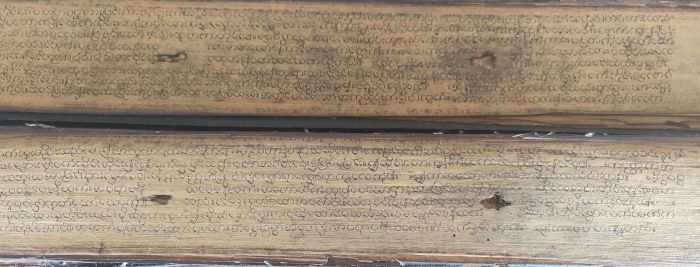
After processing the leaves, scribes used an iron stylus to incise text and illustrations into the surface. At this stage, the incisions remained invisible. To make the work legible, a mixture of lamp soot or charcoal powder and oil was applied across the leaf. Wiping away the excess left the black pigment trapped within the grooves, making the script and drawings stand out clearly.
Storage and Decoration
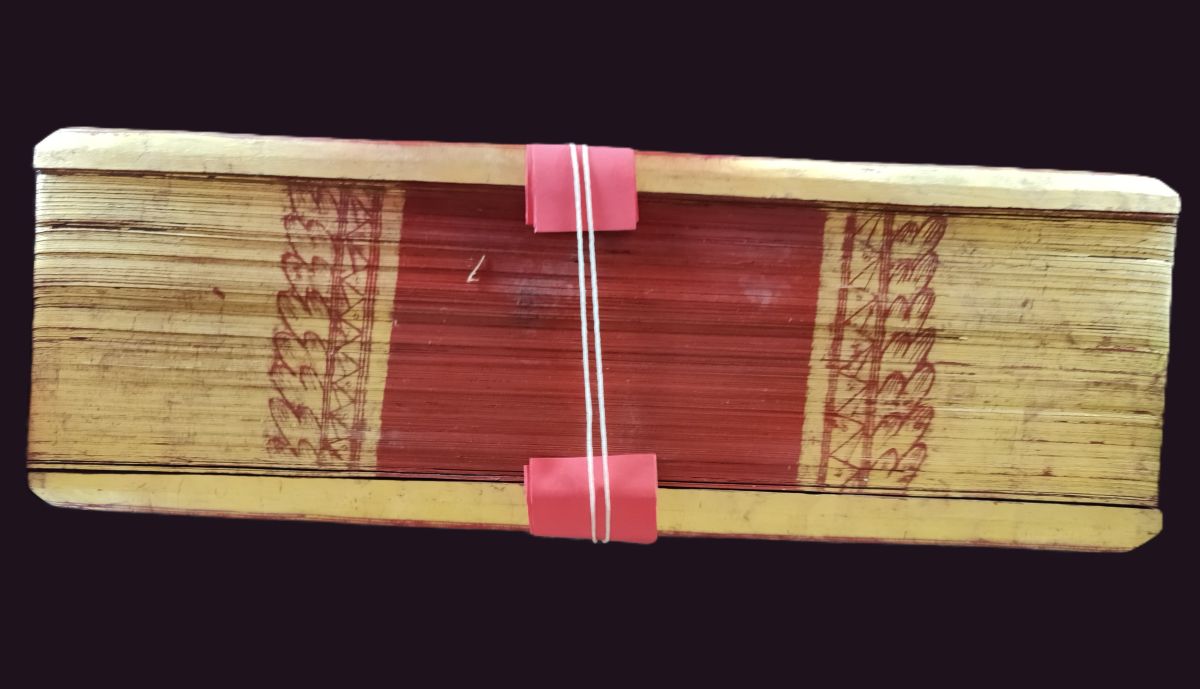
To preserve the completed manuscripts, the palm leaves were placed between two wooden covers. A cord or bamboo stick was passed through holes pierced into each leaf to maintain their order and position. In Myanmar these wooden end boards were sometimes decorative, but the majority have plain wooden end covers painted in a cinnabar-coloured lacquer.
The more decorative palm leaf manuscripts feature:
- Thayo lacquer work
- Inlaid mosaics and rare gemstones
- Carved ivory accents
Deterioration and Prevention
Palm-leaf manuscripts are susceptible to several forms of deterioration. Common defects include:
- Surface staining and spots
- Surface discoloration
- Insect and fungal damage
- Loss of flexibility
- Splitting of the leaf layers
Cleaning and Restoration
Stains on incised palm leaves can often be removed with water, but written manuscripts require non-aqueous solvents such as ethyl alcohol or acetone. Trichloroethane is also an effective cleaning agent. Discoloration, typically caused by oxidation, dirt, or excessive oiling, can be addressed using a dilute detergent for incised leaves or a mixture of acetone and ethyl alcohol to strip away old oil.
Pest and Fungal Control
The “bookworm” (Gastrallus indicus) is the primary insect threat to palm leaf manuscripts. To control infestations, manuscripts should be fumigated with paradichlorobenzene at 65% relative humidity. While fungus is uncommon, it can be removed with ethyl alcohol swabs or managed through thymol fumigation.
Structural Fragility
As these manuscripts age, they become increasingly fragile and brittle. The breakdown of the leaf’s internal structure leads to a loss of flexibility, causing the edges to crumble and the leaves to break easily upon contact, especially so if they are kept in moist, dirty or unprotected places.
In order to impart the original suppleness and flexibility to the palm leaf, as well as act as an insecticidal deterrent an oil such as citronella, camphor, or lemon grass oil is applied onto its surface with a piece of soft cotton cloth with the excess wiped off with a dry piece of cloth.
Small holes can appear in the palm leaf if they have been exposed to insects. To repair these holes, fibers of mulberry tissue paper can be used. An adhesive like diluted Mowicoll is mixed with fibers. Big holes or broken edges can be repaired by using materials like thick Japanese tissue paper or natural wood paper veneer or unused palm leaf.
Another defect often noticed in palm leaves is the cleavage of the surface layer from the main body of the leaf. This type of cleavage is due to the breaking of the bond between various layers. Sometimes, the surface layer of one leaf gets stuck to the adjoining leaf. For repairing the separated layers, an acrylic emulsion adhesive is used. After the adhesive is applied with a thin brush and the separated layer becomes fixed back.
Faded script on palm-leaf is another very common defect. In the case of incised leaves, fading is caused by the loss of the ink or the carbon black which was used to fill the incisions. By the application of carbon black mixed with lemon grass oil, the written words can be visible again.
In the case of surface-written or surface-painted manuscripts, illegibility occurs because of the flaking of ink or paint. The leaf surface is not absorbent and therefore, the paint or the ink flakes off easily. Nothing can be done to restore this type of loss. However, to prevent the paint and the ink from flaking off, a protective coating of polyvinyl acetate solution or acrylic lacquer can be helpful.
STORAGE OF PALM LEAF MANUSCRIPTS
To store palm-leaf manuscripts for longevity, the best way is to keep the whole bundle of palm leaves between two wooden boards in the traditional way to prevent the accumulation of dust, each bundle should be wrapped in a piece of acid-free hand-made paper or a clean breathable cloth. For longevity, an insecticide chemical like Paradichlorobenzene should be placed in storage cupboards.
Resource:
Palm-leaf: The ancient writing medium of Myanmar
U Maung Maung Thein (UCL) & U Thein Lwin (Retired Professor)