

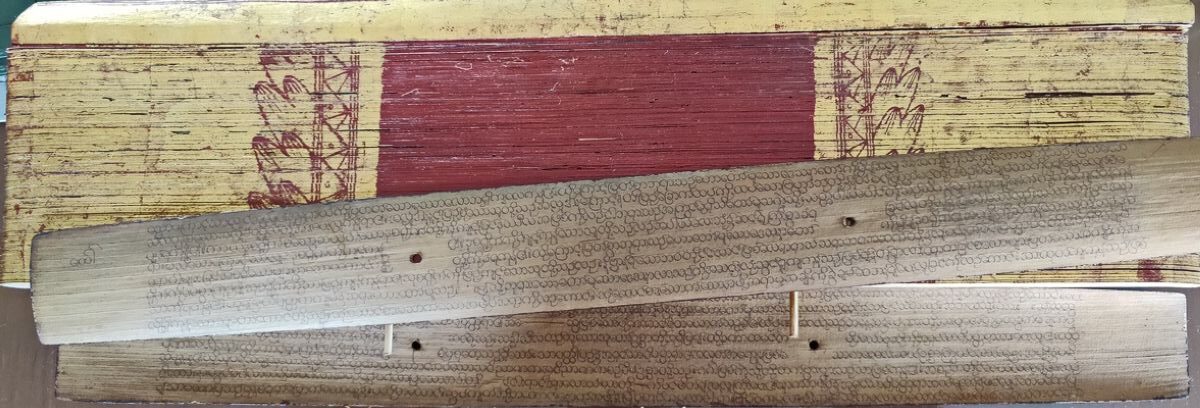

Rare Burmese Kyan-Sit Astrological Palm Leaf Manuscript
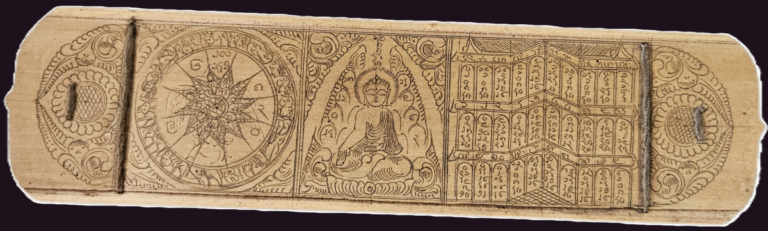
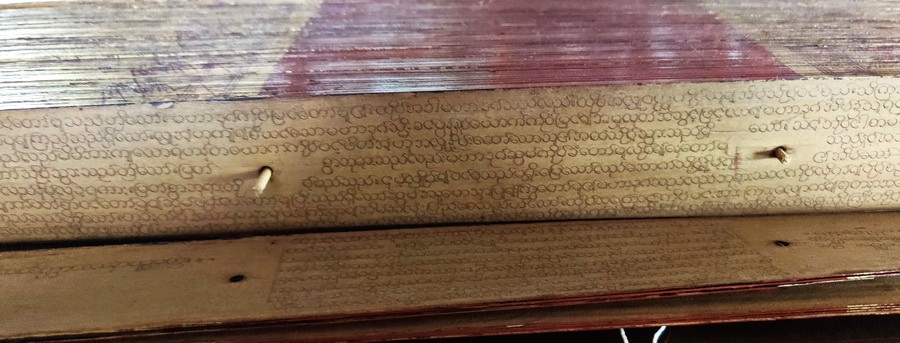
This Rare Burmese Kyan-Sit Astrological Palm Leaf Manuscript shows a glimpse into 19th-century Burmese divination traditions. Protected by hand-painted wooden end-boards (kyan-sit) featuring an intricate astrological wheel and fine floral line work, this rare document contains finely incised palm-leaf leaves (pe-sa).
Manuscripts like this were created by astrologers to record horoscopes, planetary calculations, and auspicious dates, making it an exceptional historical artifact for collectors of Asian art and manuscripts.
The symbols painted on the covers of this manuscript likely represent the eight Burmese zodiac animal with the mythological hamsa bird between each symbol.
SPECIFICATIONS:
- AGE: Late 19th – early 20th century (Assumption)
- LENGTH: 50 cm
- WIDTH: 17 cm
- #375
Rare Burmese Kyan-Sit Astrological Palm Leaf ManuscriptI
In pre-colonial Burma (particularly during the Konbaung dynasty, 1752–1885), decorative treatments on manuscript edges served as a clear indicator of status and rank.
Kyan-hsit Style Manuscripts
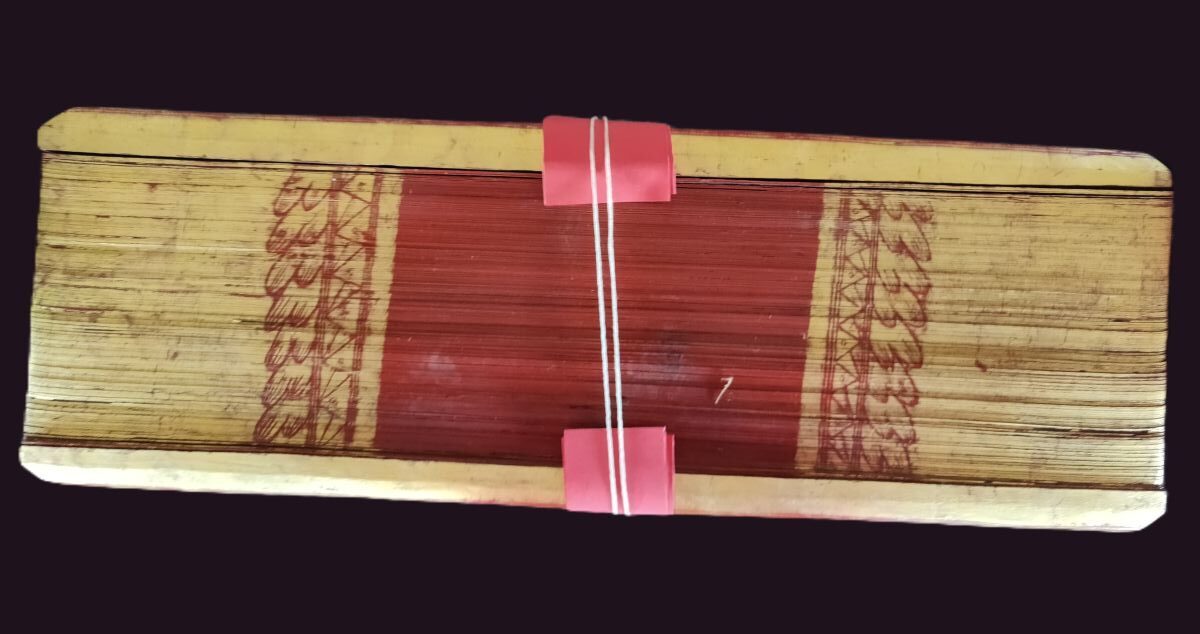
In traditional Burmese manuscript production, a kyan-hsit or kyan-sit palm-leaf manuscript (pe-sa) refers to a specific style of edge decoration applied to the leaves.
The term literally translates from Burmese as “sugarcane joint” or “sugarcane node,” referring to the visual pattern created along the cut edges of the stacked palm leaves.
When the palm leaves are stacked and bound between two wooden covers (kyan), the outer edges are trimmed and treated with red vermilion lacquer and gold leaf:
- The Design: Scribes paint the length-wise edges with red vermilion lacquer, leaving a central section (typically three to four inches wide) coated in gold leaf. This central band of gold framed by red gives the edge profile an appearance similar to the segmented nodes of a sugarcane stalk.
- The Technique: Scribes incise text into the cured palmyra or talipot palm leaves using a sharp iron stylus. They apply an ink mixture (often made of wood oil and soot) across the leaf to fill the incised lines, then wipe the surface clean before lacquering and gilding the outer margins.
Kyan-hsit palm leaf manuscripts such as this contain a wide variety of texts, ranging from Pali Theravada scriptures (such as the Vinaya or Abhidhamma) to secular court administration records, legal codes (dhammathat), royal mission logs, and astrological texts, with some palm leaf horoscopes (zata) made specifically for a child when born.
In Burma, the number eight holds deep cosmological significance, tying together eight planetary energies, eight directions, and an eight-day astrological week within a 12-month calendar. The Mahabote astrological system incorporates seven physical celestial bodies alongside Rahu, an invisible shadow planet representing the lunar node where eclipses occur. To accommodate this eighth energy, Wednesday is divided into two distinct days: Wednesday morning, ruled by Mercury, and Wednesday afternoon, ruled by Rahu.
The Mahabote astrological system relies on seven visible celestial bodies alongside Rahu, a conceptual planet representing the orbital intersection of the Earth, Sun, and Moon where eclipses occur. To integrate Rahu into the zodiac, Wednesday is split into two separate astrological days: Wednesday morning (from 12:01 AM to 12:00 PM), ruled by Mercury, and Wednesday afternoon (from 12:01 PM to midnight), ruled by Rahu.
Types of Palm Leaves used in Buddhist Manuscripts
In Myanmar, traditional palm-leaf manuscripts are called pe-sa, where pe means palm leaf and sa means written text. Ancient scribes used leaves from two primary species: the Toddy or Palmyra palm (Borassus flabellifer) and the Talipot or Corypha palm (Corypha umbraculifera).
The Toddy palm (known as htan in Burmese and tāla in Pali) produces leaves with weak, parallel fibers that tear easily. In contrast, the Corypha palm (called pe in Burmese and rai in Mon) produces broad, flexible leaves with a durable, webbed fiber structure ideal for incising. Because the Corypha palm is monocarpic flowering only once in its 30-to-60-year lifespan, scribes harvested leaves from trees between eight and twelve years old. Properly treated, these leaves can last over a millennium.
| Edge Style | Description | Patronage / Rank |
| Shwe-bain-cha / Shwe-myin | Fully gilded on all four edges with gold leaf. | Reserved for royal commissions by the King or senior royal family members. |
| Kyan-Hsit | Red vermilion edges with a central gold panel. | Commissioned by court ministers, high-ranking officials, and wealthy patrons for monastery donations. |
| Vermilion / Plain | Plain red lacquer or unlacquered natural edges. | Standard manuscripts produced for routine monastic study and lower-ranking donors. |
Unearthed Story of Myanmar History: Preserving Myanmar Manuscript