



Nepalese Bronze Image | Guru Padmasambhava
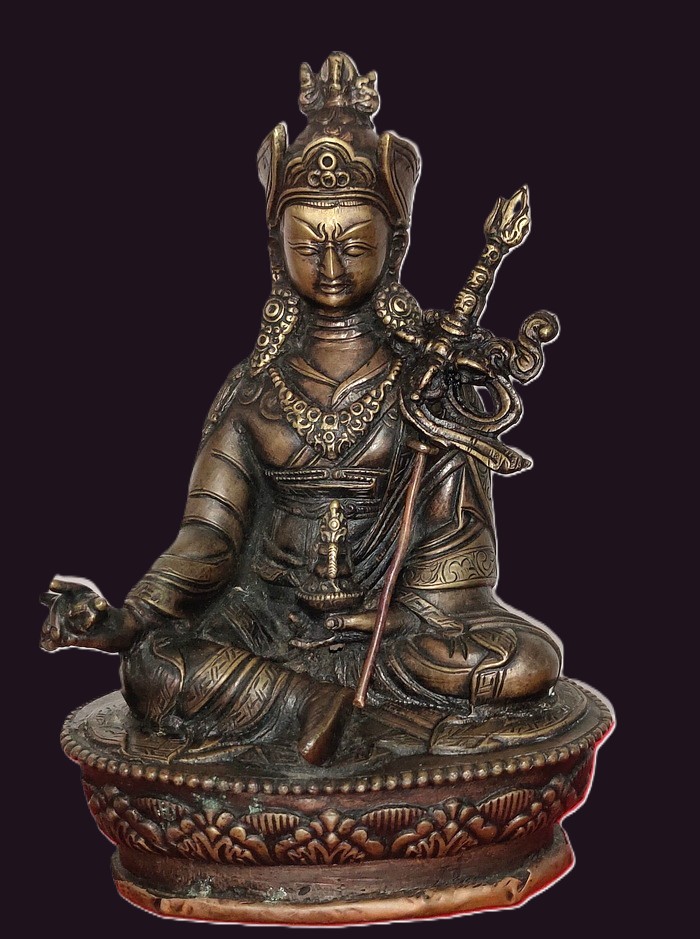
Nepalese bronze image | Guru Padmasambhava – an 8th-century meditation master central to Tibetan Buddhism. Known as the “Second Buddha,” he introduced Vajrayana teachings to the Himalayas, focusing on the mastery of the fundamental elements of existence. In 787 A.D., he established Samye, the first Buddhist monastery in Tibet, solidifying his legacy as the era’s preeminent scholar and yogi.
The spiritual significance of Padmasambhava is anchored in a prophecy. As Lord Buddha approached final Nirvana, he comforted his followers with these words:
Do not mourn, for in the center of a lotus flower on the Lake of Dhanakosha, I shall be reborn as a master of the secret mantra teachings. I will be known as Padmasambhava, and I shall turn the wheel of the Vajrayana Dharma.
This worldly life is transitory and separation is inevitable. But eight years from now, in the midst of an immaculately pure lake in the northwest land of Oddiyana, one will appear who is wiser and more powerful than myself. Born from the center of a lotus blossom, he will be known as Padmasambhava, and will reveal the teachings of the Secret Mantras to deliver all beings from misery
SPECIFICATIONS:
- AGE: – Mid-20th Century (circa 1950s–1960s; pre-1973 provenance)
- METAL: – Brass/bronze
- HEIGHT: – 22cm
- WIDTH:– 14cm
- DEPTH: – 10cm
- WEIGHT:– 1.25 Kg.
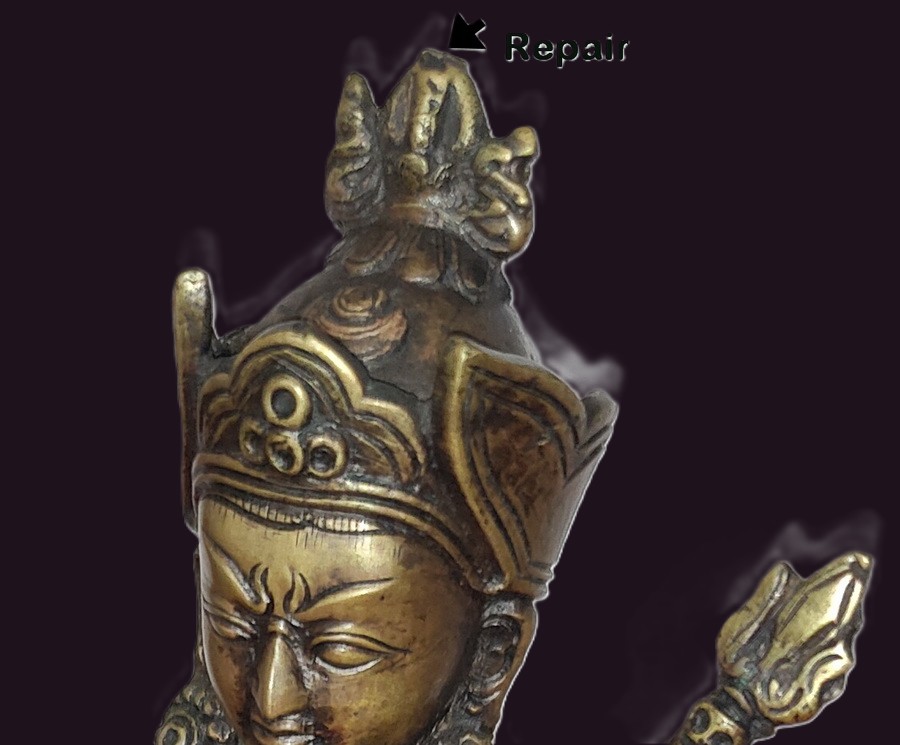
- CONDITION: The small tip on the finial is missing
- #01
Nepalese Bronze Image | Guru Padmasambhava
The statue Nepalese Bronze Image | Guru Padmasambhava exhibits a blend of styles often found in Sino-Tibetan or Himalayan bronzes.
Facial Features: The slightly furrowed brow and intense, “wrathful-peaceful” expression are classic for Padmasambhava. The sharp, aquiline nose and the defined shape of the lips suggest a strong Nepalese (Newari) influence, which historically shaped much of the bronze work in the region.
Attributes: He holds the characteristic vajra in his right hand and the kapala (skull cup) containing the vase of immortality in his left. The khatvanga (ritual staff) resting in the crook of his left arm is intricately detailed with the three severed heads and a trident top.
Garments: The heavy, layered robes with ornate floral or geometric engravings along the borders are typical of later Tibetan and Sino-Tibetan works. The “lotus hat” topped with a half-vajra and a vulture feather (indicated by the tall central point) is his most recognizable stylistic marker.
Surface and Patina: The dark, rich patina shows signs of age, but the crispness of the secondary engravings on the robes suggests a more modern production compared to early medieval bronzes.
Lotus Base: The double-lotus base with beaded edges is a standard design used for centuries, but the specific proportions and the way the petals are rendered may point toward a 19th- or 20th-century artisan tradition.
Casting Technique: The detail in the khatvanga and the jewelry indicates a sophisticated “lost wax” casting process consistent with professional workshops in Patan (Nepal) or Tibetan refugee communities in the mid-20th century. The hammered edge would indicate is a properly sealed, high-quality casting made using traditional methods, but the materials and tools used to achieve it align with a modern production date.