


Antique Burmese Mandalay Buddha, Royal Attire, 19th C
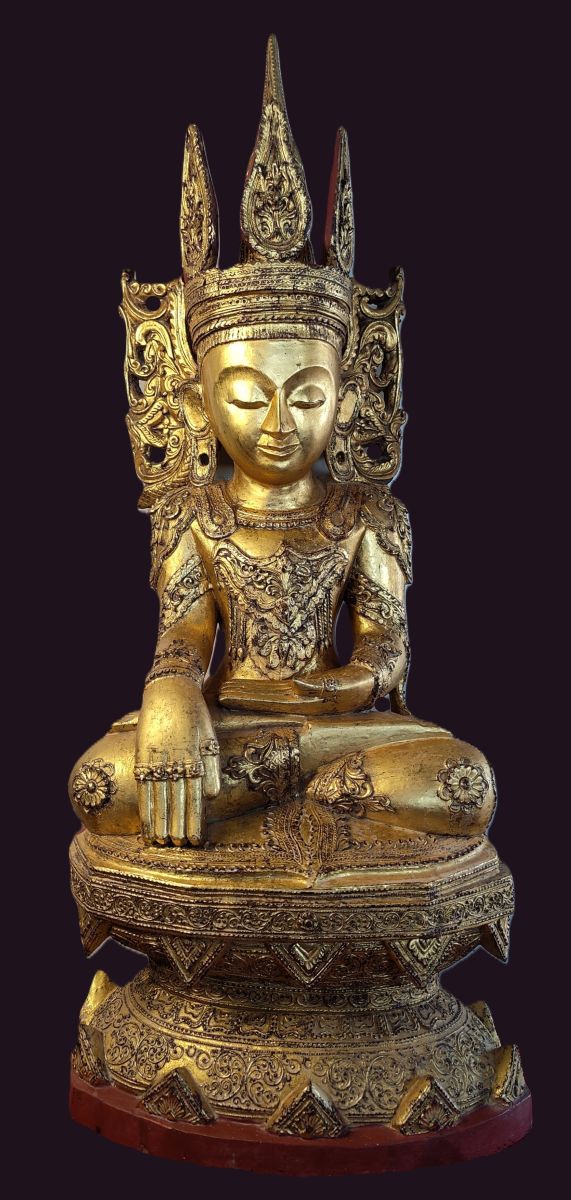
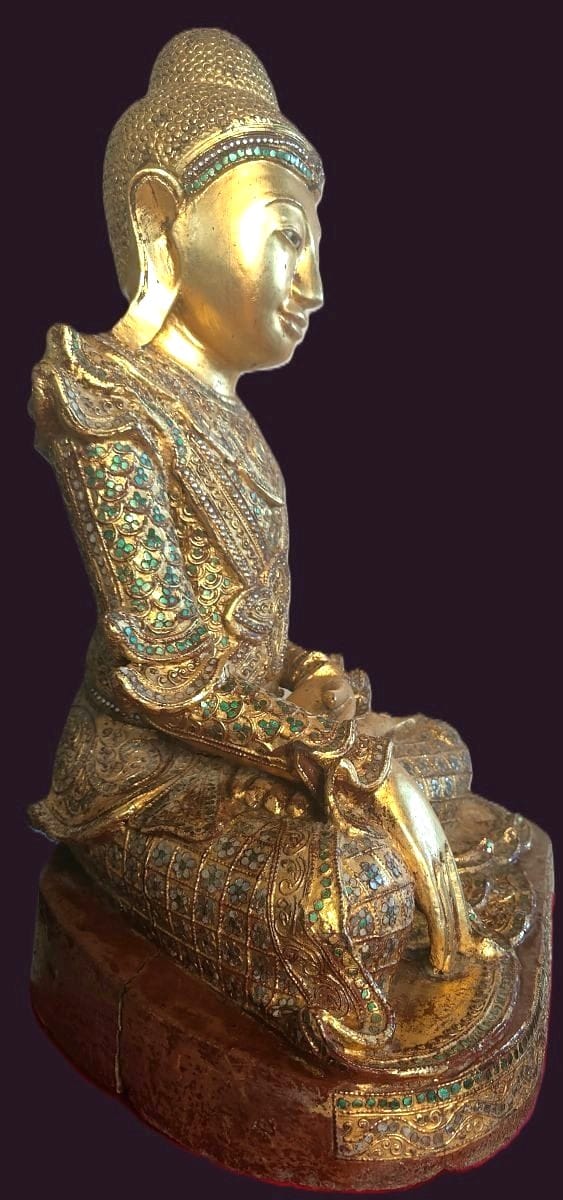
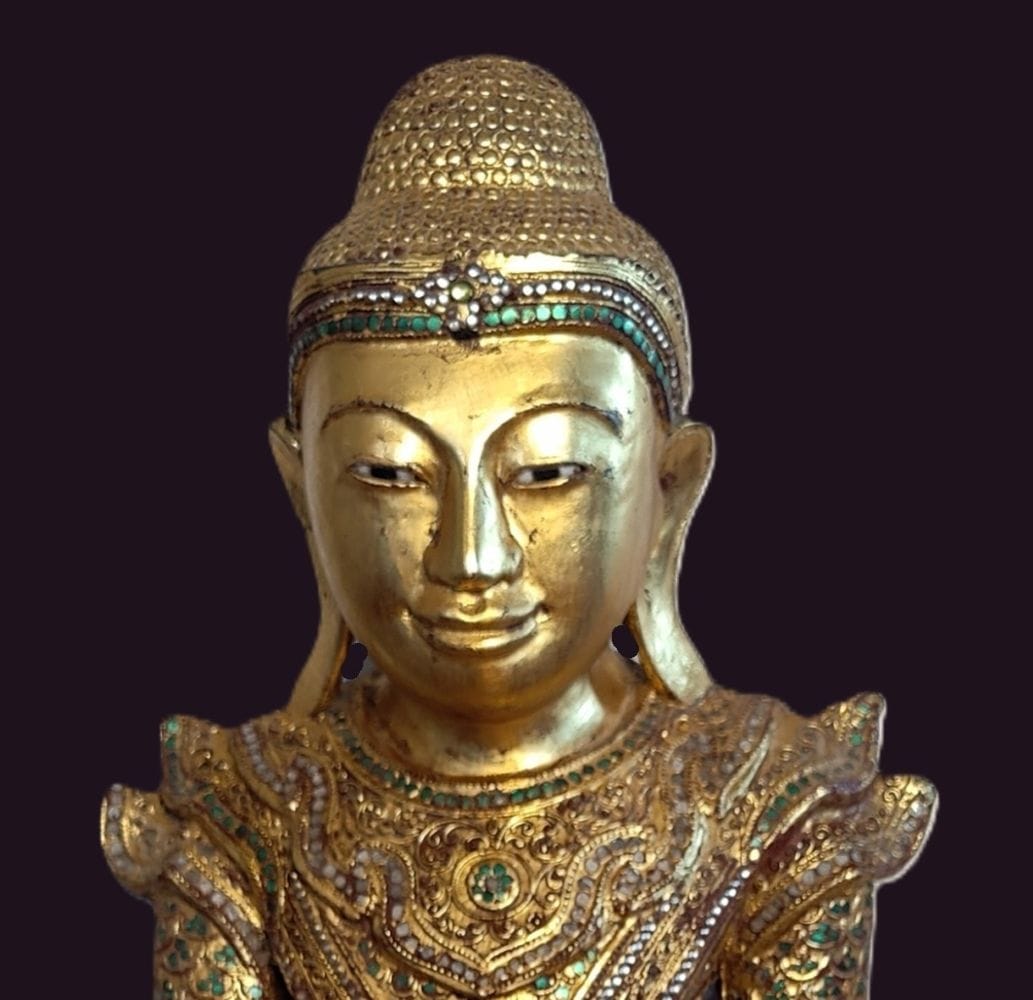
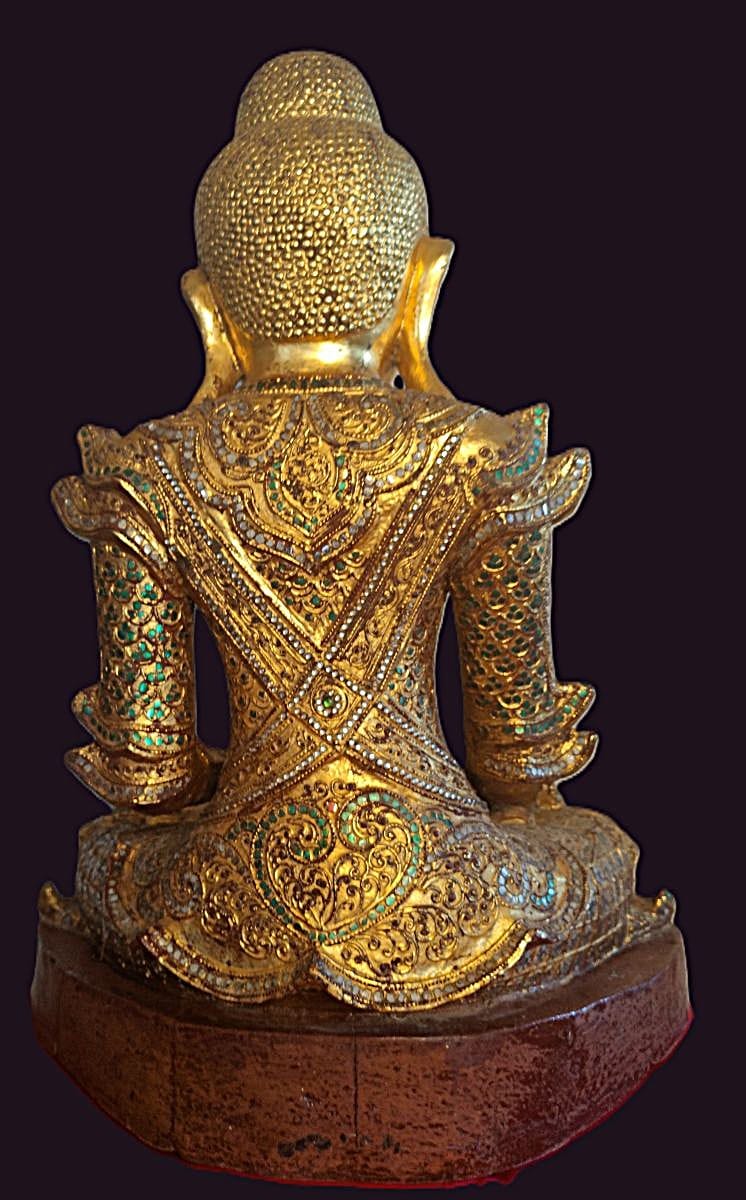
64cm fully worked decorative Antique Burmese Mandalay Buddha in royal attire, 19th C. The Buddha wears a detailed robe and ornate regalia fit for a king, with tiered flanges at the shoulders, elbows and wrists. The wood is gilded and inlaid with glass mosaic, and the back is fully decorated.
The ushnisha and hair curls are sculpted in thayo lacquer, framed with a forehead band inlaid with clear glass stones over a row of green glass mosaic tiles with a rosette in the centre in clear stones. The eyes are set with stone, and the hands are carved with long, slender fingers in Bhumis Parsa mudra. The Buddha sits on an oval pedestal decorated with scrolling thayo lacquer work and glass mosaics.
A central medallion on the torso supports the royal regalia extending from the shoulders on both front and back. Intricate thayo lacquer work details the body in a fish-scale pattern covering the arms with a decorative scrolling pattern in thayo lacquer covering the back and upper torso of the front view, giving way to geometric and scrolling floral patterns across the legs, accented throughout with green and white glass mosaic and clear beads dispersed between the thayo lacquer.
SPECIFICATIONS:
- AGE: – Late 19th Century
- HEIGHT: – 63.4cm
- WIDTH: – 49cm
- WEIGHT: – 14.25 Kg.
- CONDITION: The base shows old repairs, which are common on temple statues of this period or possibly indicates that it may have been a sealed relic cavity, a few mosaics missing.
- #820
Antique Burmese Mandalay Buddha, Royal Attire, 19th C
This king Buddha statue also referred to as a Jambupati style Buddha, became popular in Myanmar during the Konbaung period between 1752-1819 century and into the early and later Mandalay period.
Buddhas in royal regalia are associated with the legend of King Jambupati, a proud and powerful king said to have lived in the Buddha’s time. In the story, the Buddha appears in royal attire to humble him. There is no historical record of Jambupati outside the legend.
Crowned Buddhas appear in Burma from the Pagan and Mrauk-U periods, usually in a more restrained form, with a crown and modest jewellery. The style became far more elaborate under the Konbaung kings. Royal-attire Buddhas are also found in Thailand, Laos and Cambodia, each with its own style. In the Mandalay period they were made in gilded wood with thayo lacquer relief and glass mosaic, in bronze with metal regalia, or carved in alabaster or marble with decorative multi piece regalia.