

Song Longquan Celadon Twin Fish Bowl
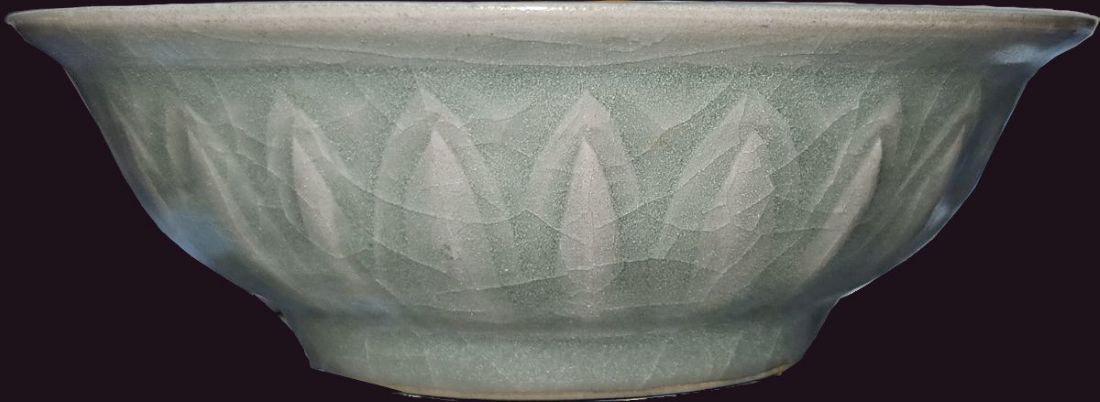
This Song Longquan celadon twin fish bowl perfectly illustrates how fish serve as an enduring symbol of prosperity in Chinese decorative arts, a connection rooted in the fact that the word for fish sounds identical to the word for surplus.
A pair of fish carries an even deeper meaning, representing mutual fidelity, double abundance, and marital happiness. Because of this rich symbolism, collectors and historians often refer to these specific Song and Yuan Dynasty ceramic vessels as wedding bowls.
Produced in Zhejiang Province, these distinctive green-glazed stonewares were manufactured at the Longquan kilns across the Song and Yuan dynasties (960–1368 AD).
Exterior Decoration and Form
- Carved Lotus Petals: A continuous band of lotus petals. The glaze pools slightly around the edges of these carvings, highlighting the design.
- Flared Profile: The bowl features deep, gently curved sides that flare outward to a flat, slightly everted rim.
- The Base: The unglazed foot rim reveals the characteristic light-grey stoneware body. The underside of the base is fully covered in glaze within the foot ring.
Interior Decoration
- Molded Twin Fish: The interior base features two small, molded fish applied in relief. They are positioned parallel to one another, swimming in opposite directions. The details of their scales and fins are slightly softened by the thick glaze.
Glaze Characteristics
Crackle Pattern: The glaze exhibits a prominent, highly visible network of crazing or ice-crackle lines extending across both the interior and exterior surfaces.
Color and Texture: The thick, unctuous celadon glaze shows an olive to sea-green hue.
SPECIFICATIONS:
- AGE: – Southern Song Dynasty 1127 – 1279 / Yuan Dynasty 1271-1368
- HEIGHT: – 4.5cm
- DIAMETER:– 14cm
- BASE DIAMETER: – 7cm
- WEIGHT:– 300gms
- #1248C
Song Longquan Celadon twin fish bowl
The word “celadon” has a surprising history. Despite its deep association with ancient Chinese ceramics, the term was coined in 17th-century Europe. It comes from a character named Caledon in a popular French novel who wore grey-green clothes. European collectors began using the character’s name to describe the beautiful imported Chinese wares, and it stuck.
Though the Song Dynasty perfected this wood-ash glazed stoneware, the tradition of green glazes actually began as early as the third century. The glaze colors on Song pieces are incredibly varied, spanning from a clear, translucent bluish-green to deep olives and matte, darker greens. These beautiful vessels were not just for local emperors; vast quantities of Longquan celadons were produced as vital trade goods destined for markets across Southeast Asia and the Middle East.
Note: Although I have called this a song Dynasty twin fish bowl it could be Yuan. In many of these bowls the fish tails are turned towards the centre of the bowl in this piece they are turned out towards the outside of the bowl. From my research into the differences related to the stylistic difference are as follows:
Southern Song Dynasty (1127–1279 AD): The fish tend to be slightly more slender, delicate, and integrated tightly into the center. Their tails often curve inward or stay relatively straight to maintain a strict geometric harmony.
Yuan Dynasty (1271–1368 AD): As production scaled up for global export, the sprig-molds became slightly larger, and the fish became more robust, plump, and deeply raised. To accommodate the slightly larger size of the fish within the same circular space, molds were frequently carved with the tails flaring outward toward the edge of the central medallion.