Mrauk-u Bronze Buddha Statues – Rare Chignon Jata Usnisha
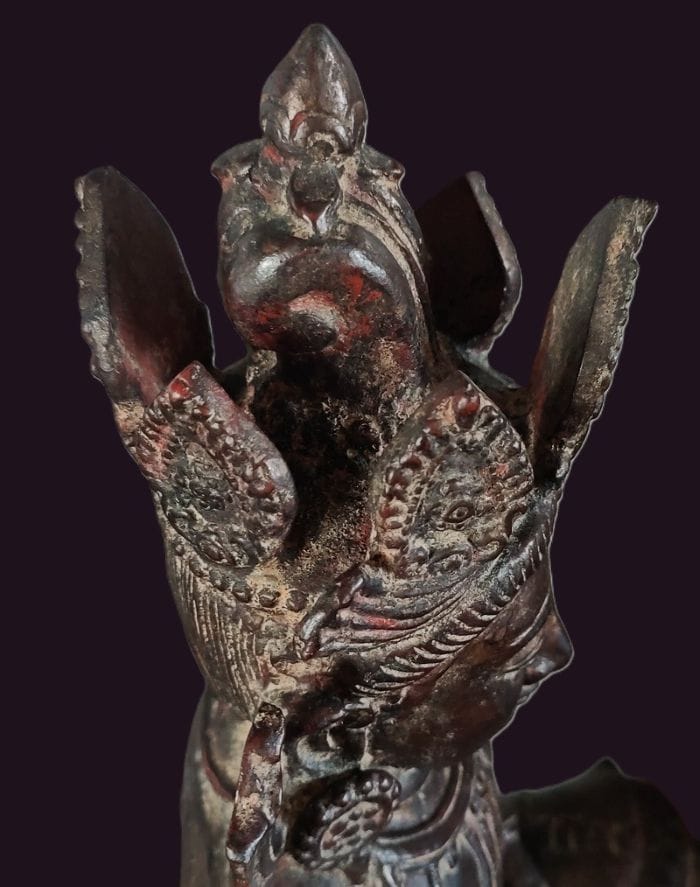
During King Min Bin’s reign (1531–1553) in the high Mrauk-u period, some crowned Mrauk-u bronze Buddha statues featured a tall, fluted chignon style usnisha (jata). Unlike the low, rounded cranial bumps of central Burma, these topknots curve gently upward before meeting a small, conical finial. The chignon jata (topknot) is frequently seen emerging from a ring of lotus petals or a beaded collar, framed by a multi-pronged crown and a carved headband.
The Mrauk-u bronze Buddha statues carry a compact, powerful presence, marked by broad shoulders and a distinctive banded necklace hung with beaded pendants or a secondary necklace. The ear flanges sit tucked behind the ornamented lobes and rest directly on the shoulders. Compared to the longer, highly decorative flanges typical of Shan or Mandalay crowned Buddha statues, these are shorter and more restrained.
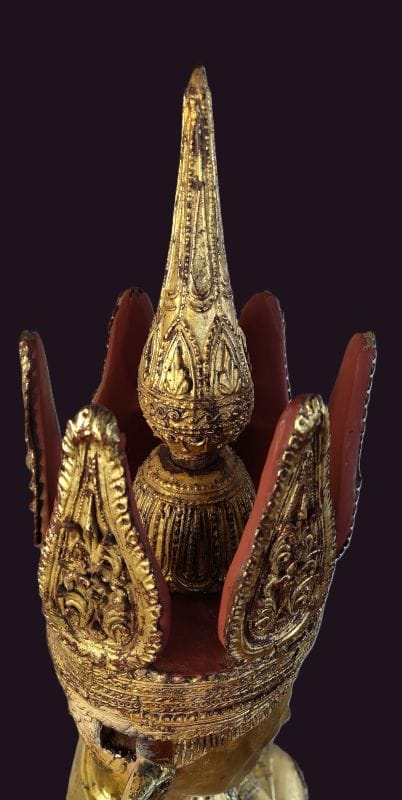
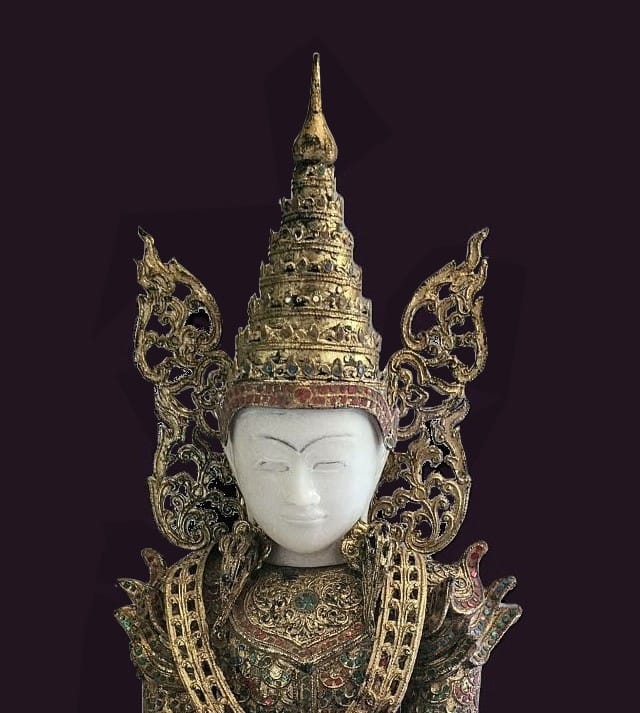
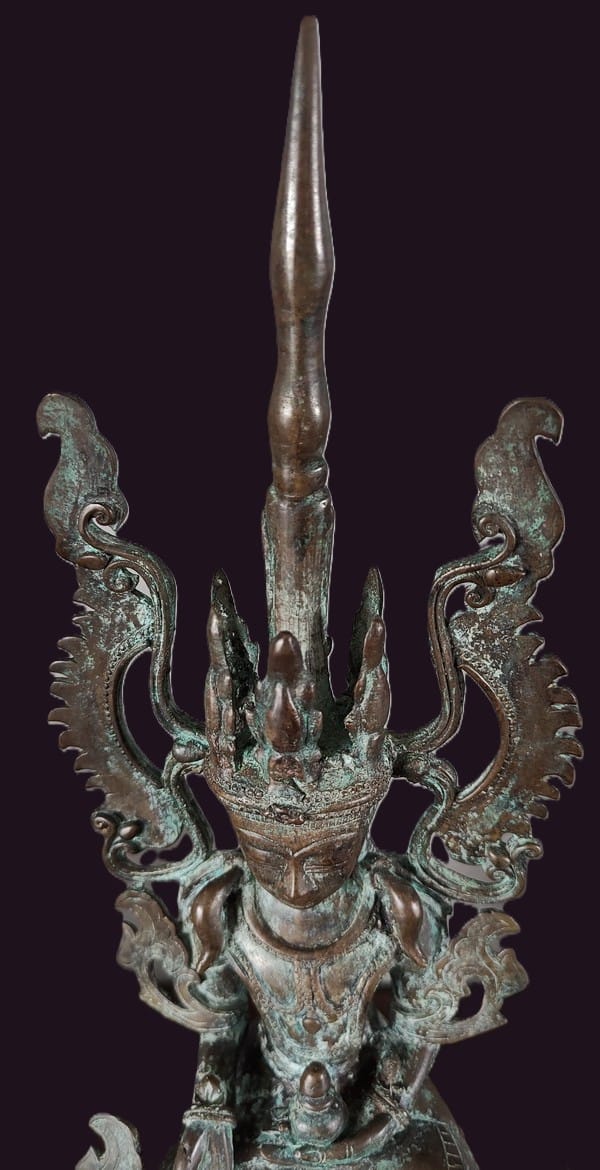
The Shan and Mandalay style crowned images, by contrast, are more intricate and flamboyant, the torso is longer, the limbs finer, and the conical usnisha is usually long and decorative, resembling a miniature pagoda, a characteristic that many Shan bronze or wooden Buddha statues attribute to the Tai Yai tradition.
While Shan workshops sometimes borrowed Arakanese and Ayutthaya crowned models, the tall, fluted chignon and precise ear‑flange junction are characteristic of Mrauk‑U metalwork. Shan bronzes that emulate these features still diverge from early Arakan examples in proportion, finish, and style of usnisa.
Like the Shan bronze statues Mrauk-U bronzes were also made using the lost-wax (cire perdue) casting method. Artisans carved the high chignon, hair striations, and crown ribbons directly into the wax model for each individual piece rather than using standardized re-usable moulds. Because of this, exact variations in hair fluting, finial heights, and flange shapes differ from one bronze to another.
Rarity of Surviving Mrauk-u ronze Buddha statues
During the 15th and 16th centuries, maritime trade across the Bay of Bengal supplied Arakanese foundries with a steady stream of copper and tin. Backed by royal and monastic patrons, local artisans produced vast numbers of lost-wax bronzes, most notably the crowned Jambupati Buddhas with their characteristic short ear flanges and broad bases. This high output faltered after January 1666, when the Mughal Empire captured Chittagong, the region’s vital trade hub in modern-day Bangladesh. Losing the port cut off metal imports, while the resulting political instability starved local foundries of funding.
The industry partially collapsed when the Burmese King Bodawpaya invaded and annexed Arakan in 1785 which resulted in the Konbaung troops looting massive amounts of metalwork, confiscating royal regalia, and carrying off major treasures as war booty to central Burma, most famously the Mahamuni Buddha image (now located in the Mahamuni Pagoda in Mandalay). They also marched Arakanese artisans back to the capital as captives. Because so much metal was melted down, destroyed, or relocated, surviving original Arakanese bronzes from this era are rare, especially those with this chignon jata style usnisha.
Post-Invasion Production (Late 18th & 19th Centuries)
Bronze casting in Rakhine didn’t die out; it simply shifted from courtly extravagance to everyday devotion. Without royal patrons commissioning heavily gilded Jambupati statues, local metalworkers began casting smaller, modest pieces for village monasteries and family altars. Artisans used local metal alloys with higher lead content, blending traditional Rakhine features such as the distinct crown lines with the fluid drapery and bulbous finials brought in by central Burmese styles.
Note: In Pamela Gutman book “Burma’s Lost Kingdoms: Splendours of Arakan”, (Pages 148–149) Gutman specifically details the Mrauk-U bronze casting tradition during the late 15th to 17th centuries. She illustrates and analysis crowned Buddha images modelled on Sino-Tibetan prototypes (Yongle/Ming court gifts), highlighting the multi-leaf crown (kirita) enclosing the high, fluted jata (cylindrical chignon).
- Mrauk-U sat at a maritime crossroads between Eastern India, Ming Dynasty China, and mainland Southeast Asia. Artisans blended Sino-Tibetan Ming imperial bronzes (such as those from the Yongle and Xuande periods sent as diplomatic gifts) with local Arakanese traditions.
- This specific combination, a high, fluted jata (striated hair cone) enclosed by leaf shaped crown peaks and winged ear-flanges (pattapatta) is a signature of that syncretic Sino-Tibetan/Arakanese court style.
Crowned Jambhupati Buddha in bhumisparsha mudra (earth-touching gesture) depicting the Buddha in royal regalia with robe flaps that drape over the forearms, this is also seen in some Shan crowned buddha statues.
Stylistic features of the Mrauk-u Bronze Buddha Statues – Rare Chignon Jata Usnisha
In regional Burmese and Arakanese Buddhist iconography, multi-tiered crowns signified escalating levels of celestial and terrestrial sovereignty.
Some rare earlier Arakan Buddha statues are seen with a tall, fluted jata (hair-chignon) enclosed by a multi-pointed leaf kirita (crown) and topped with a small lotus-bud finial, this style faded out in the mid to late Mrauk-u period during the 17th century.
The openwork ear-flanges and upward-flaring ribbon extensions (pattapatta) is derived from Sino-Tibetan prototypes.