Mandalay the Former Capital of Burma
Between 1853 and 1885, Yadanarbon served as the final stronghold of the independent Konbaung Dynasty. King Mindon established this royal capital at the foot of Mandalay Hill in 1857, moving his court from nearby Amarapura. Officially inaugurated in 1859, the royal city was named Yadanarbon, a Pāḷi term meaning “City of Gems”. Today, Mandalay remains Myanmar’s second-largest city and its premier cultural hub.
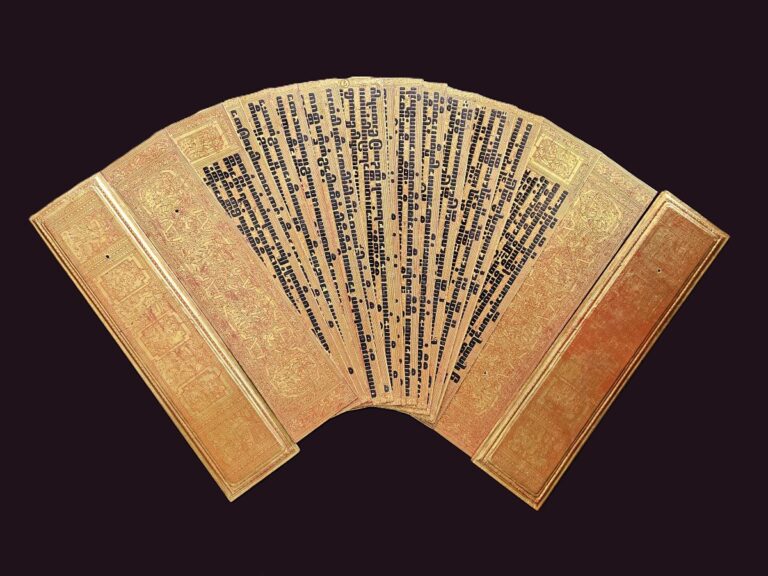
King Mindon, who reigned from 1853 to 1878, is remembered as one of the country’s most progressive and respected monarchs. He built a royal library specifically to safeguard the Buddhist scriptures, transforming Mandalay into the spiritual heart of Burma and an international center for Buddhist learning.
The Mandalay era represents a pinnacle of Burmese intellectual and artistic achievement. To mirror traditional Buddhist cosmological principles, artisans constructed the royal city as a perfect geometric square, a design that secured its legacy as Myanmar’s enduring cultural center.
As the independent Konbaung Dynasty approached its final years, the “Mandalay style” established itself as the definitive term for the unique sculptural and artisanal traditions that flourished in the era, a legacy that persists today.
The kingdom’s independence ended abruptly in 1885 when British forces seized the royal palace and exiled King Thibaw (King Mindon’s son) and his wife, Queen Supayalat, to India. The British military converted the walled palace compound into a military outpost named Fort Dufferin. They repurposed sacred royal spaces for mundane military and social uses; the Great Audience Hall and surrounding throne rooms became social quarters and bars for colonial officers as well as storage purposes. Using these spiritually significant architectural sites for drinking and revelry was a deep insult to Burmese culture and the monarchy.
The Lily Throne Room: Situated in the western wing of the palace, fell within the private domain traditionally reserved for the queen and female members of the royal family. Under British occupation, this specific state room was altered to serve as a ladies’ reading room for the exclusive Upper Burma Club.
The Monastery of the Atumashi nearby was also occupied and used for various military functions, which accounted for the loss of many of its treasures.
THE ROYAL REGALIA
Following the fall of Mandalay in 1885, the British military confiscated the Konbaung Dynasty’s royal regalia and transferred it to the Victoria and Albert Museum in London for safekeeping. To the Burmese people, these artifacts were not mere museum pieces, but vital symbols of their stolen sovereignty and cultural identity. This historical displacement was largely resolved in 1964, when the British government returned more than 140 pieces of the looted treasures, including the sacred coronation dagger to Myanmar.
Today, while the Victoria and Albert Museum retains a single, highly ornate gold and jeweled betel nut container gifted by Myanmar in appreciation of the museum’s long-term custodianship, the true heart of the royal regalia is proudly displayed at the National Museum in Yangon.
The Iconography of the Mandalay Style Buddha Statue
The Mandalay-style Buddha is celebrated as one of Burma’s most ornate artistic traditions. These statues are distinguished by their richly layered robes, featuring three-dimensional folds accented with intricate glass mosaics and delicate lacquer scrollwork. The facial features are particularly striking, typically characterized by a straight nose, flared nostrils, and a distinctive cleft in the upper lip.
While the use of glass inlay varies, it is commonly found highlighting the edges of the robes and the headband, often incorporating rounded glass “stones”, coloured glass mosaics or medallions for added brilliance.
Distinctive features of Mandalay-style Buddha figures include a prominent, rounded usnisha at the crown and a broad, youthful face with widely spaced features. A hallmark of this tradition is the slender headband that spans the forehead, typically terminating either above the ears or near the temples. These statues are commonly portrayed in three primary positions: seated, standing, or reclining.

MANDALAY ROYAL KING BUDDHA STYLE (Jambhupati)
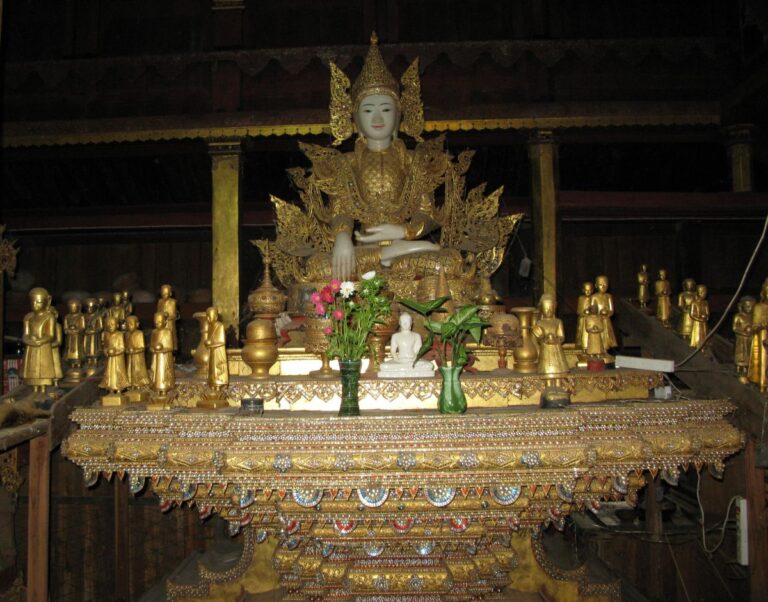
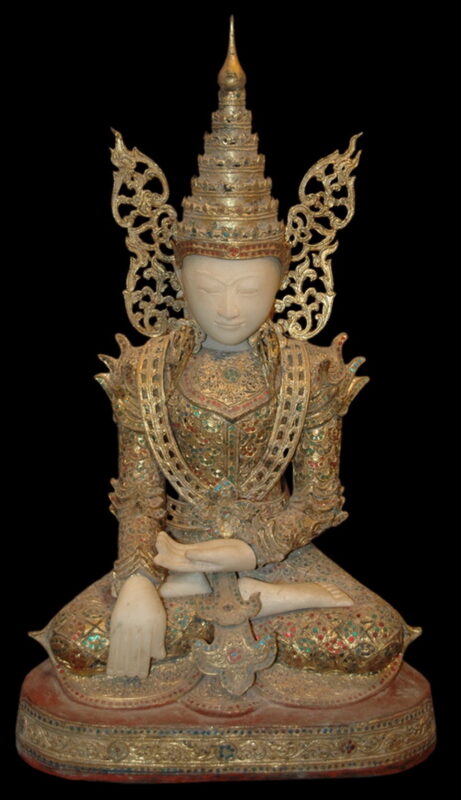
The Mandalay Jambhupati Buddha, frequently designated as the “Royal Crowned Buddha,” departs significantly from standard Mandalay iconography. This distinctive variation is distinguished by a multi-tiered metal crown reminiscent of a pagoda, which is topped with a subtle ushnisha.
Notable for its grandeur, the statue features large side flanges that extend dramatically from the crown toward the shoulders, and the image may include highly ornate, ceremonial metal regalia. The torso is often embellished with a distinct fish-scale motif, masterfully rendered in thayo lacquer and accented with shimmering glass mosaics. When depicted in a seated posture, these statues are almost universally portrayed with the hands positioned in the Bhumisparsha mudra (the earth-witness gesture.
MANDALAY STYLE RECLINING BUDDHA STATUES
The Mandalay-style reclining Buddha statue is also referred to as the “Yadanarbon sleeping Buddha in Burma.” These images illustrate the Buddha in a reclining position, a pose that can signify either restful sleep or his final transition, known as Parinirvana.
To expand on this with further iconographic depth, the reclining posture (shayanasana) is one of the most powerful and serene depictions in Burmese art. While casual observers often view these statues simply as “sleeping Buddhas,” the subtle positioning of the body dictates whether the image represents the living Buddha resting, or the historical Buddha at the moment of his physical death and ultimate release from the cycle of rebirth.
In the late Konbaung and early Mandalay periods, artisans used specific visual cues to distinguish between these two states:
- The Living, Resting Buddha: When depicting the Buddha resting, the body is relaxed yet vital. The head is supported by the right hand, with the palm cupping the cheek or temple, and the elbow rests heavily on a stacked, ornate pillow. The feet are typically aligned perfectly parallel to one another, with the toes matching up evenly, indicating a conscious, disciplined state of repose.
- The Parinirvana (Passing): When representing the final transition into Parinirvana, the posture shifts toward a solemn, weightless grace. The head no longer rests in the palm of the hand; instead, the hand lies flat beneath the head, or the head rests directly down onto the pillow itself, signaling the complete release of physical energy. In some traditional variations, the left leg is slightly withdrawn or the top foot slides back, meaning the feet are no longer perfectly parallel, symbolizing the departure of life.
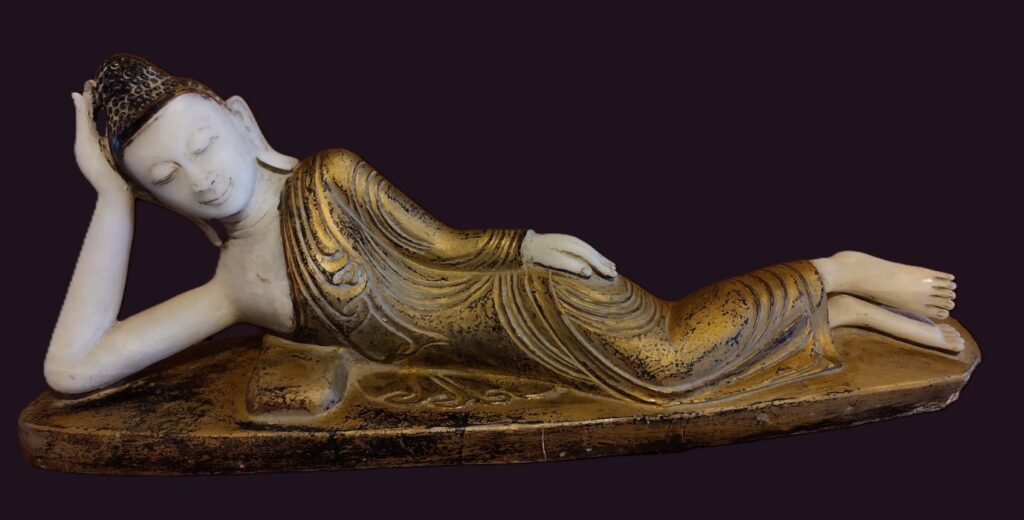
The Mandalay style brought a new level of naturalism to this ancient posture. Rather than the rigid, blocky forms of earlier centuries, 19th-century Burmese carvers utilized the fluid yone-daing style of drapery to show the monastic robes cascading in deep, realistic folds over the side of the reclining body. The hem of the robe often terminates in a dramatic, undulating wave pattern at the feet. Combined with the characteristically sweet, youthful face and the signature glass-inset forehead band (thin-kyit), the Yadanarbon reclining Buddha transforms a moment of profound theological significance into a masterpiece of peaceful, flowing elegance.
Many significant Mandalay sculptures feature a Buddha in a natural, resting pose. In these instances, the feet are offset and the knees are softly flexed to convey a sense of physical ease. The posture is further defined by the right arm, which is bent at the elbow so the Buddha can rest his head directly on his palm. This style captures a living moment of rest, distinct from the rigid symmetry seen in Parinirvana images.
The Dying Buddha (Parinirvana)
This specific posture commemorates the Buddha’s last moments after falling ill from food poisoning, marking his departure from the physical realm into Nirvana. He is depicted lying on his side with his legs stacked and feet aligned, his head supported by a decorative pillow.
Interestingly, the reclining form with the Buddha in Maha Parinirvana is often featured as a secondary icon above the figure of the seated Buddha in the Bhumisparsa mudra, with the right hand pointing towards the ground. The depiction of the dying posture is frequently seen over the head of the seated Buddha in Buddhist icons or stele.
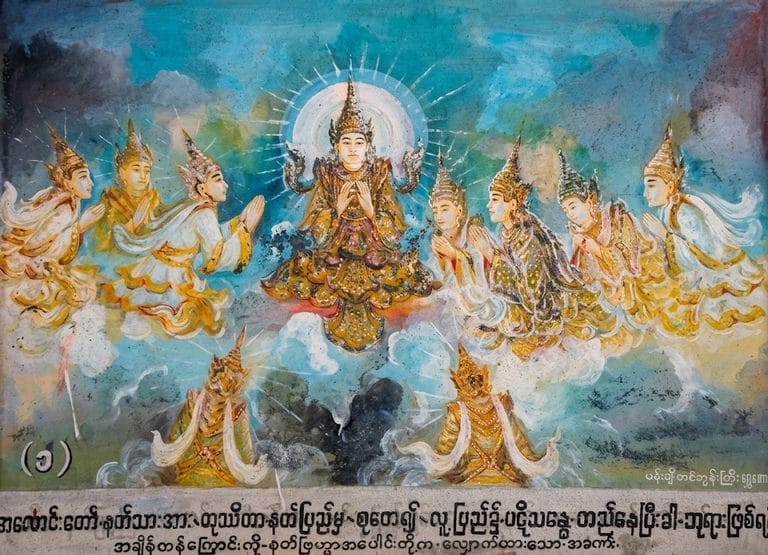
The earth‑touching gesture marks the moment the Buddha overcame the final obstacles to enlightenment. As Māra and his daughters tried to distract and discourage him, the Buddha reached down to touch the earth, calling it to witness his right to awaken. The earth responded, and Māra’s challenge dissolved. This gesture has come to symbolise his victory over fear and temptation, and his unwavering resolve on the path to enlightenment
Many significant Mandalay sculptures feature a Buddha in a natural, resting pose. In these instances, the feet are offset and the knees are softly flexed to convey a sense of physical ease. The posture is further defined by the right arm, which is bent at the elbow so the Buddha can rest his head directly on his palm. This style captures a living moment of rest, distinct from the rigid symmetry seen in Parinirvana images.
The reclining Buddha was first depicted in Gandhara sculptures between 50BC and 75AD and is a popular iconographic representation of the Buddha’s last moments and is seen in Thai, Indian, Burmese, Lao and Chinese sculptures.