King Mindon’s Royal Ploughing Ceremony

At the heart of every enduring civilisation lie three basic requirements:
life security, food security, and water security.
- Life security – A good strong army is a first and foremost need for life security
- Food security – Food production, agriculture
- Water security. – water source and storage is the third. In all civilization
King Mindon’s Royal Ploughing Ceremony
The three needs outlined above have always been central concerns of rulers and governments, and Myanmar was no exception. Throughout every period of Myanmar’s history, newly enthroned kings typically began their reign by securing the foundations of the state: establishing or strengthening frontier outposts, reorganizing the army, restoring arable lands, reclaiming new agricultural areas, and repairing existing irrigation systems and reservoirs while also constructing new ones.
These practical measures were complemented by the ritual obligations of Burmese kingship. Rulers performed ceremonies intended to ensure timely rainfall, agricultural fertility, and the prosperity of the realm and rites that paralleled the material work of sustaining the agrarian economy. As the monsoon approached in the month of Nayone (June), farmers commenced the agricultural cycle with ploughing and field preparation, aligning their labour with both seasonal rhythms and the expectations of the court.
Royal ploughing rites formed an established component of Burmese kingship, serving both to inaugurate the agricultural year and to affirm the monarch’s role as guarantor of fertility and prosperity. According to the chronicles, Myanmar kings customarily performed the ceremony at least once during their reign, and some rulers are described as having conducted it annually in order to encourage cultivators and ensure auspicious conditions for the harvest.
Within the early Bagan tradition, four kings are specifically recorded as performing the ploughing ceremony every year. Their names appear with the prefix “Htun”, meaning plough, a designation that reflects their association with this rite. These rulers are listed as:
- Htun‑Taik (569–581 CE),
- Htun‑Pyit, his son (582–597 CE),
- Htun‑Chit, his son (598–612 CE), and
- Htun‑Twin (753–761 CE).
Although these figures belong to the legendary strata of the Bagan chronicles rather than the securely dated historical period, their inclusion underscores the symbolic importance of the ploughing ceremony in articulating early Burmese conceptions of kingship and agrarian order.
Burmese kings are described as following the precedent set by King Suddhodana, the father of Prince Siddhartha. According to the Buddhist narrative tradition, Suddhodana performed the royal ploughing ceremony while the infant Siddhartha was still in the care of his attendants. During the rite, the nurses and caretakers placed the royal child in the shade of a jambu (rose‑apple) tree while they observed the proceedings. Upon returning in the evening, they witnessed two auspicious signs: first, the infant prince was seated upright in a cross‑legged meditative posture; and second, the shadow of the jambu tree had remained fixed, continuing to shade the child despite the movement of the sun. These miracles became part of the canonical accounts affirming the Buddha’s innate spiritual destiny.
King Mindon’s predecessors Bodawpaya, Bagyidaw, and Thayawady are all recorded as having performed the royal ploughing ceremony at least once during their respective reigns. Court chronicles note these events and describe the formal compositions produced to commemorate them. On such occasions, the royal bards were required to compose dedicated verses or ceremonial songs marking the significance of the rite. When King Mindon conducted his own ploughing ceremony, a special song was likewise composed, as follows:
With a golden whip of Yamaha cane,
Royal legs stepped on the plough
Pulled by milky-white bullock twin,
Entering royal paddy field for good harvest of grain
Pray, Shwe bein nyin [King fisher] bird in the sky
Bring down rain.
Note: Yamaha cane is the best species of cane in the Myanmar forest
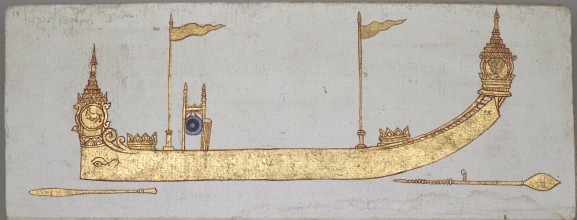
Two eyewitness accounts provide detailed documentation of King Mindon’s ploughing ceremony. One was produced by the renowned court artist Saya Chone, who painted the scene on a white parabike (folded papyrus manuscript). His depiction is now preserved in the British Museum, London. The second account comes from the British administrator and writer J. G. Scott, who published extensively on Myanmar and, under the pen‑name Shway Yoe, authored The Burman: His Life and Notions. In this work, he offers a vivid, first‑hand description of King Mindon’s “Gracious Ploughing Ceremony.” Notably, the visual record of Saya Chone and the literary account of Scott correspond closely, reinforcing the reliability of their respective portrayals of the event.
The following passage is a reproduction of the account found in The Mandalay Gazetteer, Vol. 14, pp. 66–67, compiled by H. F. Searle, Settlement Officer, No. III Party, and published by the Superintendent, Government Printing and Stationery, Rangoon, Burma, in 1928.
According to this source:
“The Lehtunmigalar pwé was customarily held in the fields below the Aungbinle Tank, and after the founding of Mandalay it was transferred to a site east of the city on the road to Yankintaung. Beginning from a point immediately west of the northern end of Thayetkon Village, a square plot was marked out extending southwards, comprising twenty pés [y.f], ten allotted to the king and ten to the queen. Bazaar stalls were erected along the road leading from the eastern gate (Uteik).”
The king proceeded in full royal state, accompanied by the court, and travelled down the Nadi Chaung to a temporary pavilion erected in the Mingala Uyin. Near the designated ploughing ground, shrines were set up for the Thirty‑Seven Nats. When the auspicious moment arrived, the king, wearing his royal robes and regalia, ploughed a furrow in the large field on the western side of the marked area. He was followed in due order by the princes, ministers, and other members of the court, each likewise ploughing in full ceremonial dress according to their rank and precedence.
The ploughs and bullocks used in the ceremony were richly adorned and were referred to as the gold and silver ploughs. After completing the rite, the king returned to his temporary pavilion, where he remained for three days together with the court. Throughout this period, pwès and musical performances continued without interruption, and offerings were made continuously to the Thirty‑Seven Nats. At the conclusion of the observances, the king returned to the palace. The ceremony was generally held in the latter half of Nayon, its purpose being to ensure a favourable agricultural season.
Two principal rain‑calling rites are recorded in Myanmar from the Bagan period onward. The first involved the propitiation of the nat‑spirit Moe Khaung Kyaw Swa, during which a ritual tug‑of‑war was performed to invoke his assistance in releasing rain‑bearing clouds. The second rite centred on the Nga Yant Min fish idol, which was ceremonially washed or sprinkled with clear, scented water while the Nga Yant Min paritta was chanted to induce rainfall.
According to tradition, this second rite was introduced by Prince Min Shin Saw of the Bagan dynasty, who founded a new settlement at Htun‑ton Pu‑Tet (present‑day Bo Tet Kon) near Yankin Hill, east of the Mandalay palace city. After heavy rain reportedly followed the performance of the ritual, monks advised the prince to enshrine the Nga Yant Min idol in a natural spring‑fed pond located at the mouth of a large cave on the summit of Yankin Hill.
Both of these rain‑calling rites continued into the Konbaung period, and King Mindon is noted for having actively supported and promoted their observance.
These rain‑calling rites continue to be practised in Mandalay today during periods of insufficient rainfall, and local belief holds that they remain effective in bringing rain.
In addition to maintaining the major water bodies inherited from earlier kings, most notably Aungbinle and Nanda lakes, along with the numerous reservoirs and dams surrounding Mandalay King Mindon undertook significant new hydraulic works. Among these was the construction of the Yatana Nadi, a canal running to the east of the palace city, which became one of the principal sources of water for Mandalay’s residents. The region is also naturally supplied by springs, streams, and small waterfalls descending from the outlying spurs of the Shan Plateau, such as those around Yeytagun Hill.
Sanctification of the palace city and capital city
As Buddhist rulers, Myanmar kings consistently acted as patrons and protectors of the religion. Following the exemplary model of Emperor Aśoka, they aspired to become sāsana‑dayaka, supporters and sustainers of the Buddha’s Dispensation, either by temporarily entering the monkhood themselves to preach the Dhamma or by sponsoring the ordination of monks for that purpose. Their religious duties also included the maintenance and restoration of ancient monuments as well as the construction of new religious edifices.
In King Mindon’s case, his meritorious works may be grouped into three categories.
- First were the sacred images and statues he transferred from Amarapura to his new capital, Ratanapon.
- Second were the religious structures and sacred images already present in the Mandalay region prior to his relocation.
- Third were the monuments and images he commissioned and created during his own reign.

King Mindon passed away on 1st October 1878 but in the Burmese calendar his death often falls in Wagaung (roughly August)