Konbaung Period Burmese Royal Barge
Konbaung Period Burmese Royal Barge
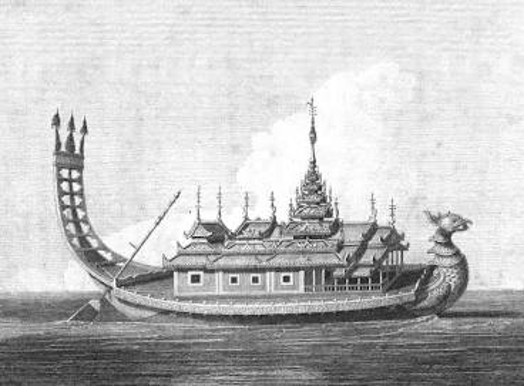
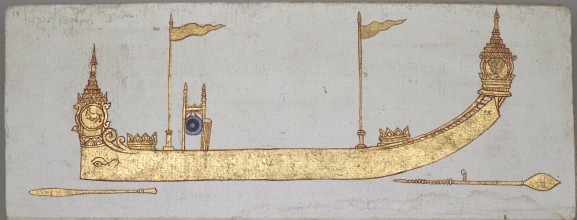
Konbaung period Burmese royal barges like the Pyigyimon represented the peak of traditional woodcarving and state pageantry, serving as floating palaces for the monarchy along the Irrawaddy River. If you want to see these vessels preserved in historical art, the British Library holds a digitized Burmese manuscript illuminated in red and gold that illustrates the various styles of royal boats.
The royal barges were carved and decorated elaborately with figures of mythical creatures such as the garuda (bird), naga (serpent), and manuk siha (half-lion half-man), and some bear structures resembling palaces or pavilions. The paintings of the vessels are as finely executed as those of scenes found in other Burmese folding books but, unusually, this book digitised by the British Library as no captions. Nonetheless, each boat is so stylistically and symbolically distinctive that they can easily be identified from historical accounts.
The Pyigyimon Barge
During the Konbaung dynasty, the Pyigyimon barge served as a vital ceremonial vessel for kings traveling the Irrawaddy River and navigating the moats of royal capitals like Mandalay and Amarapura.
Konbaung Period Burmese Royal Barge
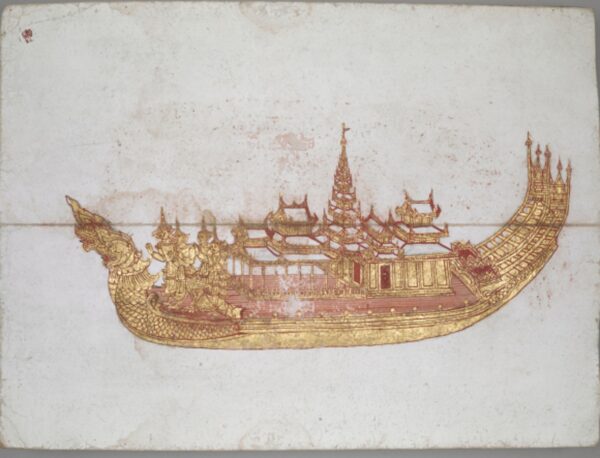
British Library Archive Or. 14005, f. 1
The Twin-Hull Engineering
Most traditional Burmese royal boats (phaung) are elongated single hulls. The Pyigyimon merges two long hulls with a central deck. This choice was structural rather than decorative.
The double hull created a wide, exceptionally stable platform capable of supporting a massive, heavy timber superstructure. This stability was vital given the weight of the multiple roof tiers, the gold gilding, and the large royal entourage on board.
The Mandalay Palace Moat replica is a modern, scaled interpretation of the Pyigyimon barge, designed to evoke the appearance of Konbaung ceremonial watercraft rather than reproduce their original dimensions. While it retains the dual‑hull form and the characteristic pyatthat pavilion, its size and construction differ significantly from the full-scale royal barges described in Konbaung court records.
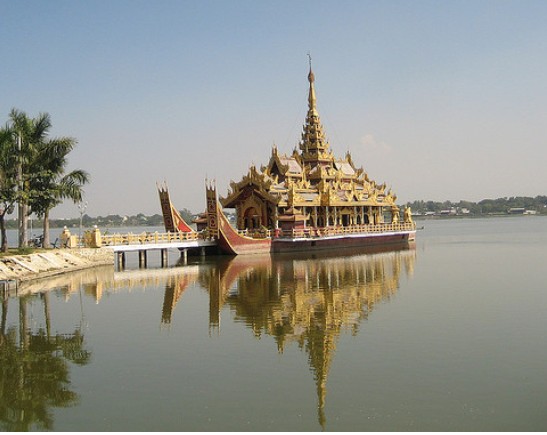
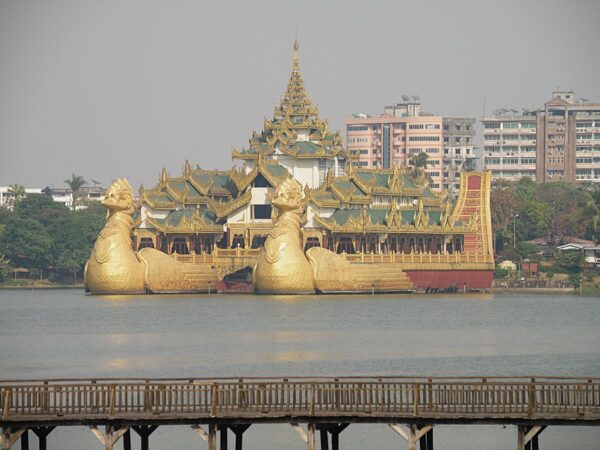
The Pyigyimon‑inspired structure on Kandawgyi Lake in Yangon follows a monumental set of dimensions. Its main deck sits 0.91 metres above the waterline, supporting a multi‑tiered royal pavilion that rises to 18.28 metres at the peak of its pyatthat finial. The vessel’s dramatic silhouette is defined by a stylised dragon bow reaching 3.65 metres at the prow, balanced by an elongated tail section that curves upward to 8.83 metres at the stern.
Cosmic Symbolism on the Pyigyimon Bows
The design represents a visual masterclass in Buddhist and Hindu cosmology, functioning as a floating universe. The combination of the figureheads makes the boat unique:
- The Left Hull (Naga): Represents the underworld, water, and fertility.
- The Right Hull (Garuda): Represents the heavens, the sky, and solar power.
- The Center (Thagyamin/Indra): Sits above and between them, balancing the opposing forces of earth and sky to ensure harmony for the kingdom.
By stepping onto this vessel, the King positioned himself literally and symbolically at the absolute centre of the universe.
The Pyatthat – (Multi-Tiered Roof)
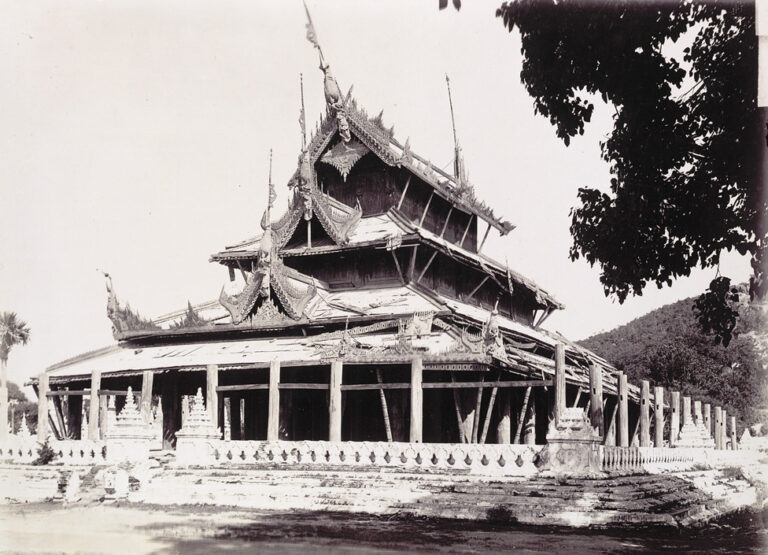
The presence of a seven-tiered pyatthat spire roof on the central deck signalled the highest possible status. Under Konbaung sumptuary laws (legal restrictions on clothing, housing, and possessions based on social rank), this architectural style was restricted to palaces, monasteries, and the King’s personal transport.
During the Konbaung dynasty (1752–1885), Burma’s rulers relied on the Ayeyarwady River as their primary transport link and strategic corridor. Within this river-centric system, the royal barge served as a potent visual declaration of the king’s supreme authority.
Rather than serving as a purely decorative vessel, the Pyigyimon barge held a vital function in the Rajabhiseka coronation ceremonies. Following a king’s enthronement in royal capitals such as Ava, Amarapura, or Mandalay, tradition required him to complete a ritual journey. The new monarch would navigate a designated section of the river or travel along the palace moat to symbolically claim his realm.
This procession served multiple purposes:
- The Ritual Circle: It symbolically claimed the territory, mirroring the mythic turning of the wheel by a Chakravartin (a universal, righteous monarch).
- Public Display: It allowed the populace to see the new king, surrounded by his ministers, bodyguards, and court Brahmins who conducted the water consecration rituals.
- The Royal Flotilla: The Pyigyimon never traveled alone. It led an armada of hundreds of specialized war boats (laung-gaw), tiered escort barges, and ceremonial vessels, creating a massive floating city on the river.
Material Used: Lacquer and Gold Leaf
From an art history perspective, the construction of these vessels represents the pinnacle of Konbaung craftsmanship. The hulls were carved from selected teak logs, seasoned to withstand the river currents.
The decoration relied on two major traditional arts:
- Thayo (Lacquer Paste Carving): Artisans used a mixture of bone ash, sawdust, and sap from the Thitsi tree (Gluta usitata) to build up intricate, raised three-dimensional patterns on the wood.
- Hmanzi Shwecha (Glass Mosaic and Gilding): This technique involved embedding fragments of colored glass and mirrors into raised lacquer designs before applying an outer layer of pure gold leaf. As the vessel travelled along the water, the sunlight and river reflections dancing off the mirrored, golden exterior created a luminous effect. This brilliance served a political and spiritual purpose, visually linking the ruler to celestial solar deities.
Despite its size and heavy timber superstructure, the Pyigyimon royal barge was propelled by human power. It was towed by smaller, faster ceremonial paddle boats crewed by dozens of royal oarsmen (hlaw-ga). These crews paddled in perfect synchronization, chanting rhythmic boat songs (yadu and bwe) that kept time and praised the virtues of the reigning monarch.
The Floating Cosmos: Inside a Konbaung Royal River Procession
The Ayeyarwady River was the vital transport corridor of the Konbaung Empire. Long before the introduction of modern roads or rail networks, this waterway served as the primary channel through which the central palace maintained control over distant territories.
Following the enthronement of a new sovereign, the execution of formal waterborne processions, known as Yatras, was an obligatory ritual that carried both political and spiritual weight. During these grand events, the Pyigyimon barge functioned as the focal point of an immense, floating royal court that moved down the river.
The Order of the Flotilla
A royal river progress was a highly choreographed military and courtly parade. The Pyigyimon barge never travelled alone; it was protected by a strict hierarchy of specialized vessels that stretched for miles down the river:
- The Vanguard (Shwe-laung): Dozens of fast, narrow war boats crewed by up to 60 oarsmen each cleared the path. These men were the king’s elite river troops, their paddles flashing in unison to the beat of drums and gongs.
- The Guard Boats: Flanking the main channel were boats carrying the royal ministers (Wungyis), court officials, and state treasures, arranged precisely by official rank.
- The Royal Barge: In the absolute center floated the Pyigyimon. Because its twin-hulled design made it slow and heavy, it did not rely on its own oars. Instead, it was towed by long, decorated ceremonial launch boats crewed by hundreds of royal rowers singing rhythmic boat songs (Ratu).
The Court on the River
In the early 1800s, onlookers waiting on the silty banks near Sagaing or Amarapura would have heard the royal procession long before catching sight of the monarch. The rhythmic pounding of ceremonial drums, the sharp chime of brass cymbals, and the synchronized cadence of thousands of rowers echoed down the river corridor. As the grand flotilla navigated the river’s bend, the Pyigyimon came into view, catching the full glare of the daylight.
The barge appeared completely transformed from its timber origins. Master artisans had coated the entire structure in thayo lacquer paste before applying intricate hmanzi shwecha a mosaic of shimmering glass panels and pure gold leaf. To the crowds on the shore, the vessel resembled a mass of molten gold gliding across the water, radiating a brilliant sheen under the tropical sky.
Positioned on the central platform of the twin-hulled craft, the king sat beneath a soaring, seven-tiered pyatthat roof. Nine sacred white umbrellas, the supreme emblems of Burmese sovereignty enclosed the throne, while court Brahmins conducted water-purification rites alongside the ruler. At the front of the vessel, imposing timber carvings of the Garuda and the Naga served as figureheads, cutting through the river currents.
The Political Reality Behind the Pageantry
While the procession was a religious spectacle that framed the king as a Chakravartin (a universal, righteous ruler), it served a sharp practical purpose.
A royal tour downriver was a direct display of force to regional governors and potential rebels. Seeing the king arrive with hundreds of war boats, thousands of disciplined troops, and a floating palace proved that the central crown held absolute control over the empire’s lifeblood, the river trade.