The Sanda Muni Iron Buddha Statue – Mandalay
Myanmar kings, as devout Buddhists, consistently functioned as patrons and promoters of the religion. Following the exemplary model of Emperor Asoka, they aspired to become sasana‑dayaka, supporters and sustainers of the Buddha’s Dispensation, either by temporarily entering the monkhood themselves to preach the Dhamma or by sponsoring the ordination of monks for that purpose. Their religious merit also included the maintenance and restoration of ancient monuments as well as the construction of new religious edifices.
In the case of King Mindon, his meritorious works may be grouped into three categories:
- First were the sacred images and statues he transferred from Amarapura to his new capital, Ratanapon.
- Second were the religious structures and sacred images already present in the Mandalay region prior to his relocation.
- Third were the monuments and images he commissioned and created during his reign.
Sanda Muni Iron Buddha Statue – Mandalay
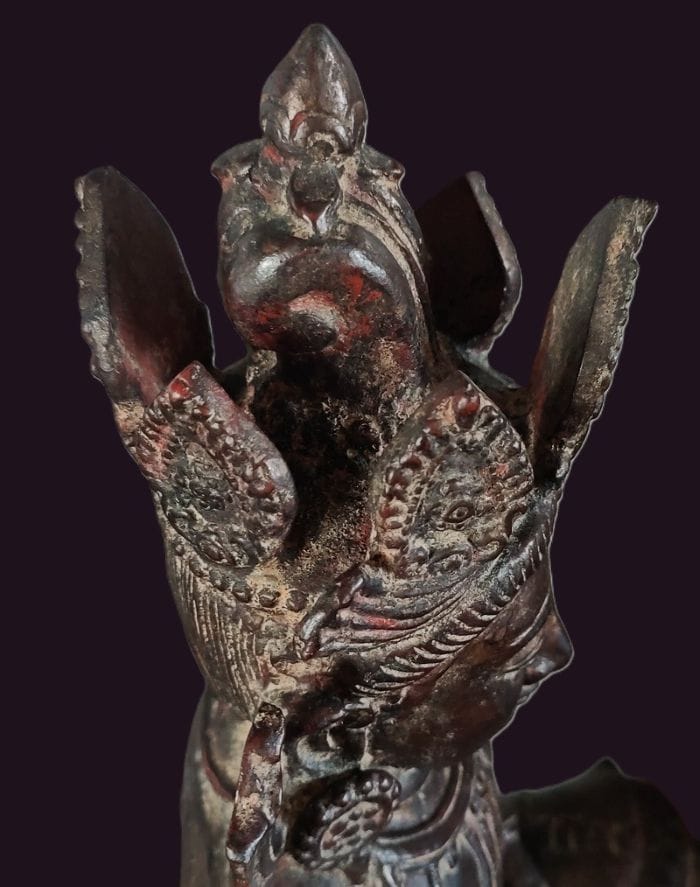
The first category includes two notable Buddha images brought to the pagoda. The first is the large Sandamuni iron Buddha statue, moved from the old capital of Amarapura. The second is a tiny, two-and-a-half-inch image carved from sacred sandalwood (tharakhan), brought from the Anya Thihataw Pagoda on an island near Thabeikkyin town, north of Mandalay. Both statues possess their own unique legends and historical lineages.
The iron Buddha statue was cast by King Bodawpaya in 1802. During the period when he was personally supervising the construction of the colossal brick stupa at Mingun on the west bank of the Ayeyarwady River, while he lived in a temporary palace on the island now known as Nantaw‑ya‑kyun (“Palace Island”). There he commissioned the casting of an iron seated Buddha image weighing 11,368 viss (approximately 18.3 tons), intended for installation within the great stupa. When the stupa was left unfinished, the iron image was later transported to the royal capital at Amarapura.
When King Bagyidaw succeeded to the throne and transferred the capital to Inwa, the iron Buddha statue was moved there as well. Later, when his successor King Tharrawaddy returned the capital to Amarapura, the statue was brought back once again. After King Mindon established Ratanapon, he transferred the iron image to the new capital in 1867, one year after the Palace Rebellion of 1866.
Today, the Sanda Muni iron Buddha statue stands on the site of King Mindon’s temporary palace, Nan Myey Bontha, now known as Sandamuni Pagoda. In 1866, a rebellion broke out under the leadership of Mindon’s sons, Princes Myingun and Myinkhondaing. Although King Mindon narrowly escaped assassination, his brother Crown Prince Kanaung together with Princes Malun, Saku, and Pyinsi were killed while defending him.
After the uprising, Nan Myey Bontha was dismantled, and the fallen princes were buried on the site. In 1867, the Sanda Mani image was installed in a brick shrine about two cubits (one and half feet) from their tombs. Now heavily gilded, the iron image has the appearance of a gold Buddha.
The second statue was a tharakhan wood Buddha image measuring 2½ inches, believed to be one of the figures carved from the Thiknet wood that King Alaungsithu of the Bagan dynasty received as a gift from Sakka Deva during his maritime journey along the Myanmar coast. This small image was enshrined at the Anya Thihataw Pagoda, situated on an island near Thabeikkyin. The pagoda was a favoured pilgrimage destination for Myanmar kings, esteemed not only for its sanctity but also for the natural beauty of its island setting.
It was during a visit to this pagoda that King Singu (1776–1782), son of King Hsinbyushin, was overthrown by his cousin, the Prince of Phaungka, who seized the Inwa Palace with armed followers. As King Singu hastened back toward Inwa, he met his sudden death at the sword of Bodawpaya.
Since that time, the Anya Thihataw Pagoda situated on an island in the Ayeyarwady River near Thabeikkyin became inseparably linked with this tragic episode. No later Myanmar king dared to visit the site, fearing that he too might meet the same fate as King Singu. Yet the question is still, how and when did the small Tharakhan statue once enshrined there come to appear in the shrine room of the Mandalay Palace? It is possible that King Mindon or perhaps one of his predecessors had the statue brought to the palace for worship, unwilling to risk his life and throne by visiting the island shrine himself.
When the British occupied the Mandalay Palace after deposing King Thibaw and exiling the royal family to Ratnagiri, India, the palace treasures were plundered. Buddha Images made of gold and precious stones were taken, while the remaining objects were gathered and sent to the Shwe Kyi Myint Pagoda, southwest of the palace city. The small wooden statue is now displayed in the sanctum of the Shwe Kyi Myint Pagoda in western Mandalay.
A little to the southwest of the Thudama Zayat stands the Thudama Kyaung, a small monastery adorned with carved woodwork. Built in 1868, it served as a refectory during ecclesiastical convocations held at the Zayat. Across the road to the east, almost directly opposite the Thudama Zayat, lies the Sanda Muni Pagoda, distinguished by its high parapet walls. Each October, a festival is held in its honour, and its care traditionally falls to the descendants of the Crown Prince, King Mindon’s younger brother.
The pagoda also houses the graves of the Crown Prince, the Sagu Mintha, and the Malun Mintha, all of whom were killed during the Myingun rebellion of 1866.
Information source: Archive.org, Sandamuni Pagoda – Archetron, The Free Social Encyclopedia
(On 11 November 2012, a magnitude‑6.8 earthquake struck Thabeikkyin, causing considerable damage to Anya Thihataw Pagoda adding to its historical association with King Singu’s downfall
Other Historical Mandalay Pagodas
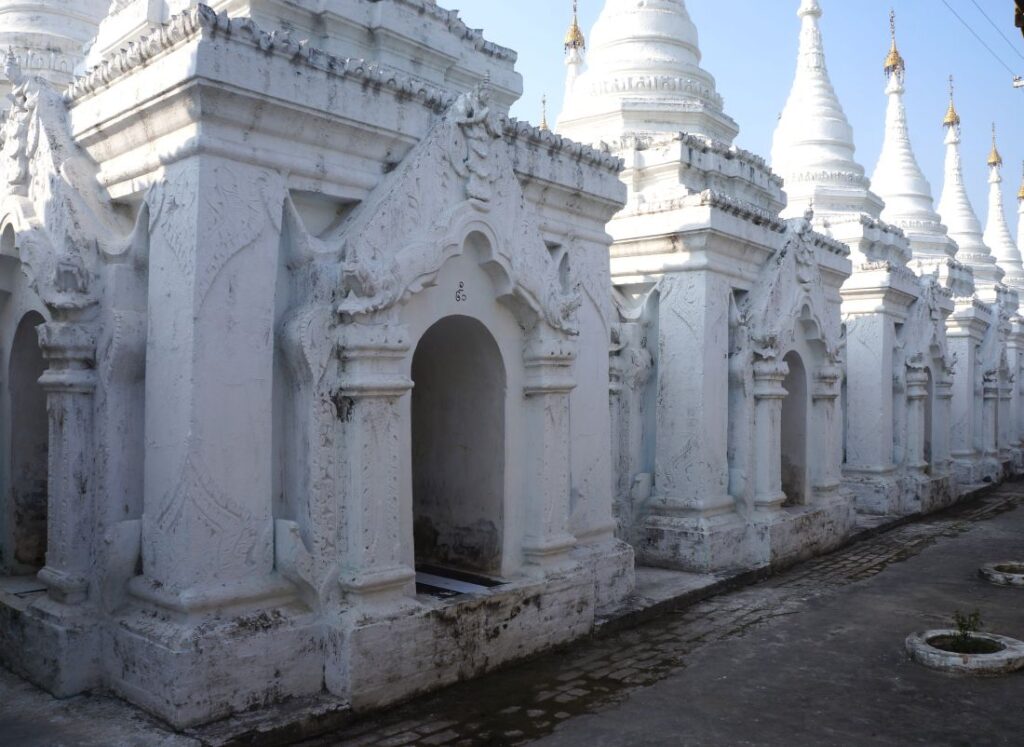
From the eastern entrance of the Sandamani Pagoda, a short walk northeast leads to the renowned Maha Lawka‑Mayazein, or Kuthodaw Pagoda. Built by King Mindon in 1857 and modelled on the Shwezigon Pagoda of Pagan, it remains one of Mandalay’s most celebrated monuments. In 1913 the pagoda was fully regilded by U Po Tha, a prominent paddy broker from Rangoon, at a cost of Rs. 30,000. His act of merit is still remembered in accounts of the pagoda’s history, alongside King Mindon’s original foundation in 1857–1868. It shows how wealthy lay donors, not only royalty, played a role in sustaining Buddhist monuments in colonial Burma.
The pagoda’s most distinctive feature is its collection of 729 stone slabs inscribed with the entire Tipiṭaka, the Buddhist Canon. In effect, the pagoda enshrines an authorised version of the Buddhist “Bible,” highly valued by Oriental scholars. This assemblage of inscribed tablets is unique in the Buddhist world.