Taoist Temple Deity Tu Di Gong





Taoist Temple Deity Tu Di Gong
The Taoist temple deity Tu Di Gong is the Earth God or God of the Soil and Ground, he is firmly integrated into the Taoist pantheon, though his origins lie in ancient Chinese folk religion.
In Chinese spiritual practice, the line between folk religion and institutional Taoism is very fluid. Taoism adopted, organized, and formalized many local earth spirits, absorbing them into its cosmic celestial bureaucracy. Within this structure, Tu Di Gong acts as the lowest-ranking administrative official, overseeing a specific, small localized neighborhood, village, or piece of land.
His Role in the Taoist Bureaucracy
In formal Taoist theology, deities operate much like an imperial government cabinet:
- The Local Administrator: Tu Di Gong is essentially the local “district magistrate” or “neighborhood watch” of the spiritual world. He keeps a meticulous census of the living and the dead in his specific area.
- The Celestial Hierarchy: He is not an omnipotent supreme being. He reports directly to higher-ranking regional Taoist deities, such as the Cheng Huang (City God), who in turn reports up the chain of command to the Jade Emperor (the supreme ruler of heaven).
- The Bureaucratic Office: Unlike major immortal cosmic deities, the office of Tu Di Gong is a position that can be filled by different souls over time. According to Taoist tradition, when a virtuous, honorable, or charitable person dies, the higher celestial authorities may appoint that person’s spirit to serve as the local Tu Di Gong for a specific plot of land.
SPECIFICATIONS:
- AGE: Late Qing to Early Republic (c. 1900-1920)
- HEIGHT: – 39cm
- WIDTH:– 21cm
- DEPTH: – 19cm
- WEIGHT:– 3.7 kg
- CONDITION: Age related wear to gilding
- #4210
Taoist Temple Deity Tu Di Gong
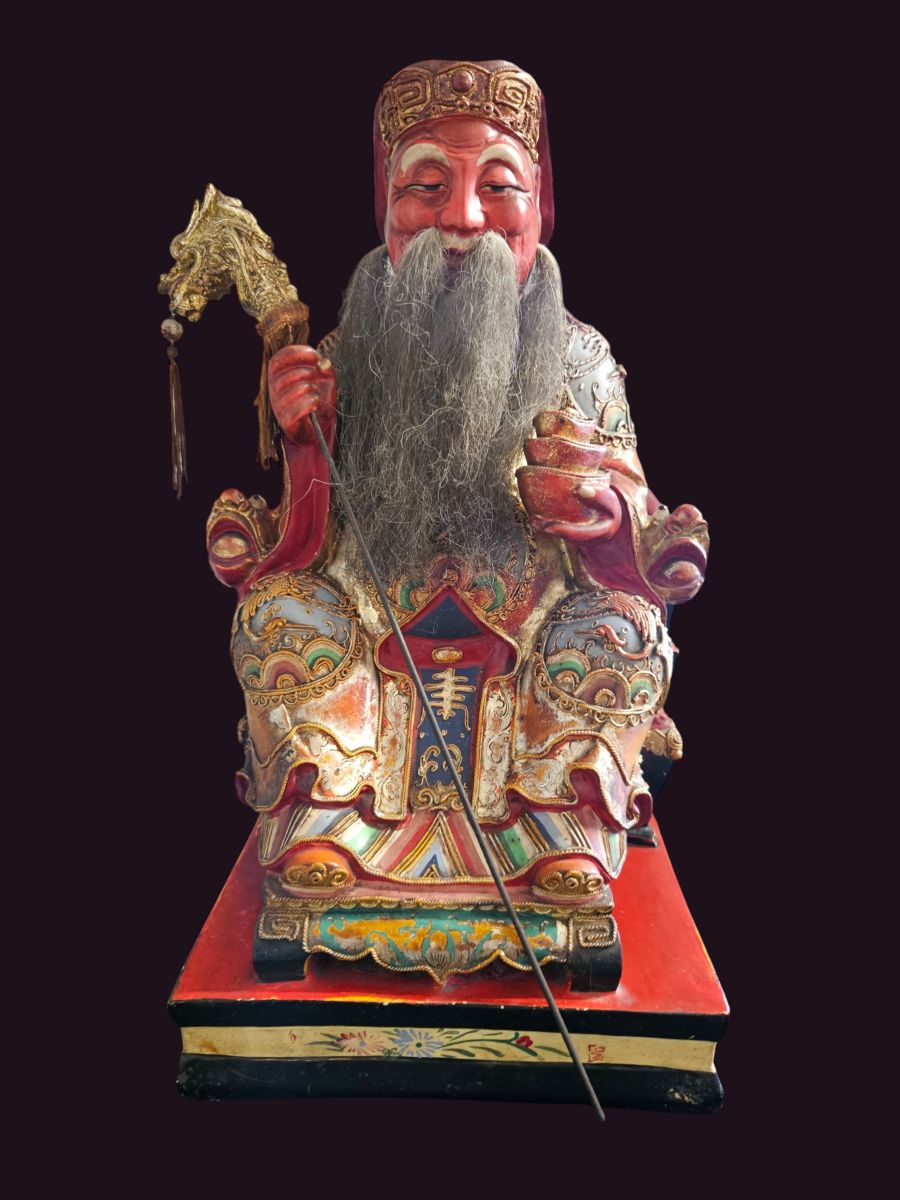
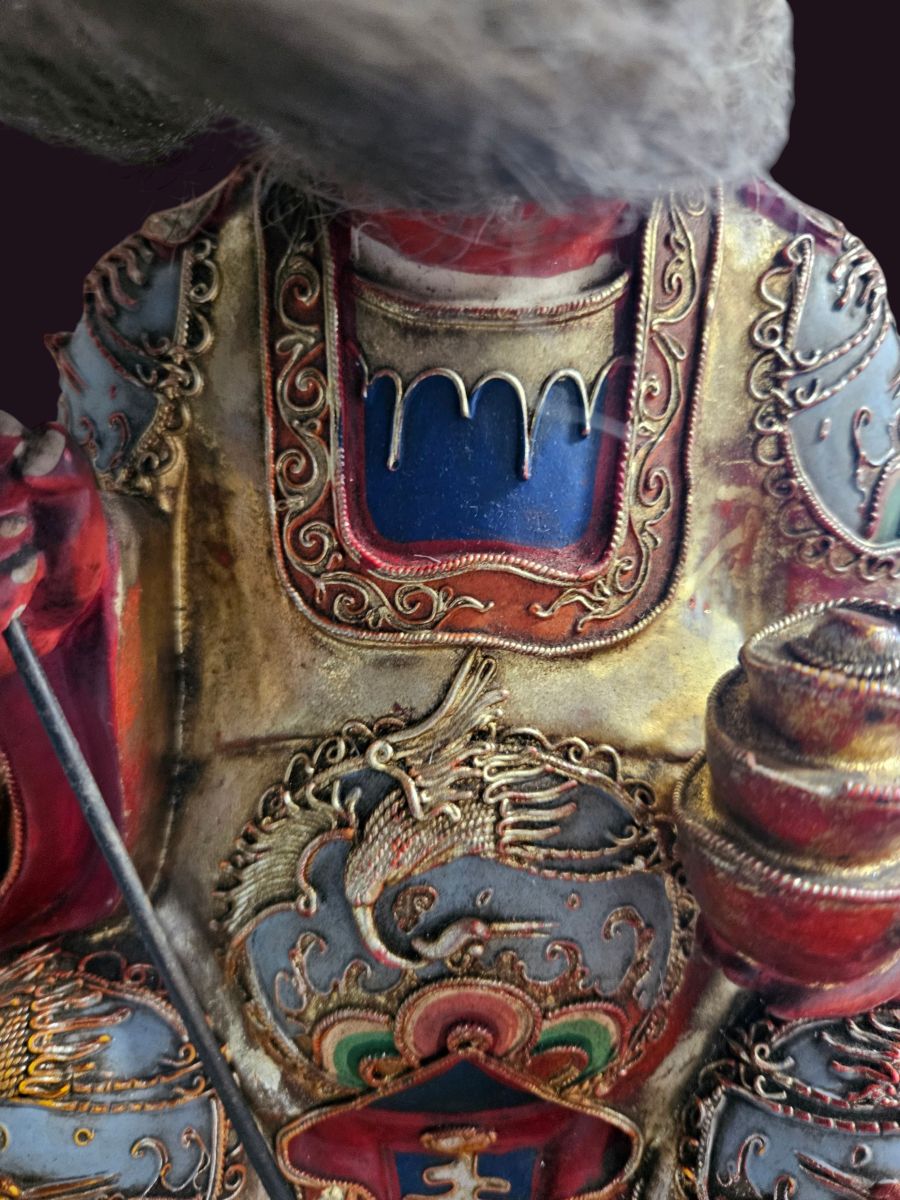
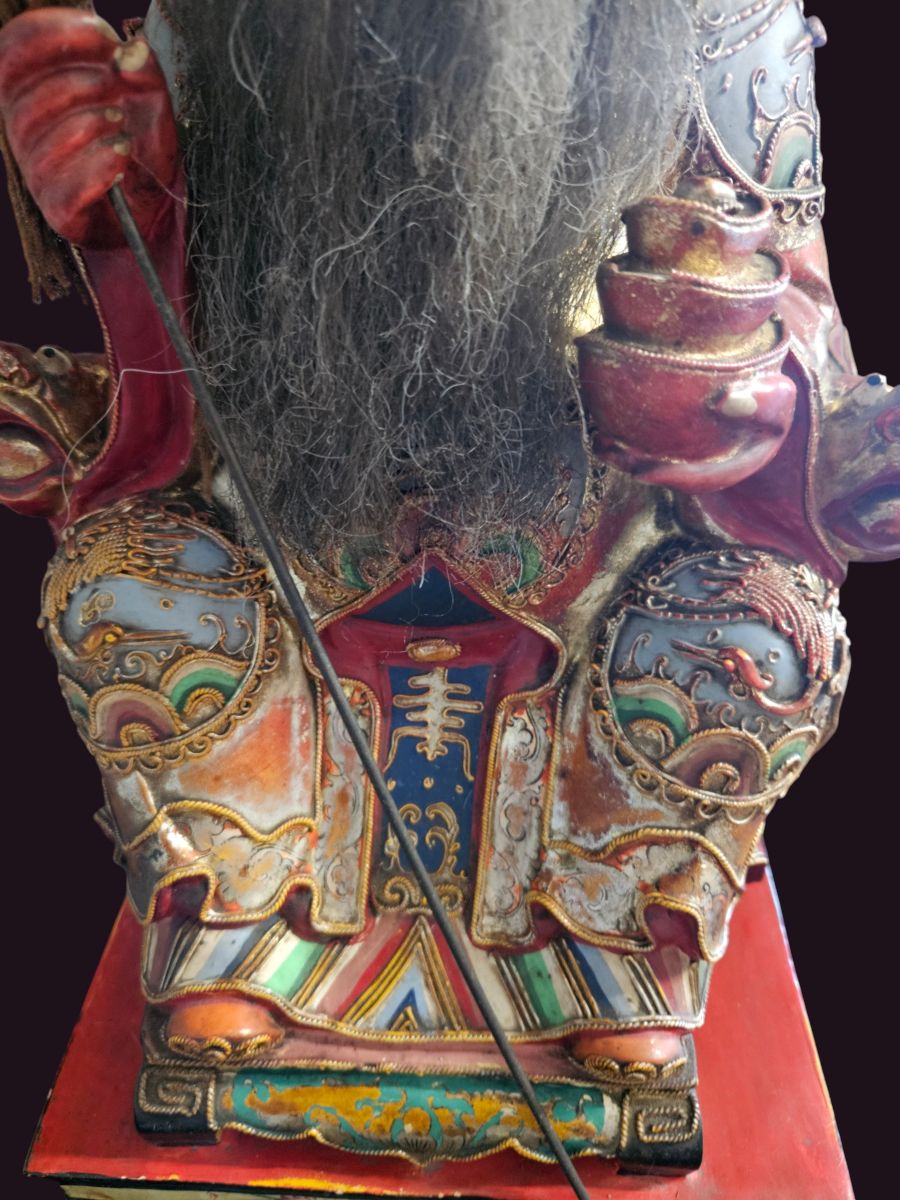
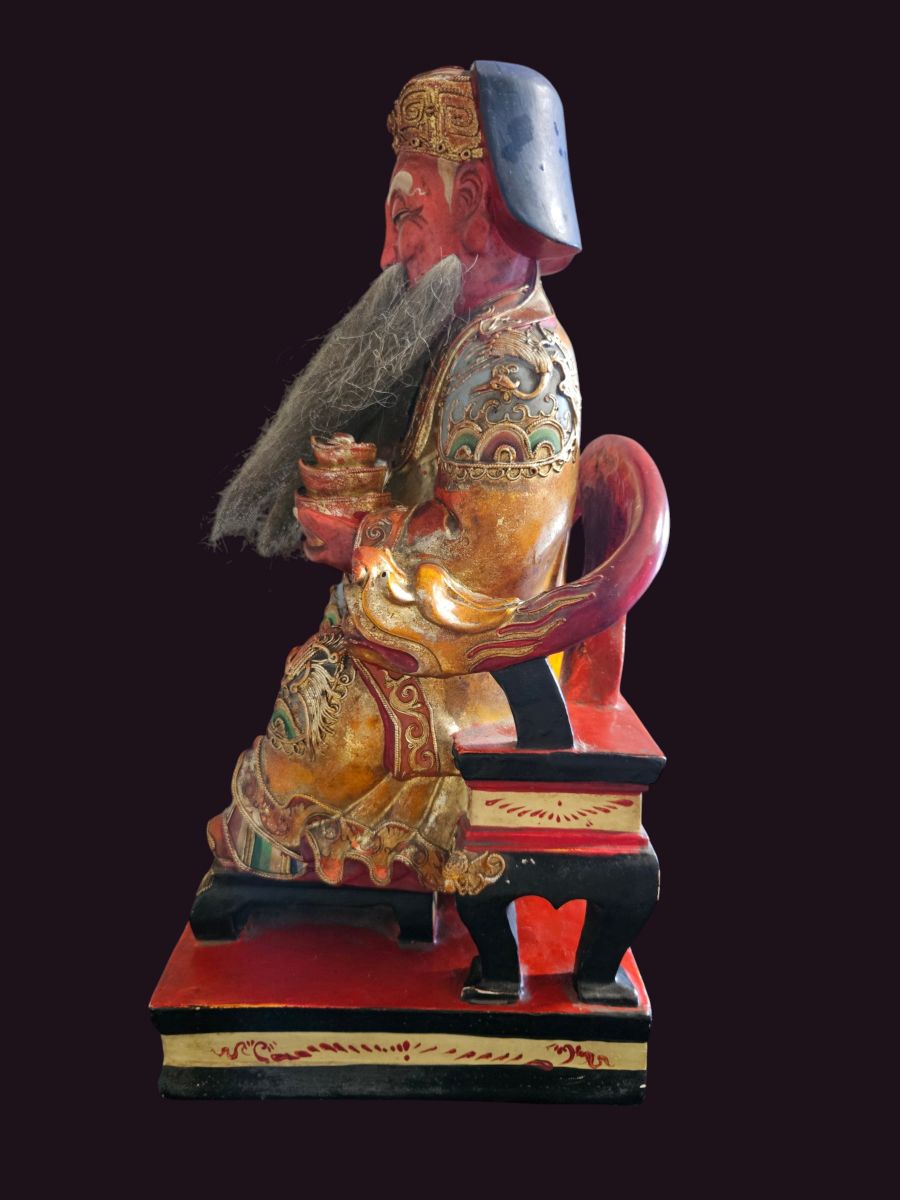
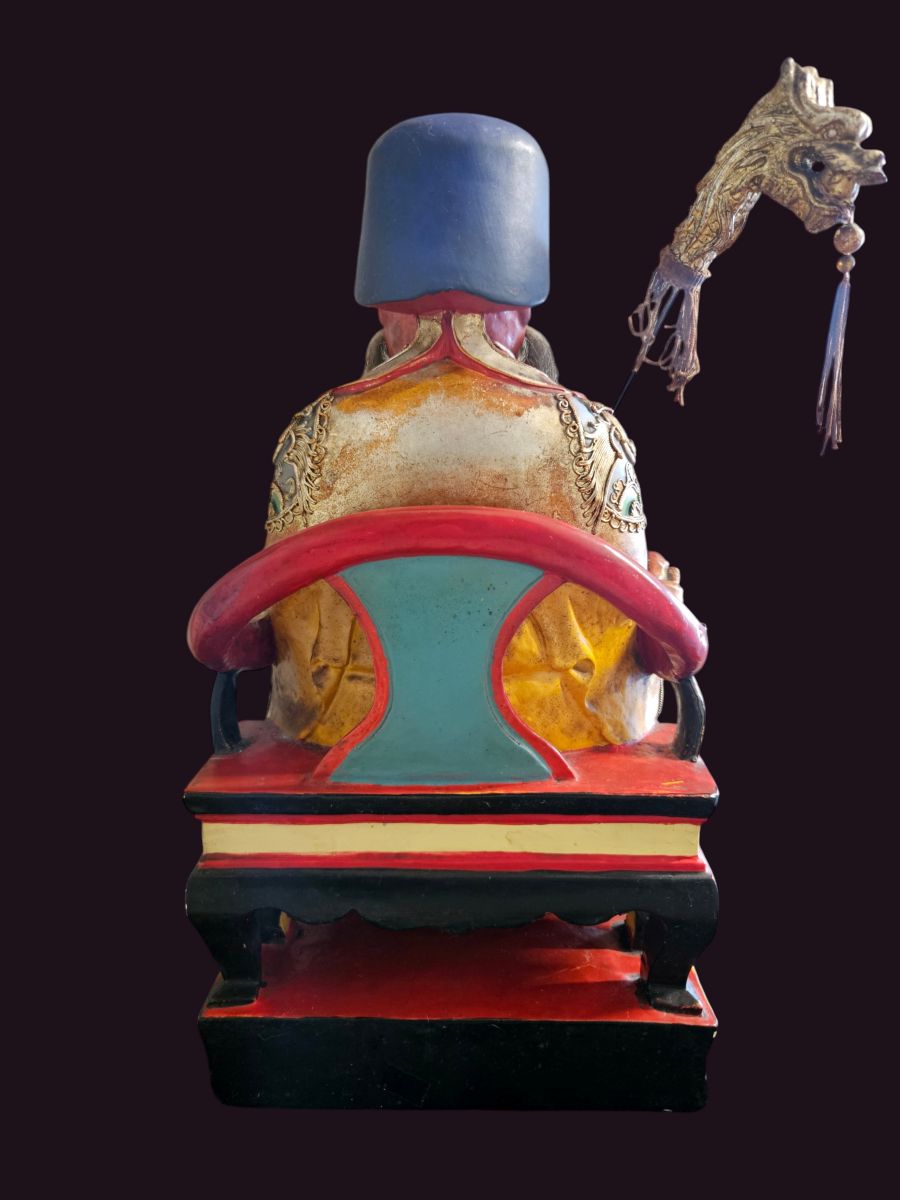
This deity is shown seated in full official regalia, wearing a deep blue court hat with gilded ornamentation and a vividly painted robe embellished with scrolling gold motifs, multicoloured borders, and auspicious emblems typical of Southern Chinese workshop production in the late Qing and early Republic periods.
The figure’s vermillion‑toned face, serene expression, and inserted fibre beard reflect the iconographic conventions of Tudi Gong as a benevolent elder. In his hands he holds a gold ingot, symbolising abundance, while a dragon‑headed staff, a sign of territorial authority accompanies the figure.
The statue retains much of its original lacquer and gilding, with gentle age‑appropriate wear that enhances its surface character. The craftsmanship, palette, and construction techniques all support a dating of circa 1900–1920, placing the piece within the transitional period between imperial and early modern Chinese religious art.
A well‑preserved and expressive example of regional Tudi Gong imagery, this figure embodies both the devotional warmth and the artisanal sophistication of Southern Chinese temple sculpture.
Iconography and Placement of Taoist Deity Tu Di Gong
In art and statuary, his appearance reflects his approachable, grass-roots nature:
- Appearance: Tu di Gong is almost always depicted as a benign, smiling old man with a long white beard in this case grey, wearing a traditional magistrate’s cap or a simple householder’s hat.
- Attributes: He typically holds a wooden staff in one hand (representing his travels across his territory) and a golden ingot (yuanbao) or a ruyi scepter in the other, symbolizing his ability to grant agricultural abundance, wealth, and domestic peace to the households under his care.
- Shrines: Because of his local status, his shrines are often small, modest structures placed at ground level beneath large trees, at village borders, or tucked into corners near the entrance of family homes and businesses to protect the immediate threshold.
The name Tu Di Gong literally translates to “Grandpa of the Earth” or “Lord of the Soil.” He is the most widely worshipped Earth God in Chinese culture.
In Chinese religion, however, the concept of the “Earth God” is divided into different levels of authority, much like a real-world government. Tu Di Gong is the local, grassroots Earth God.
The Three Levels of Chinese Earth Deities
To understand his exact place, it helps to see how he fits into the broader hierarchy of earth worship:
- Tu Di Gong (The Local Guardian): He manages a specific, small boundary—a single farm, a burial plot, a neighborhood street, or a specific home. If you want a good harvest from your personal garden, or peace within your property lines, you pray to him.
- Cheng Huang (The City God): He possesses a higher level of regional authority. He acts as the spiritual magistrate over an entire city or district, managing the collective earth and the spirits of that larger territory.
- Houtu (The Cosmic Earth Goddess): This is the supreme deity of the entire planet. While Tu Di Gong handles local human affairs on the surface of the soil, Houtu represents the cosmic force of nature, the deep earth, and creation itself.
Tu Di Gong’s Alternate Title: Fude Zhengshen
Because “Tu Di Gong” is an affectionate, colloquial nickname (like “Grandpa of the Soil”), he is addressed by a much more formal title in temples and on traditional altars: Fude Zhengshen which translates to the “Righteous God of Fortune and Virtue.”
When you see a small, ground-level stone shrine in a Chinese community or near the foundation of a building, it is dedicated to him as the immediate guardian of that piece of earth.