
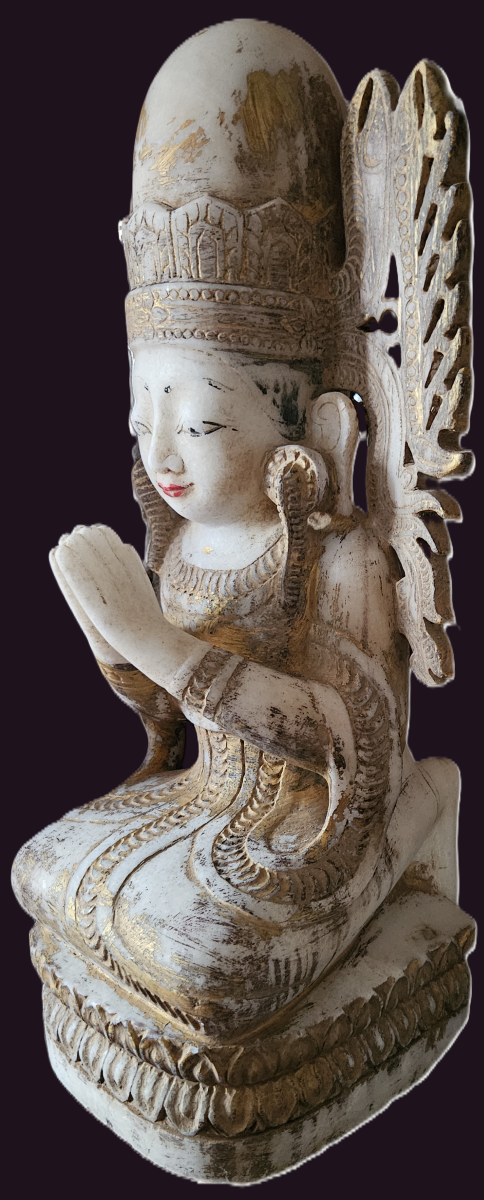

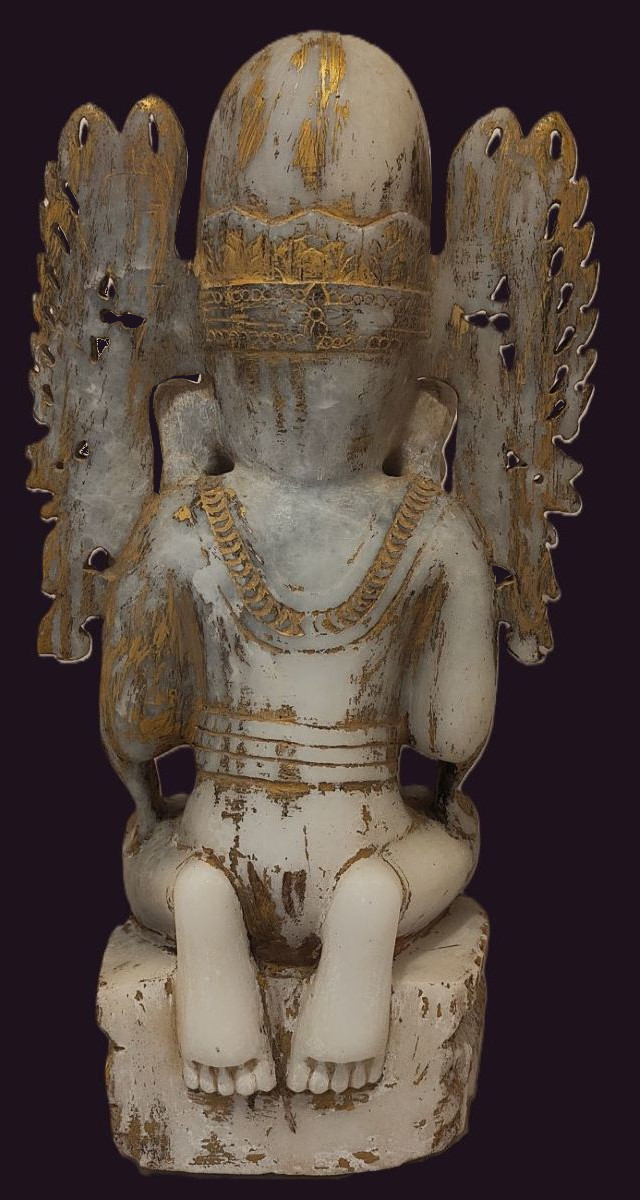
Rare Celestial Nat Mandalay Period 19th Century
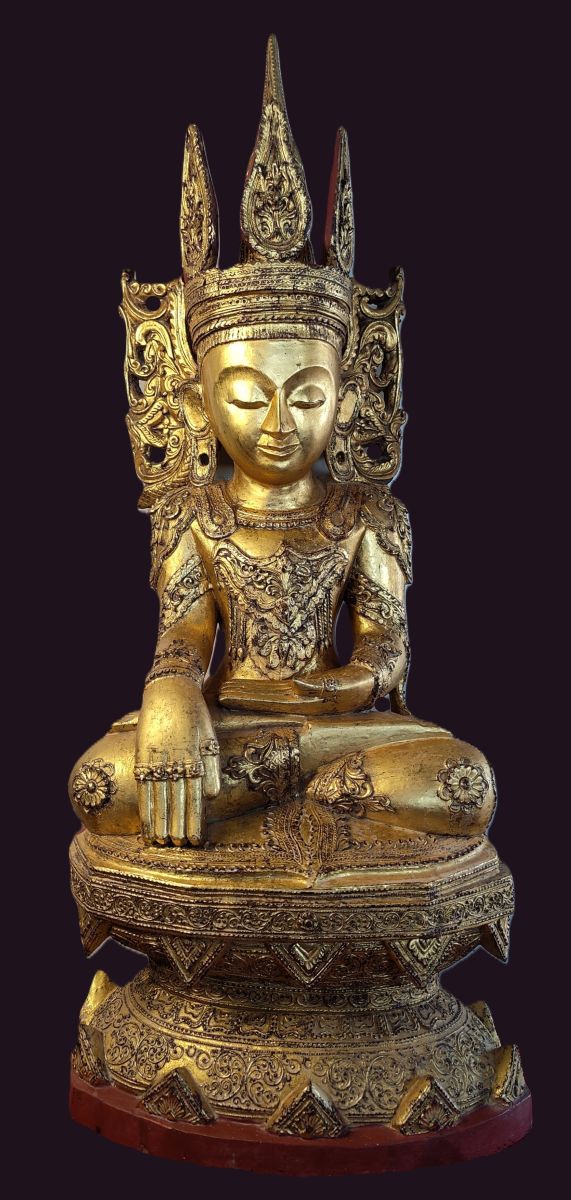
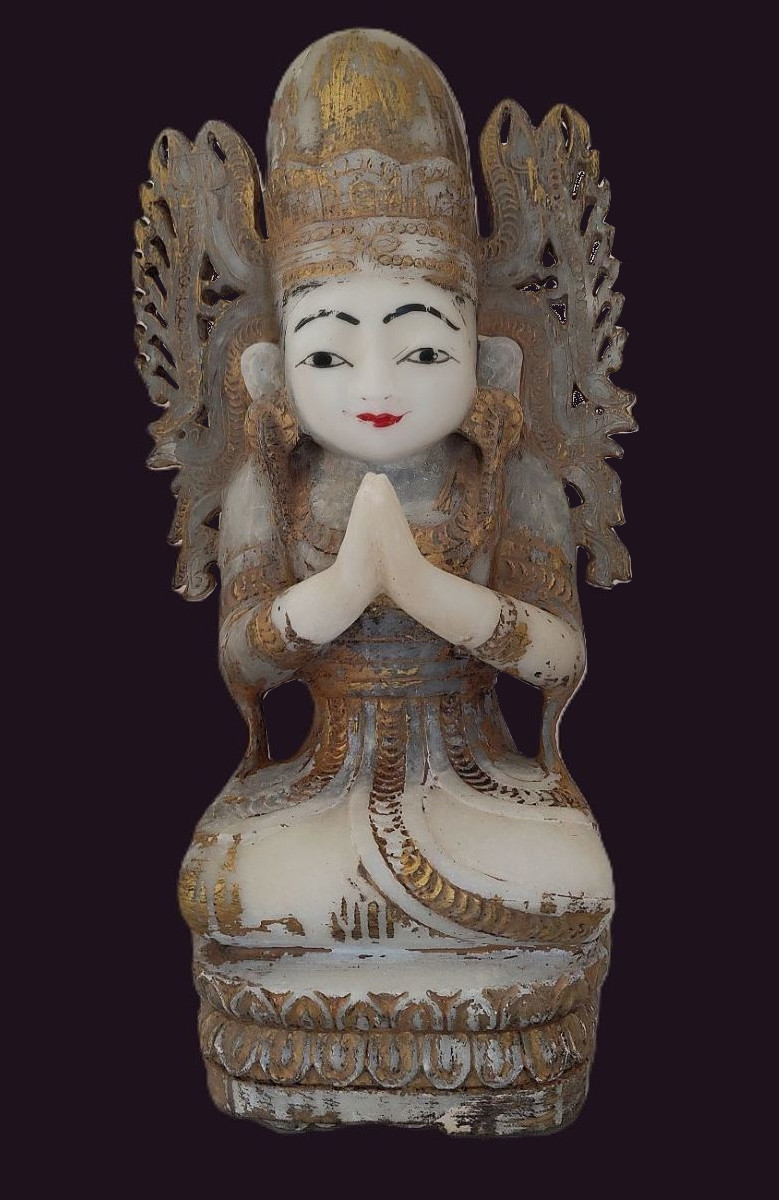
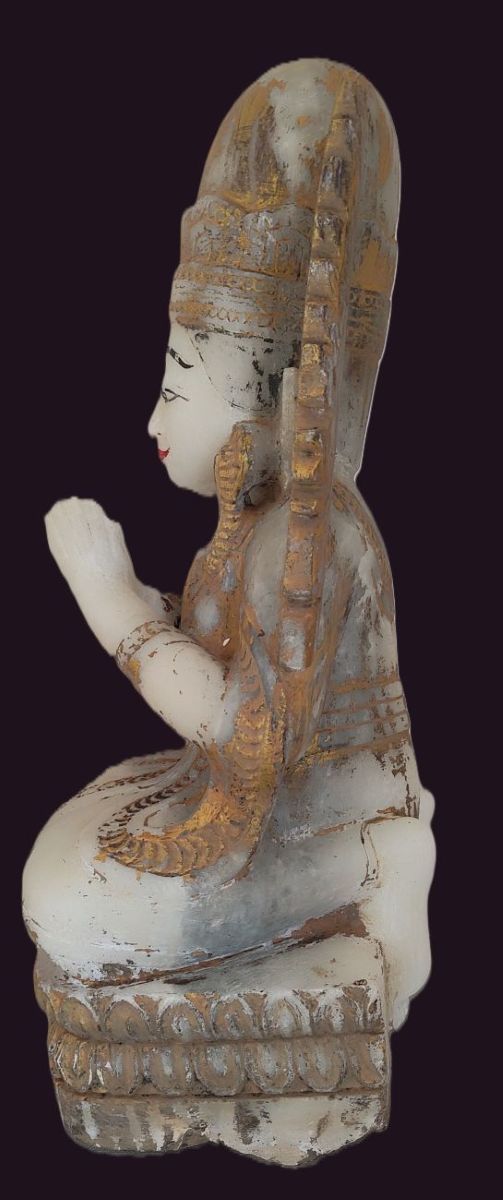
Rare Celestial Nat Mandalay Period 19th Century with side flanges and a tall rounded dome on top of the head with a carved incised band circling the head resembling a crown. The figure is shown wearing large ornate earrings and regalia of someone of high status or who has attained noble status within the royal court, kneeling on a double lotus pedestal.
When we purchased this piece, it was described to us as a celestial being Nyaungyan style. It looked like a monk to me, so that is how I always referred to it. My views on its monk status changed after I came across paintings and photos showing figures with the same unique tall, rounded dome on the head surrounded by a crown who were prominent people in the Burmese royal courts. (see image)
While it shares the royal attire of a Jambupati Buddha, the difference lies in the Anjali Mudra (palms pressed together at the heart), which signifies a being showing reverence to a higher power.
Mandalay carvers mastered “openwork” drilling by carving completely through the stone to create empty space, giving the flanges a light, airy, lace-like quality, although they are in fact quite thick and the sweeping ear-wings is a direct callback to the Ava tradition. This is a masterpiece in Burmese stone carving.
SPECIFICATIONS:
- HEIGHT: – 60 cm
- WIDTH: – 30 cm (flanges)
- DEPTH: – 24cm
- WEIGHT: 29.45 kg.
- #803
Rare Celestial Nat Mandalay Period 19th Century
High officials, ministers, and even regional governors in the Burmese royal court were not only depicted wearing headdresses that look identical to devas (celestial beings or divine guardians), but the cultural concept of the court intentionally blurred the lines between the earthly administration and the heavenly realm.
When the artisan guilds moved to Mandalay in the mid-19th century, they took the basic template of the Ava headdress but completely transformed how it was carved, using the new tools and stylistic preferences of the Yadanapon court.
The connection between high officials and Celestial Nats in Burmese iconography comes down to two main factors:
The King as Sakra (Thagyamin):
The king was viewed as the earthly equivalent of Sakra, the king of the devas.
Ministers as Celestial Attendants:
Ministers as Celestial Attendants: If the king was Sakra, his wungyis (prime ministers), atwinwuns (ministers of the interior), and regional governors were the earthly equivalents of the high-ranking devas who attended to Sakra in his heavenly court. Consequently, court costumes were intentionally designed to look divine. When these officials were depicted in woodcarvings, lacquerware, or temple donor statues, artists used the exact same iconographic rules, robes, and crowns for a minister as they did for a celestial deva.
The Baung (The Crowned Dome Headdress)
The tall, rounded dome surrounded by a crown is the formal ceremonial hat of a Konbaung-era court official. It consisted of a velvet or silk skullcap that rose into a rounded dome or bulbous peak, encircled at the base by an ornate, gilded metal crown featuring flame-like or wing-like leaf details (tazaung).
The height, color, and number of gold bands on the crown indicated the official’s precise rank in the Hluttaw (Royal Council).
Because the devas in Burmese Buddhist murals and carvings were also styled after contemporary royal fashion, a statue of a minister in full court dress is visually indistinguishable from a deva or a nat (spirit guardian) unless an accompanying inscription gives the historical person’s name.
If the figure is seated or standing with its hands clasped in reverence (anjali mudra), it is highly likely a donor statue representing a real historical minister or governor, carved in the guise of a celestial deva to eternalize their piety and high status in the kingdom.