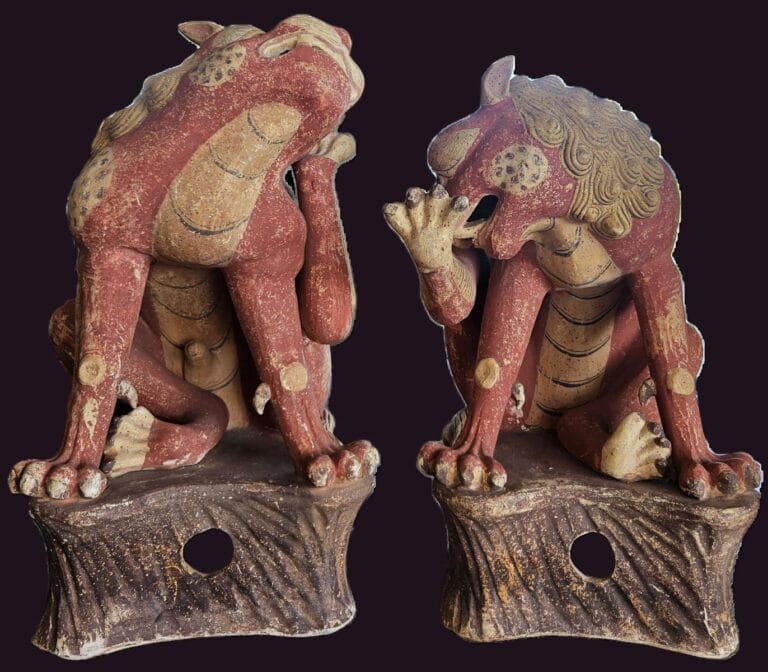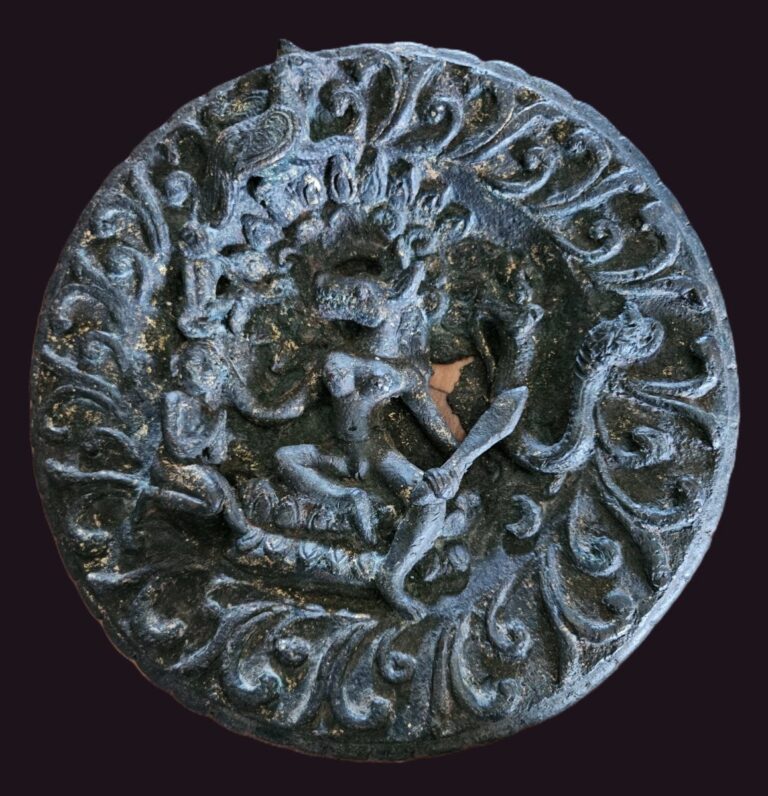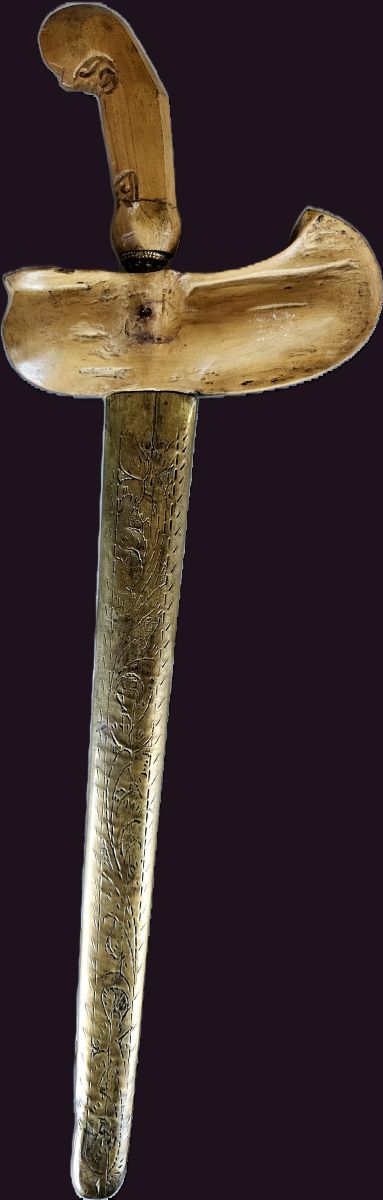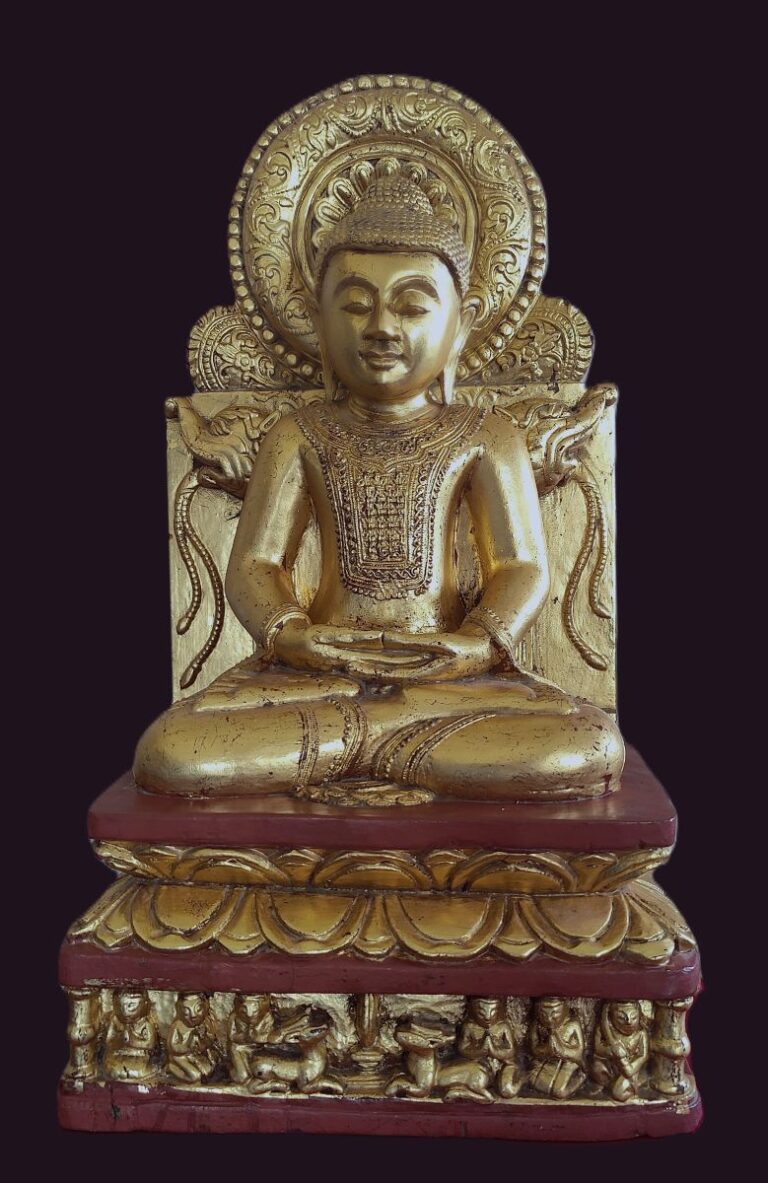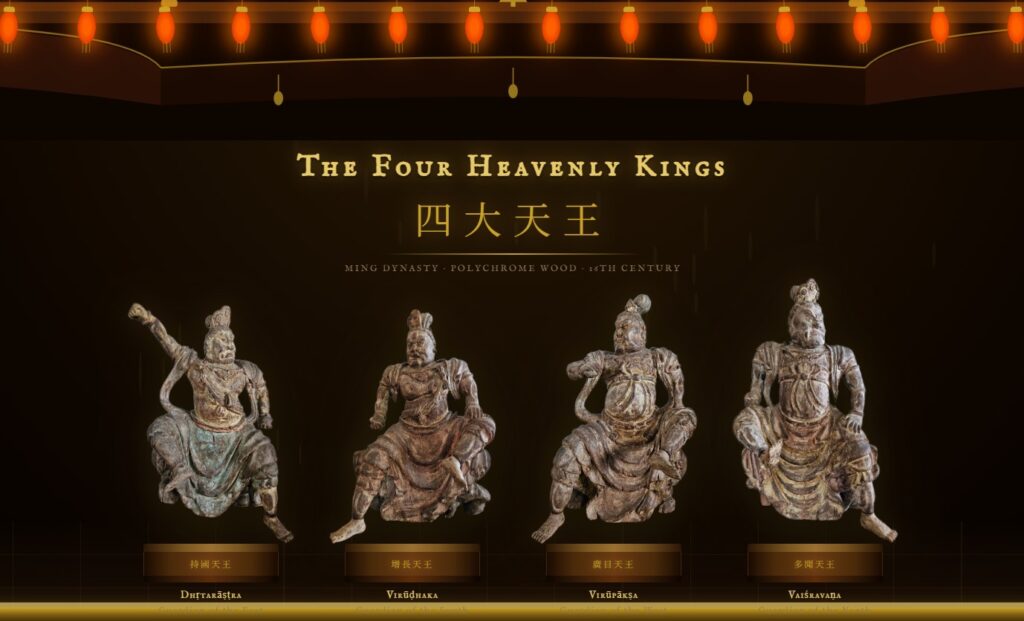
Chinese Ming Dynasty Wooden Lokapala Figures
This rare set of Chinese Ming Dynasty Wooden Lokapala Figures bears a striking similarity to the terracotta guardian statues outside the entrance to the “Hall of the Devas” at the famous Shuanglin Temple, in Qiaotou Village, South of the ancient city of Pingyao in Shanxi Province in China. These four large, three-meter-tall Tianwang (Heavenly King) clay statues standing under the eaves of the veranda outside the Heavenly Kings Hall (Tianwang Dian) at the Shuanglin Temple date to the Ming Dynasty (1368–1644).
These four imposing wooden Chinese temple statues represent the Tianwangs (Heavenly Kings). While the concept of these guardians originated as traditional royalty in early Indian Buddhist texts, Chinese artists during the Tang, Song, and Ming dynasties transformed their appearance into the fierce, heavily armored generals seen here, characterized by wrathful expressions and elaborate Ming-style military armor.
True to traditional Ming Dynasty craftsmanship, the ball carved into each of their hands which held the attributes of each figure were carved as separate elements. While the original attributes have been lost to time, as is standard for wooden temple figures of this antiquity, the clean, original mounting holes remain intact and provide excellent evidence of the set’s period construction.
Note: A few years ago we placed these weathered guardians with a professional conservator for stabilization. While the figures were in the workshop, a person from Sotheby’s viewed them and attributed the set to the Ming Dynasty. While this evaluation was relayed to us directly by our conservator rather than a formal written certificate, it strongly supports the stylistic and material evidence of the period.
We have tried to identify each figure but as they are missing their attributes it may not be accurate.
Chinese Ming Dynasty Wooden Lokapala Figures
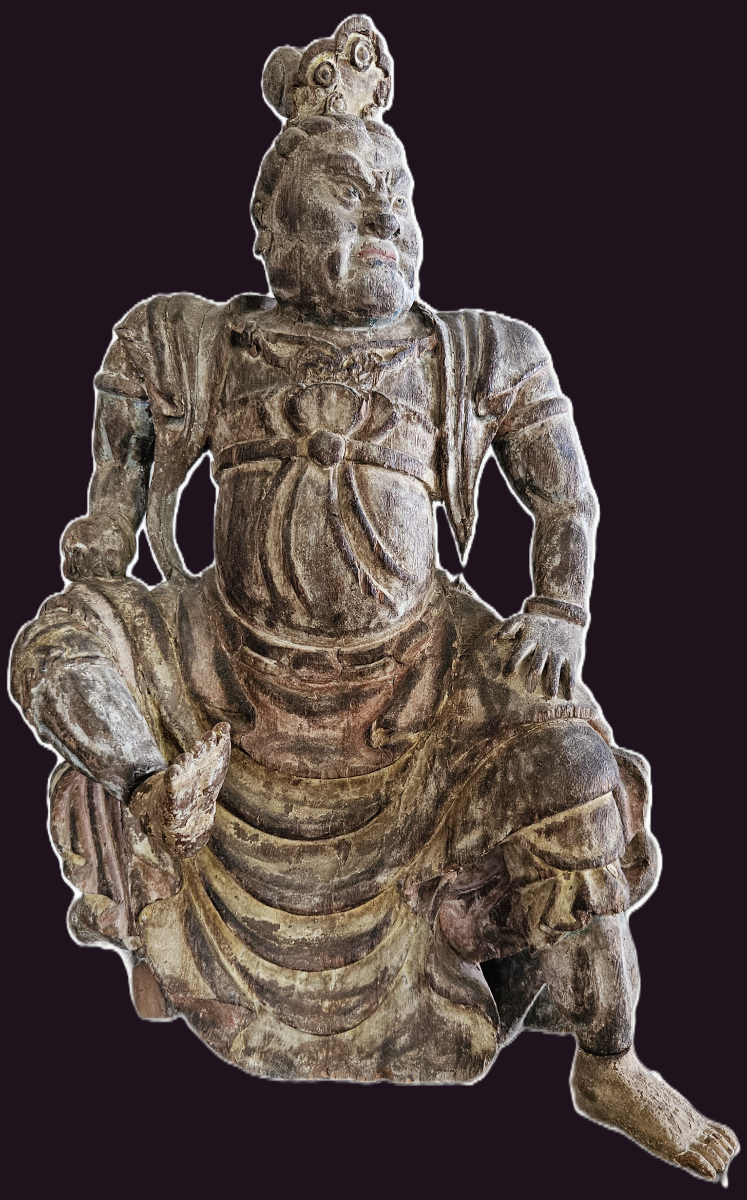


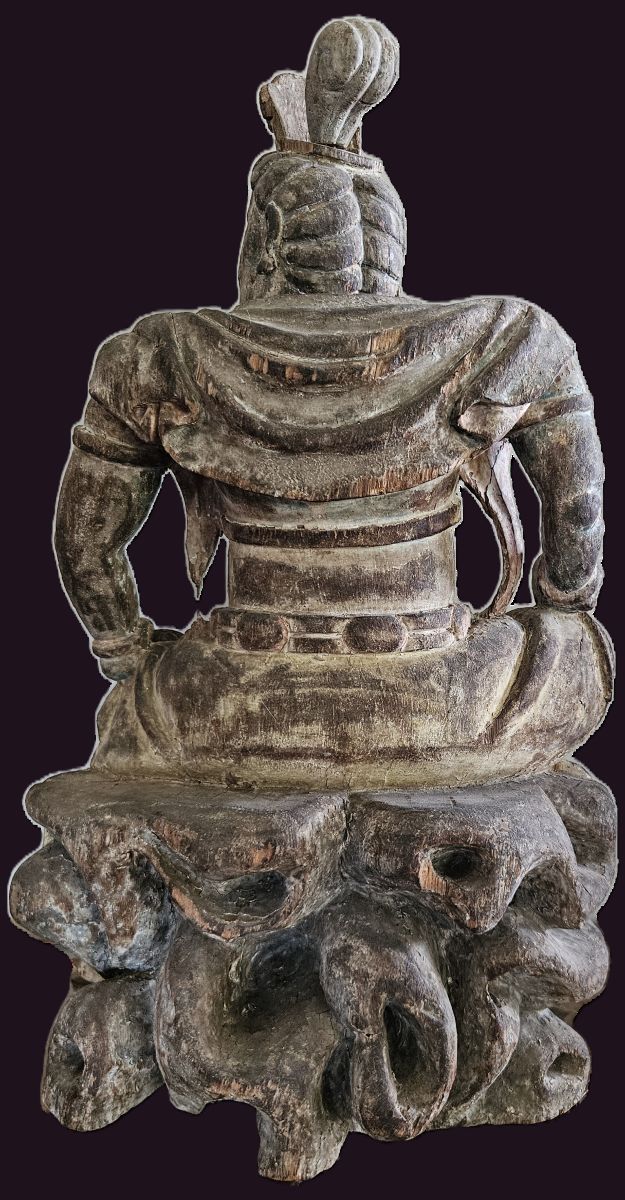
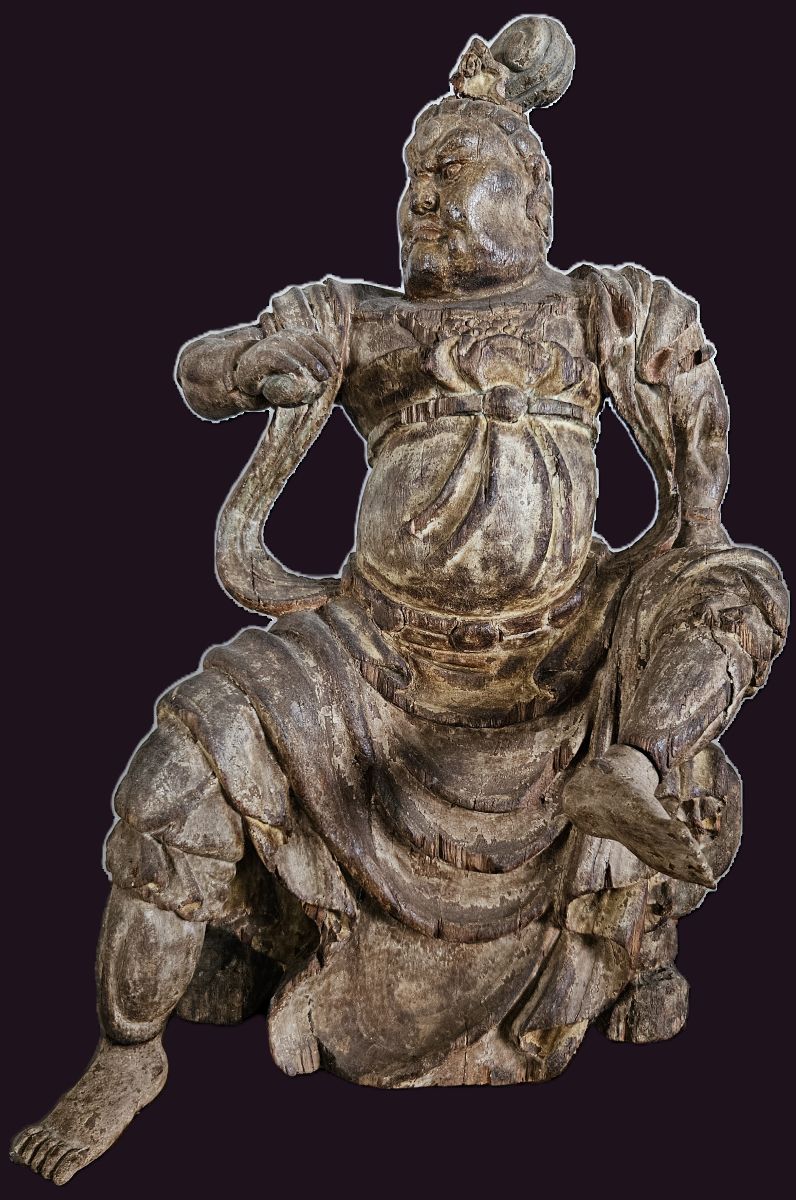
Dhrtarastra – King of the East – Moli Hai
The Musical Instrument Angle: The posture of both arms. His left hand is placed firmly down on his left knee to balance his weight, while his right arm is bent at the elbow, raising a closed fist near his torso. The angle of the right arm and the open space across his chest perfectly mimic the position needed to cradle and hold the neck of a pipa (lute).
The Flat Right Foot: he has his right leg raised with the foot resting flat against the seat, creating an angled lap. In Ming woodcarving, this specific leg positioning provided a natural, stable shelf to support the heavy body of a carved wooden lute.
SPECIFICATIONS:
- HEIGHT: – Varying up to 50cm
- WIDTH:– Vary between 35cm and 33cm
- WEIGHT: – Total 11.7kg.
- #65
- CONDITION: All of these statues have some pieces missing, such as the objects each held and to parts of the robe where it is unattached to the main body.
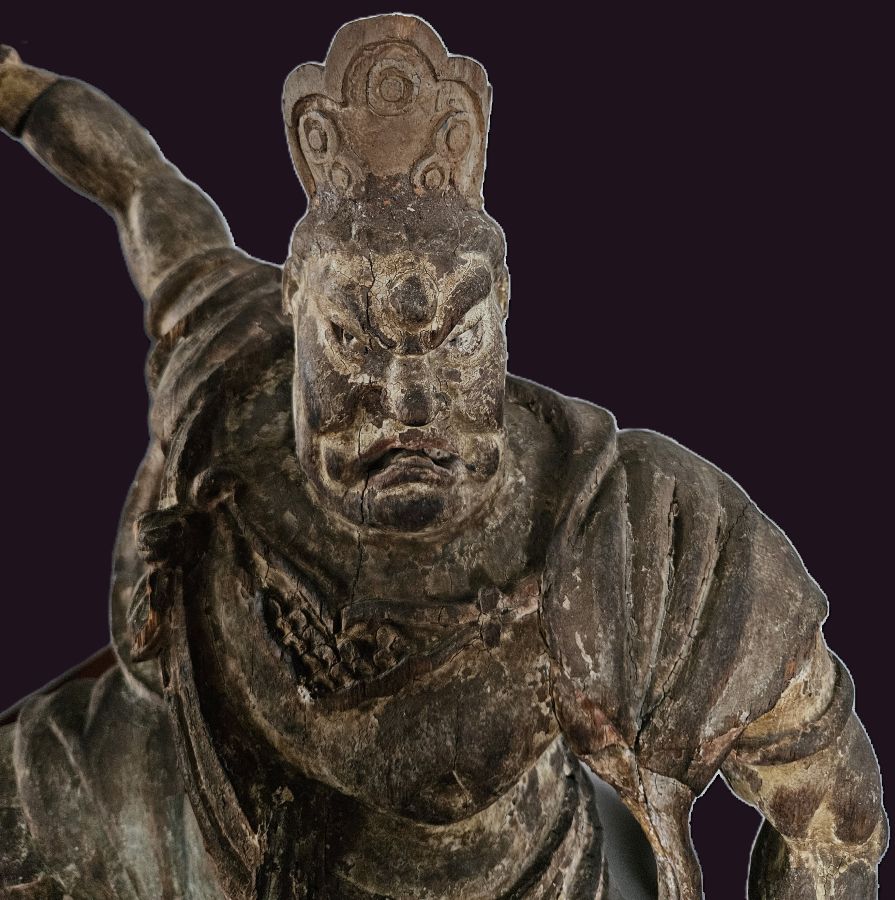
Virudhaka – King of the South – Moli Qing
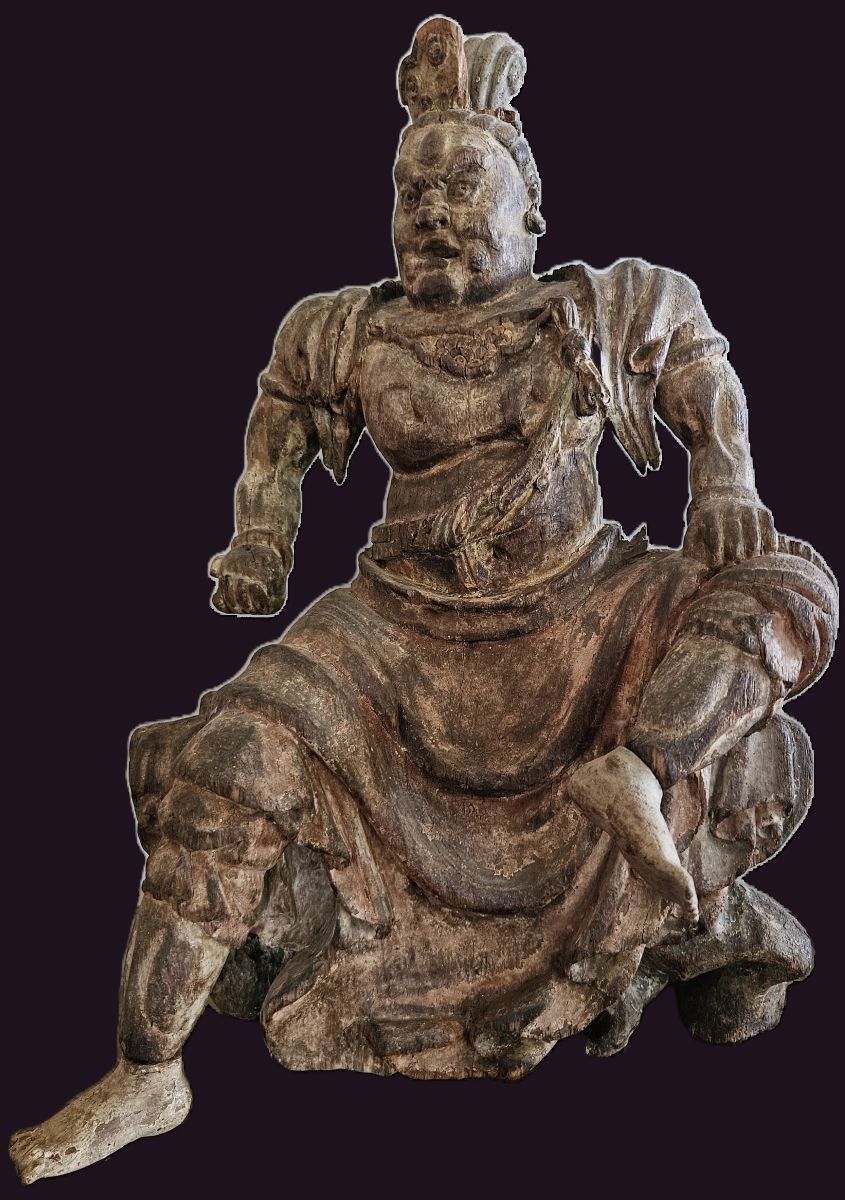
Dynamic, Powerful Stance: The figure is seated in a dramatic, active posture known as lalitasana (a variation of royal ease), with the left leg raised and the right leg extended downward. This gives the sculpture an immediate sense of tension and movement.
Fierce Warrior Iconography: The face is deeply carved with a wrathful expression, characterized by bulging eyes, a furrowed brow, and an open mouth. The hair is bound up into a high, elaborate topknot secured by a decorative band or crown, typical of divine protectors.
Ming Dynasty Armor and Drapery: He wears heavy military armor over his torso, visible at the chest and stomach plates. A thick, flowing sash wraps across his chest and drapes over his left arm, providing the classic contrast between rigid military gear and fluid, sweeping textiles that defines Ming religious carving.
Hand Gestures (Mudras): The right hand is clenched into a tight fist, resting near the hip, which originally may have held a weapon (such as a sword or lance) or simply signified martial power. The left hand rests heavily on the raised left knee, stabilizing the powerful, asymmetric pose.
Material and Condition: Carved from solid wood, the piece displays an excellent aged patina with a weathered, textured surface. There are visible remains of early gesso and dark lacquer undercoating in the deep recesses of the carving, showing standard wear for a temple figure of this antiquity.
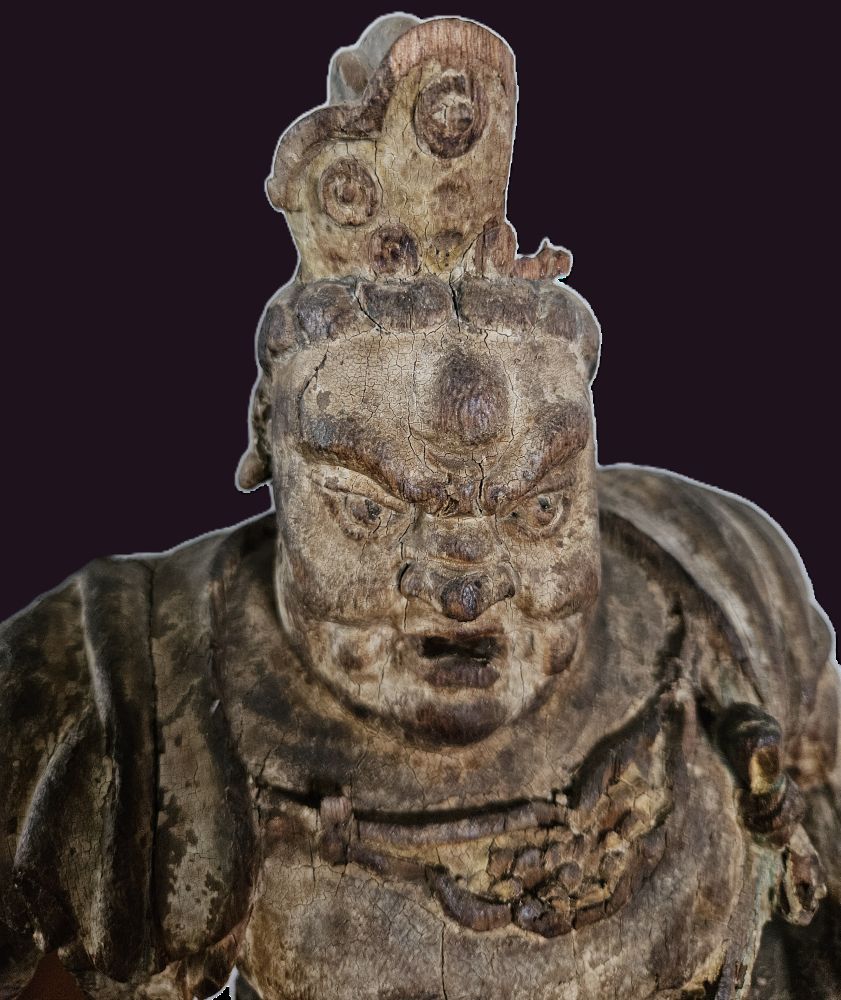


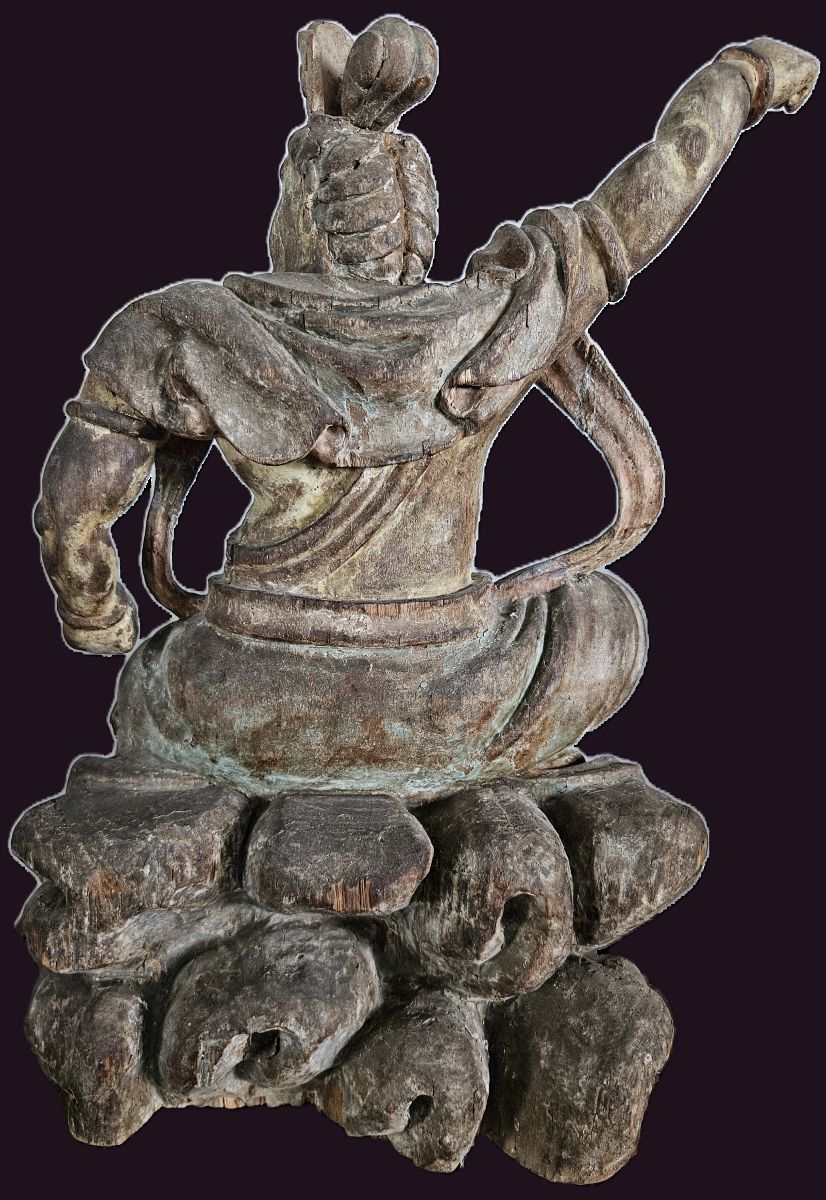

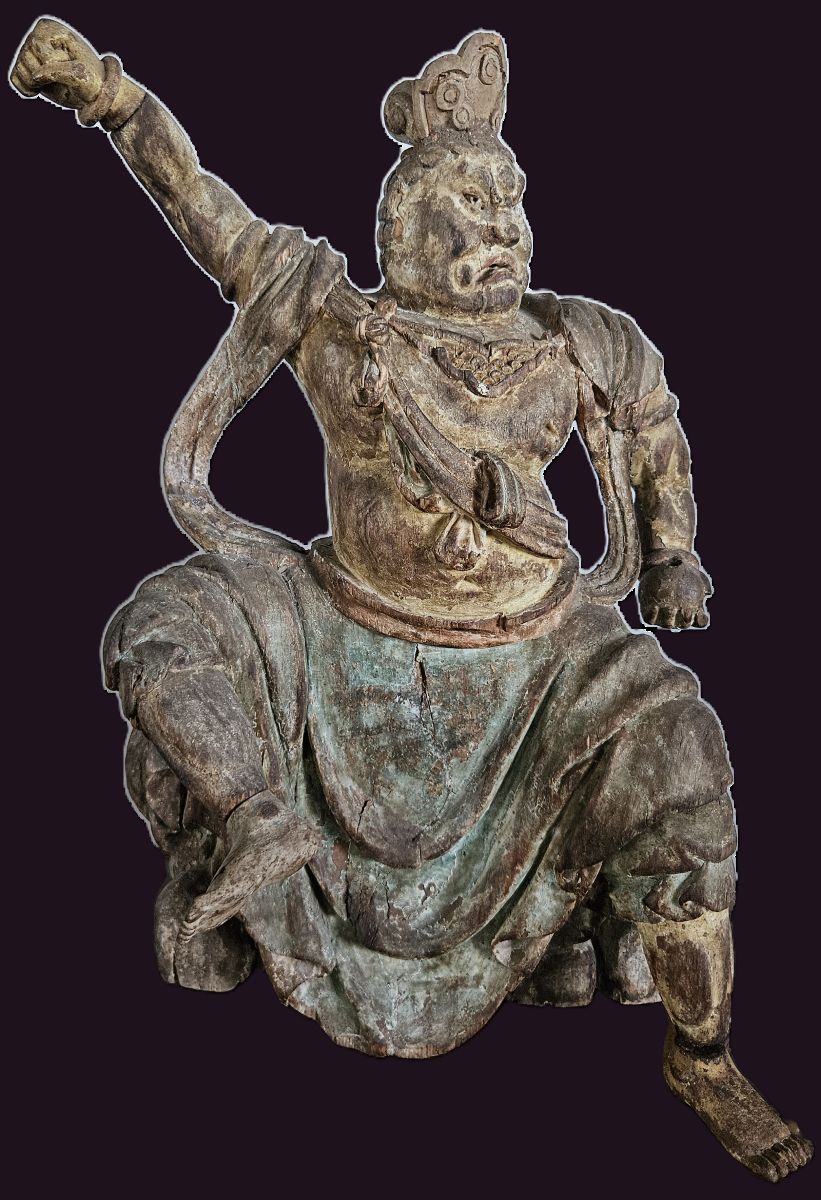
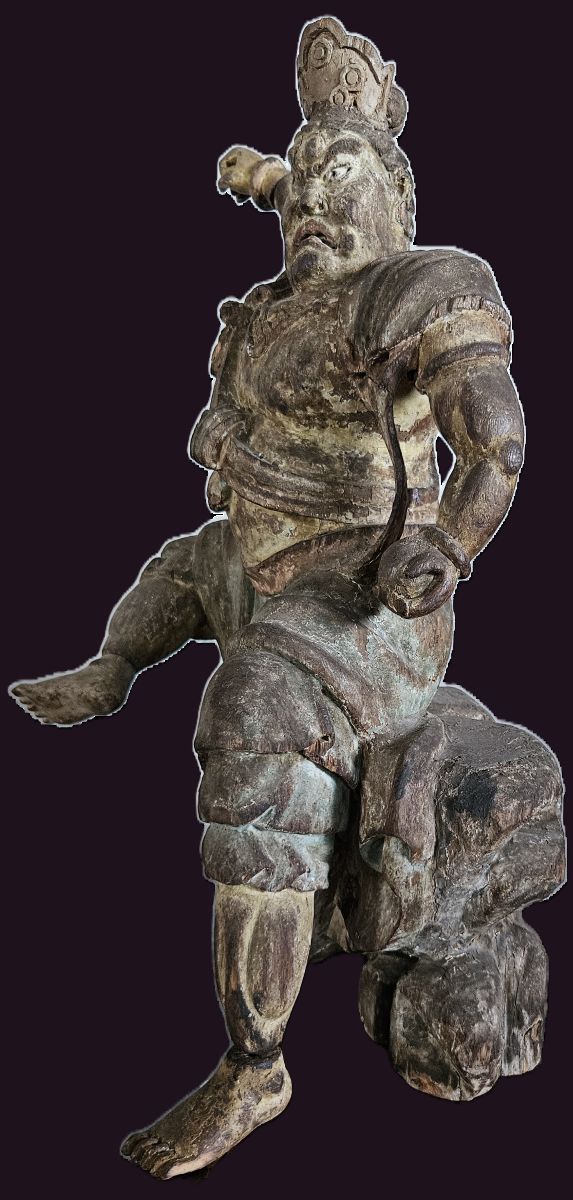


Virupaksa – King of the West – Moli Hong
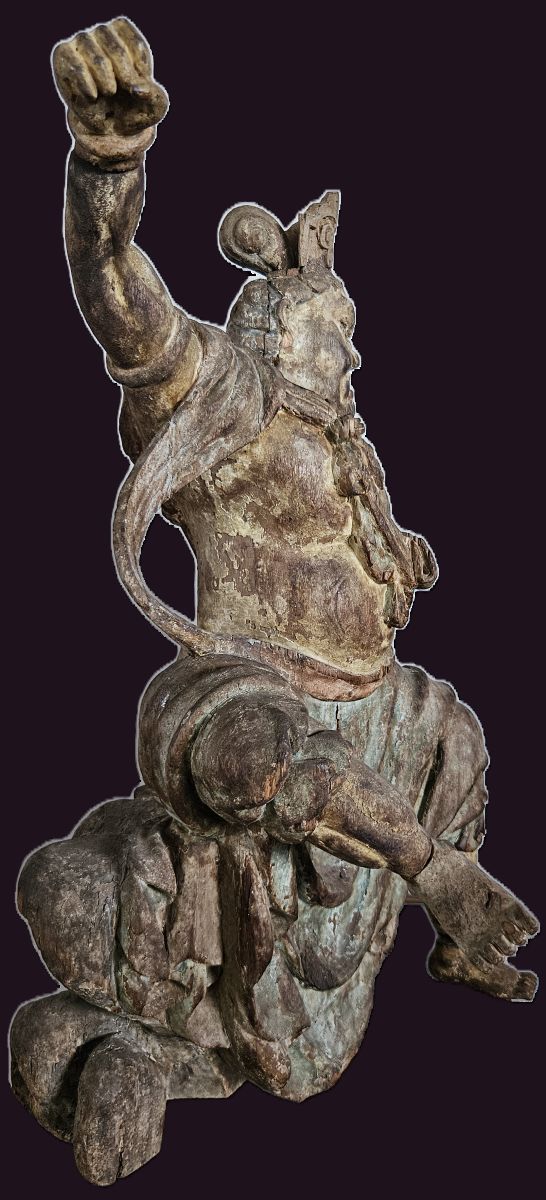
The celestial guardian of the western quadrant and the leader of the Nagas (serpent deities). His Sanskrit name translates to “He who has varied eyes” or “The All-Seeing,” referencing his ability to look out over the world, monitor human conduct, and protect the sacred Buddhist teachings (Dharma).
In Chinese temple iconography, he is depicted as a powerful, wrathful martial general. His primary attributes are a testament to his cosmic power over the elements:
- The Magical Umbrella: Moli Hong carries a jeweled parasol (Hun-yuan San). In Chinese Buddhist lore, opening this umbrella plunges the sky into total darkness, causing thunder, fierce windstorms, and torrential downpours to vanquish forces hostile to the faith.
- The Blessing of Rain: Within the popular Chinese framework of Feng Tiao Yu Shun (Wind, Harmony, Rain, and Peace), Virūpākṣa’s umbrella specifically represents Yu (Ra
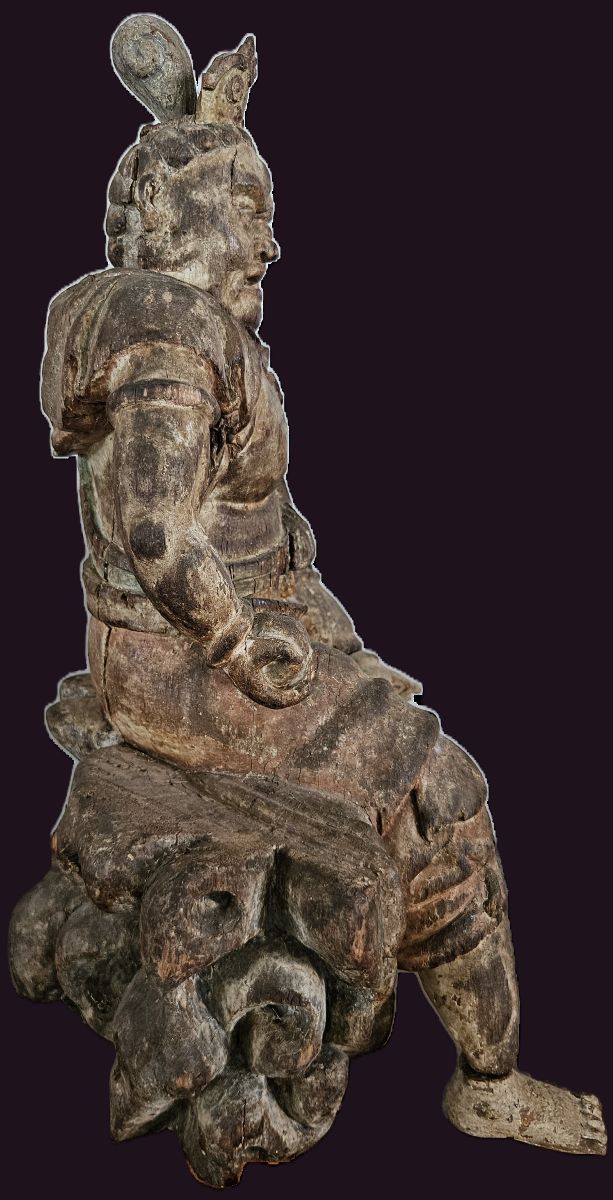
The Raised Right Arm: His right arm is thrust straight up and outward with a closed fist. In the iconographic system of Ming Dynasty Lokapala, this exact high-reaching stance is designed to hold the long shaft of a jeweled umbrella or parasol (Hun-yuan San). The umbrella would stand vertically, with his right hand gripping the upper pole or handle and the base resting near his seat.
The Balanced Left Hand: His left arm is held down near his hip with a clenched fist, balancing the intense upward energy of the right arm.
The Asymmetric Leg Positioning: This Heavenly king has his right leg raised and his left leg extended downward.
Vaisravana – King of the North – Moli Shou
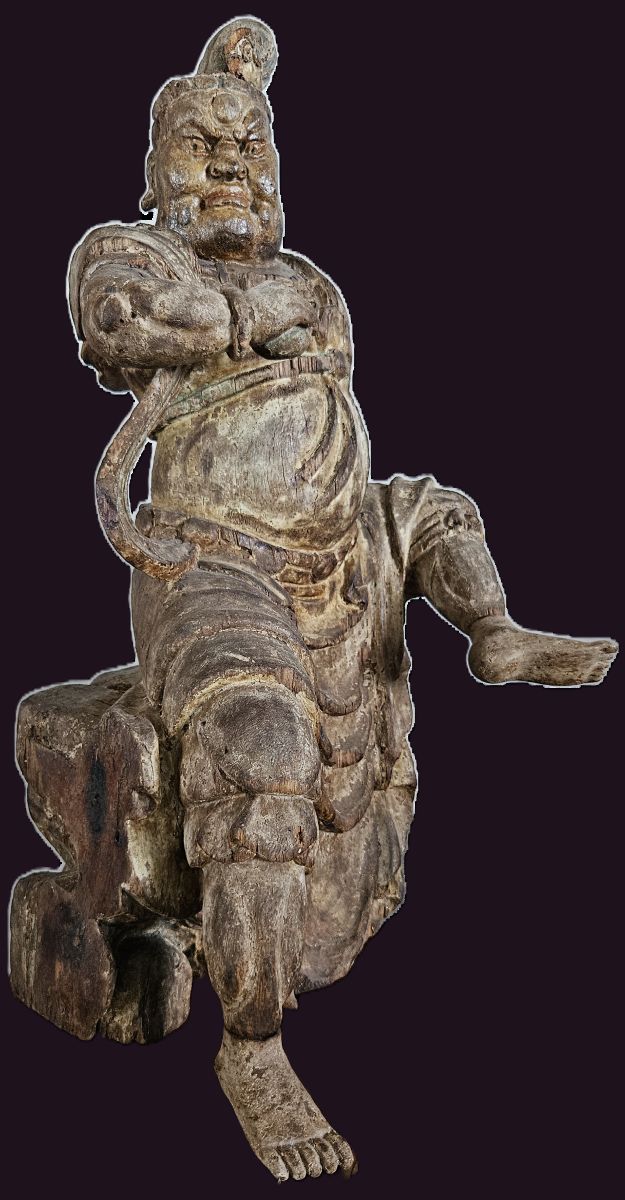
The leader of the Four Heavenly Kings and the most powerful deity among them. He guards the northern quadrant, a direction traditionally associated with the peak of spiritual and material power. He doubles as a major god of wealth and prosperity, serving as the lord of the yakshas (nature spirits) who guard the earth’s hidden treasures.
In Chinese Buddhist art, his identity shifted from an early Indian monarch into a formidable, regal commander-in-chief. In classic Ming Dynasty woodcarvings, artists conveyed his status as leader by giving him an exceptionally stable, authoritative posture. He is frequently depicted with his left leg raised, using his knee as a heavy, natural shelf to support his sacred animal or jewel, creating an unmistakable image of absolute power and security
- The Sacred Attributes: Vaiśravaṇa traditionally holds a treasure-spouting mongoose or a small dragon-like creature in his left hand, which symbolizes spiritual and material abundance. In some regional variants, he carries a precious jewel or holds upright a miniature sacred pagoda (stupa) in his palm, representing the preservation of the Buddha’s relics.
- The Blessing of Peace: Within the Chinese cultural framework of Feng Tiao Yu Shun (Wind, Harmony, Rain, and Peace), Vaiśravaṇa represents Shun (Peace or Compliance). Devotes pray to him to bring social harmony, domestic peace, and a smooth, successful harvest.
- The Left Leg Raised: Just as predicted, this figure has his left leg raised and his right leg extended downward. This creates the exact visual counterweight needed to pair with Figure 3 (Virūpākṣa), who has his right leg raised.
- The Cradled Left Arm: His left hand rests firmly on his raised left knee. The forearm and knee form a flat, stable platform designed to cradle his main attribute—the treasure-spouting mongoose or a small dragon—close to his side.
- The Right Hand Position: His right arm is bent across his chest with the hand loosely clenched. In Ming representations of Vaiśravaṇa, this hand often holds a sacred jewel (wish-fulfilling gem) or grips the lower body of the creature resting on his lap.

About these Chinese Ming Dynasty Wooden Lokapala Figures
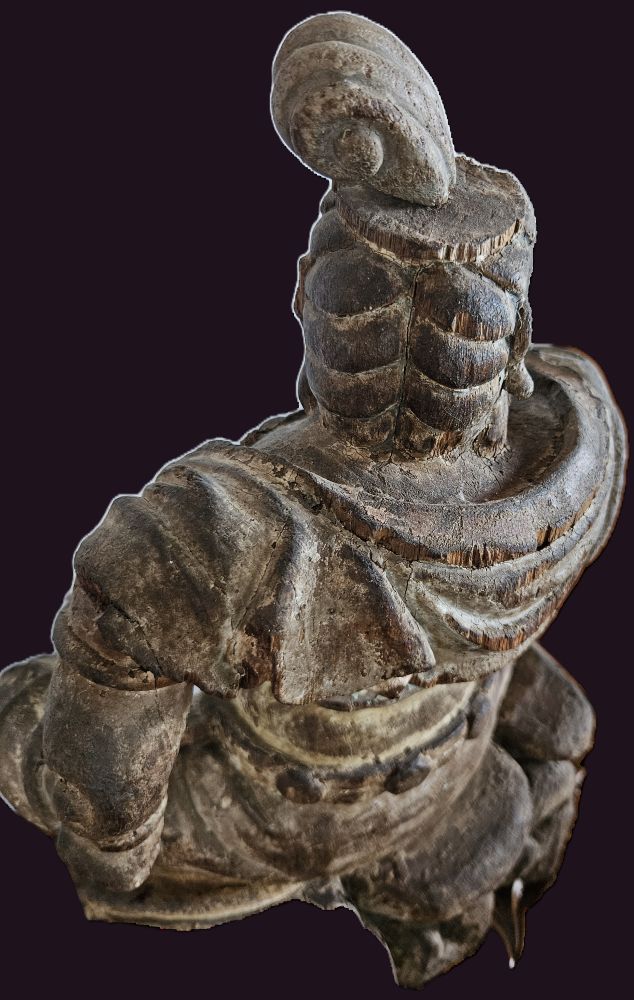
These figures boast a highly desirable weathered patina with significant remains of their original gesso undercoats and early pigments still intact. This unrestored (but conserved) surface reveals the multi-layered creation process of Ming dynasty woodcarvings, where layers of gesso were applied over the timber to receive painted detail. The aged, dry wood tones and surviving pigments give the set a powerful, authentic presence.
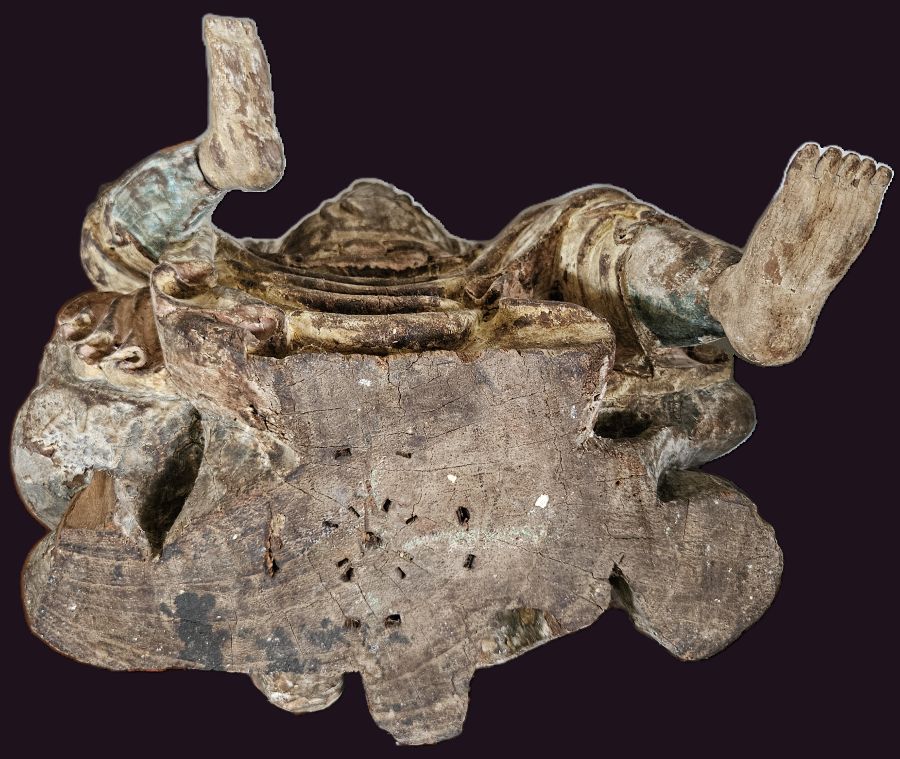
The undersides of these Chinese Ming Dynasty Wooden Lokapala Figures provide exceptional material evidence of authentic Ming Dynasty construction. Carved from substantial single-block timbers, the bases display natural historic radial checking and deep oxidation consistent with centuries of aging.
The bases feature traditional core-hollowing and a semi-circular and oblong series of bored sockets. The ring of smaller holes on each base could have held secondary stabilizing wooden dowels or iron pins to stop the figure from twisting or rotating on its main central mount once positioned.