Pyigyikone Konbaung Royal Barge
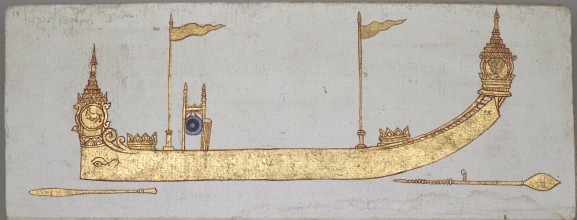
The Pyigyikone Konbaung royal barge decorated with figures of the moon and the sun on its bow and stern was the Kings boat. During royal river journeys, this vessel served as the primary link between the king and his people. The barge operated as a mobile administrative court rather than a display of isolation or raw power. When the royal fleet anchored along the riverbanks, common subjects stepped forward to submit legal petitions and written grievances directly to court officials.
The design of the craft reflects traditional Burmese creation stories. In this mythology, early humans lived in darkness until their collective merits and needs brought the sun and moon into existence. Master carvers placed a shrine to the Moon Deity at the front prow and an identical shrine for the Sun Deity at the stern to honor this tradition of answered needs. This layout reminded observers on the riverbank that the ruler carried a direct duty to hear the appeals of his people.
In the hierarchy of the Konbaung royal flotilla, boats were strictly categorized by size, hull type, and purpose. The Pyigyikone was categorized as a personal royal transport boat (Lwankyin or Hlaw Ka class variants) rather than a massive double-hulled state barge like the Pyi Gyi Mon.
Judging by contemporary single-hulled royal escort and ceremonial transport vessels of the era, it would likely have measured approximately 80 to 120 feet (24 to 36 meters) in length. The beam (width) of these single-hulled royal boats was narrow to ensure speed and maneuverability on the Ayeyarwady River, typically averaging between 6 to 8 feet (1.8 to 2.4 meters) wide.
Layout and Superstructure Constraints
While specific numbers for the length, the structural components required for its ritual function dictate its proportions:
- The Bow (Prow): Accommodated a raised, decorated miniature shrine housing the carved figure of the Moon God (represented either as a celestial deity or by a hare symbol).
- The Stern: Accommodated a matching raised shrine housing the carved figure of the Sun God (represented as a deity or by a peacock symbol).
- The Center: Featured an open or lightly sheltered area where the king could sit to hear the petitions of his subjects.
- The Floating Court Room: The midsection of the deck featured an open-sided, tiered wooden pavilion (Pyatthat or Zayat style). This structure housed the court officials, clerks, and scribes who received the public petitions.
This following description on size of the vessels and crew members is based on comparative Southeast Asian royal barge practices, including documented crew structures from Thai ceremonial barges (e.g., Suphannahong) and limited surviving information on Burmese Konbaung‑period vessels.
While specific dimensions varied slightly depending on the exact log available, a primary state or administrative barge of this class typically adhered to these traditional specifications:
- Length: Usually ranged between 100 to 130 feet (roughly 30 to 40 meters) from the tip of the prow to the peak of the stern.
- Width (Beam): Generally narrow to allow for speed and maneuvering along the Ayeyarwady River currents, typically measuring between 8 to 12 feet wide (2.5 to 3.5 meters).
- Propulsion Layout: They were built to accommodate 40 to 60 oarsmen (rowers), who sat in pairs along the narrow outer walkways flanking the central administrative pavilion.
Crew Capacity
For a vessel of this specific size and profile to navigate the river currents gracefully during a procession, it required a standard complement of 30 to 40 oarsmen (rowers), alongside a steersman at the high curved stern and a signalman or chanter at the bow to keep the rowing rhythm.
Cosmological Symbolism of the Pyigyikone
The architecture of the Pyi Kone reflects traditional Burmese Buddhist cosmology concerning the origin of the universe.
- The Legend: Royal chronicles state that in the early days of creation, humanity existed in total darkness. The sun and moon only emerged in the skies after the people offered collective prayers for illumination.
- The Bow and Stern: The vessel used celestial iconography to represent this shift from darkness to light, mirroring the monarch’s duty to bring clarity and justice to the realm. Artisans placed a dedicated shrine containing the moon deity at the bow, while a corresponding shrine for the sun deity occupied the stern.
Note: Because the original Konbaung royal fleet was largely destroyed, dismantled, or lost following the British annexation of Burma in 1885, visual knowledge of specific state barges like the Pyigyikone relies entirely on historical texts, parabaiks (traditional folding manuscripts), and detailed court records that describe their structural layouts, carvings, and dimension.
From River Progresses to Royal Ruins: Connecting the Konbaung Water Palace
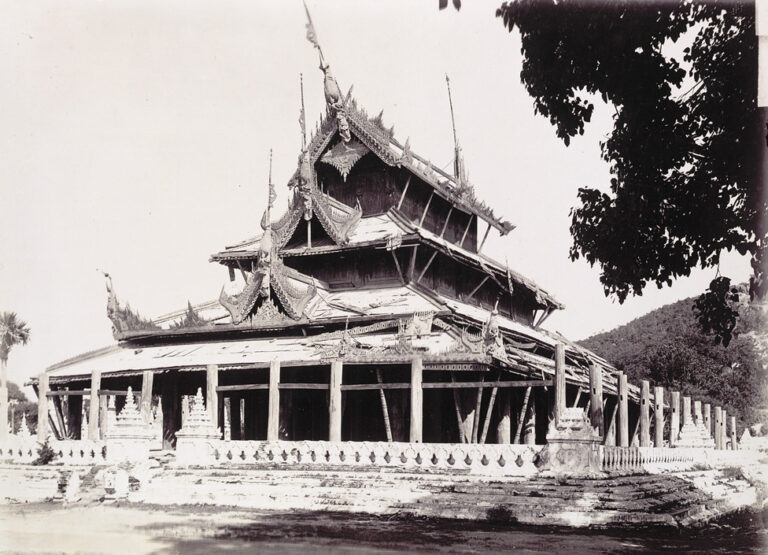
The major earthquake in 2026 at Inwa and the Mandalay region unearthed a spectacular Konbaung Dynasty water palace, providing a physical anchor to the fluid world of the Burmese royal river ceremonies. For centuries, the Konbaung monarchs ruled not just from stationary palaces, but from the water. State barges like the Pyigyikone functioned as mobile administrative courts, navigating the Ayeyarwady River to act as a direct, accessible link between the king and his subjects.
The discovery of this seasonal water palace matching the architectural layouts recorded in traditional parabaik manuscripts reveals the dry-land counterpart to that river-bound governance. Just as the royal barges allowed the court to project its authority and interact with the public along the riverbanks, this decentralized water complex suggests that royal mandarins and kings, including Mindon Min and Thibaw, maintained seasonal administrative and leisure pavilions away from the primary capital. Together, the mobile barges and this newly discovered hydraulic complex show a dynasty deeply connected to Myanmar’s waterways for both practical administration and royal ceremony.
Source: Monumental Ruins Emerge Following Massive Myanmar Earthquake
Note on Sources: The Konbaung‑period parabaik formerly viewable through the British Library’s online manuscript viewer is currently unavailable. Following the Library’s major cyber‑incident in 2023, many digital collection systems were taken offline. Although core public services were restored in early 2026 with the launch of the Alma and Primo VE platforms, the dedicated digitised manuscript viewer has not yet been fully reinstated. As a result, older item‑specific links now redirect to the Library’s main site. The descriptions provided here are based on documentation made before the outage.