Types of Burmese Palm Leaf Manuscripts
Type 1
Burmese Palm Leaf Buddhist Manuscripts – Pali text and scriptures
The Pyu people of Myanmar (4th–9th century) used palm leaves to record Buddhist scriptures. Although no organic leaves survive from this early period, archaeologists discovered gold plates shaped exactly like palm leaves, complete with incised inscriptions, at the ancient site of Sri Ksetra near Pyay (Prome).
While popular local belief states that a well-maintained palm-leaf manuscript can endure for a thousand years under perfect conditions, tropical humidity and insects usually destroy them much sooner. In reality, surviving organic manuscripts older than a few centuries are incredibly rare. The oldest known dated Burmese palm leaf in existence dates to 1492 AD and is preserved at the Universities’ Central Library in Yangon.
Aside from this rare exception, few palm-leaf manuscripts in Myanmar have survived for more than 350 years. This limited lifespan is primarily due to the harsh tropical climate, improper storage, fires, fungus, and damage caused by insects, rodents, and conflict.
The oldest surviving library building in Myanmar is the Pitakat Taik in Bagan (Pagan). It was constructed around 1058 AD by King Anawrahta (who reigned from 1044 to 1077 AD), the first Burmese monarch to embrace Theravada Buddhism.
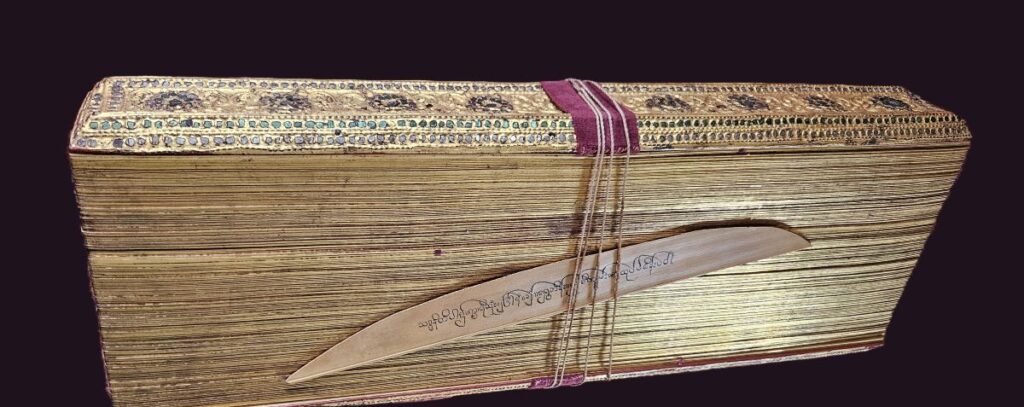
In traditional Burmese bibliography, palm-leaf manuscripts (pe-sa) are divided into five distinct categories based entirely on how their edges are colored or gilded:
Shwe-myin (or Shwe-byain): Gilded with gold leaf on all four edges.
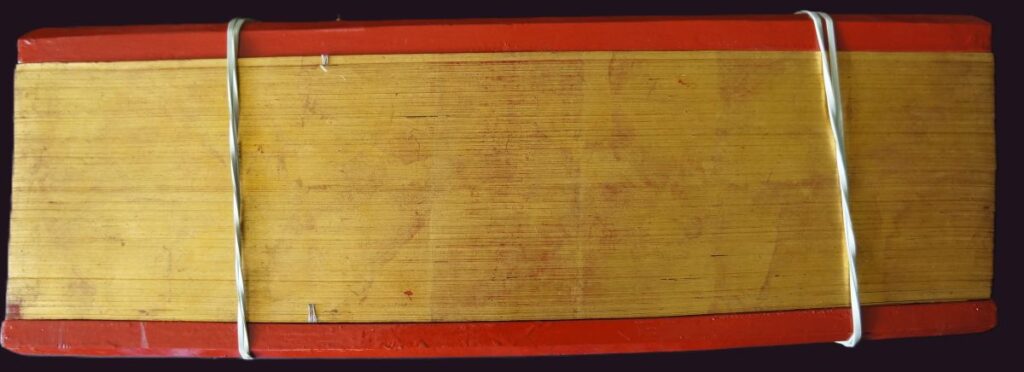
Kyan-sit: Coated with red vermilion on the edges, featuring a distinct decorative gold-gilded panel in the center (resembling the joints of a sugarcane stalk). Note: Similar to this but the decoration in gold
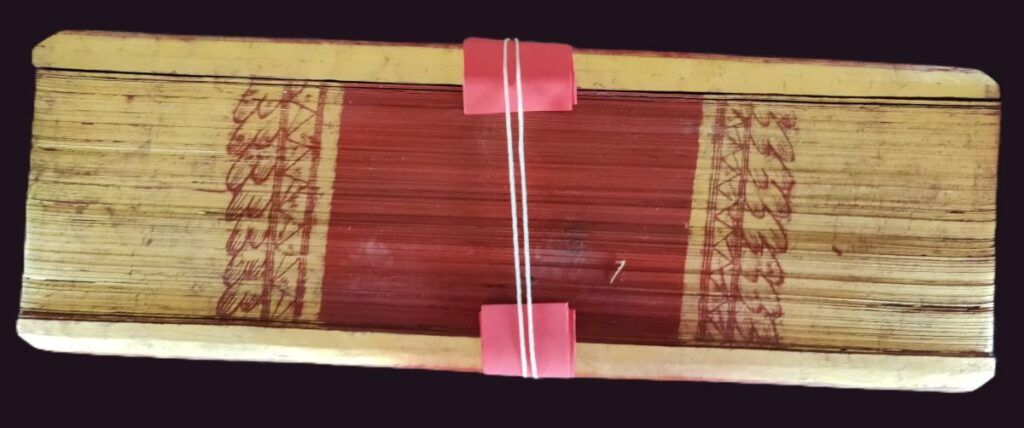
Myin-ni: Coated entirely with bright red vermilion on all four edges.
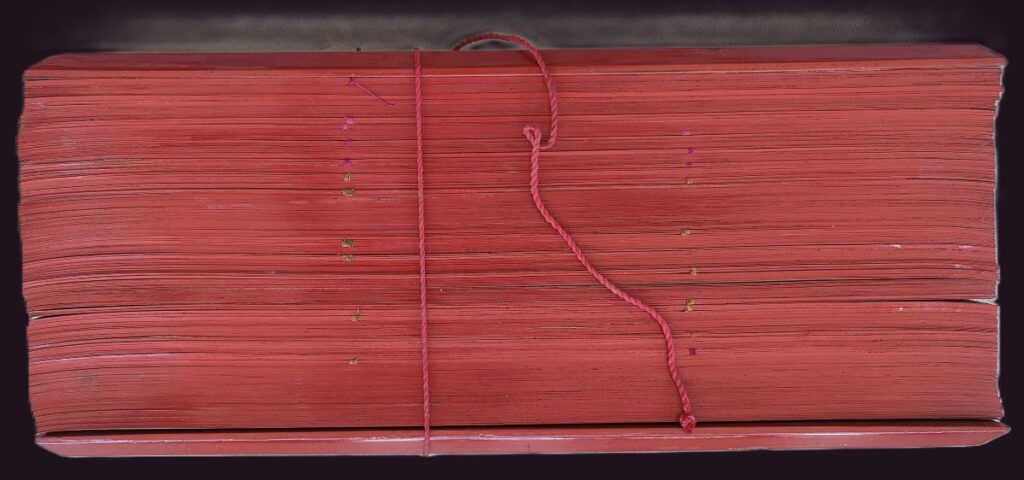
Myin-net: Finished with dark black lacquer or black vermilion on all four edges.
Pe-gyan (or Myin-phyu): Plain, raw palm leaves with uncolored, natural “white” edges.
In earlier eras, professional manuscripts were produced by monastic scribes known as Kyaung-Sa-Ye. These artisans worked at specialized writing tables measuring about two feet in height. They rested their hands on a distinctive cloth-cushioned knob attached to the table, using a pointed iron stylus to engrave their Buddhist text and intricate astrological charts directly into the raw palm leaves.
The traditional use of palm leaves as a primary writing material gradually declined following the introduction of mechanical printing presses. Printing technology was established in Yangon in 1816, spread to Innwa (Ava) in 1837, and reached Yadanabon (Mandalay) in the 1870s under the modernization efforts of King Mindon.
Type 2
Burmese Palm Leaf Horoscope – Zata
Miniature palm-leaf horoscopes are a rare and distinct class of manuscript in Myanmar. They should not be confused with traditional Shan manuscripts, which are almost exclusively parabaiks in concertina form, constructed from thick paper made from the bark of the mulberry tree.
Whether it is a palm leaf or a paper parabaik, the content of these esoteric manuscripts is heavily rooted in a blend of local folk mythology, indigenous astrology, and Theravada Buddhist teachings. They frequently feature intricate illustrations, cabalistic squares (in), grids filled with mystical characters, medicinal prescriptions, and protective mantras accompanied by scribbled marginal notes.
The writing implements used by scribes varied by medium. To write with ink on paper parabaiks, artisans used a traditional reed pen known in Burmese as a dan-yin-gauk. This pen was crafted by cutting and shaping the hollow stem of a sturdy wild grass or reed into a sharp, ink-retaining nib. For incising text into raw palm leaves, however, scribes bypassed ink entirely, utilizing a heavy iron or steel-tipped stylus to scratch the characters directly into the surface of the leaf.
Sources: Preservation and Conservation of the Ancient Myanmar Manuscripts at Universities Central Library, Yangon.