Ari Monks – Myanmar’s Misunderstood Religious Order
Ari Monks – Myanmar’s Misunderstood Religious Order
The Ari monks – Myanmar’s Misunderstood Religious Order was a dominant religious order in pre 11th century Burma (Myanmar). The appearance of the Ari monks remains shrouded in historical ambiguity, primarily because the surviving records were written by later chroniclers who sought to delegitimize the order to support the rise of Theravada Buddhism.
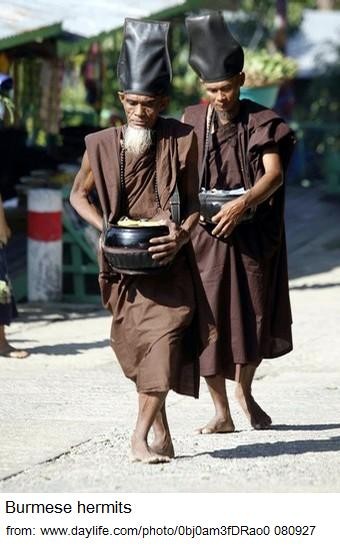
These polemical accounts often characterized the Ari as distinct from the clean-shaven, ascetic ideal, frequently describing them with beards, wearing dark brown robes, and sporting conical hats. While they are often portrayed as vigorous and well-fed to emphasize a perceived lack of discipline, these descriptions should be read as ideological tools rather than objective records.
It is more likely that their appearance reflected a regional, tantric-influenced monastic tradition, with the negative tropes such as their alleged lack of celibacy or worldly demeanor serving as a narrative justification for their systematic suppression under the Bagan dynasty.
Ari Monks – Myanmar’s Misunderstood Religious Order
Historical chronicles specifically those written from a later Theravada perspective portray the Ari monks as an aggressive, hedonistic group that rode elephants, participated in warfare, and consumed alcohol. These texts claim they held sway over 60,000 followers led by thirty masters.
During the reign of King Anawrahta (1044 – 1077), he sought to reform the state religion, he aligned himself with Shin Arahan, a monk from Thaton who practiced Theravada Buddhism. Anawrahta’s introduction of “pure” doctrine is traditionally linked to his acquisition of thirty-six sets of the Tipitaka from Thaton. To ensure the dominance of this new order, he systematically dismantled the Ari influence, forcing their followers into state-mandated military and labor roles and the leaders of the Ari were either exiled or executed.
This transition into the pure Therevada tradition was a gradual process rather than an overnight eradication and the influence of the Ari monk order persisted well past Anawrahta’s reign, up until the 13th century. Shin Arahan remained a central figure, serving four successive kings until his death at age 81. His work solidified Theravada Buddhism as the foundation of Burmese spiritual life, a status it maintains today. While the Glass Palace Chronicles serve as a primary reference for this period, historians note that these accounts reflect the biases of the era in which they were written.
Ari Monks – Myanmar’s Misunderstood Religious Order
Defamation as Doctrine: The Suppression of the Ari Order
The “Depraved” Ari Narrative: The characterization of the Ari as drunkards and warriors is heavily contested by modern historians. It is widely viewed as polemical writing designed by later chroniclers to legitimize the transition to Theravada Buddhism by casting the previous order as corrupt.
The Thaton Conquest: The narrative that Anawrahta attacked Thaton specifically to retrieve the Tipitaka is a cornerstone of Burmese national identity. However, modern scholars suggest the religious and political shifts of this period were likely more complex and gradual than the simplified “conquest for scriptures” narrative suggests.
The “Purest” Form: The claim that Myanmar practices the “purest” form of Theravada Buddhism is a matter of tradition and reputation rather than an objective academic measurement. It reflects the high status of the monastic Sangha and the strict adherence to the Vinaya (monastic code) within the country.
Shin Arahan’s Legacy: Shin Arahan is a historically significant figure, but his presence and actions are often mythologized in the Glass Palace Chronicles. While he was undoubtedly pivotal in the spread of Theravada, specific anecdotes about his life should be read as traditional hagiography rather than strict biography.
Information source: Maung Htin Aung’s “Folk Elements in Burmese Buddhism” (1981), published by the Religious Affairs Department Press in Rangoon, utilizes various historical royal Burmese chronicles, pagoda legends and oral traditions to examine the lives and practices of the Ari monks.
The Ari Monks: Heresy or Religious Reform
Traditional Burmese historical narratives posit that Buddhism, introduced via Ashoka’s missions, maintained a significant presence in regions such as Thaton, Prome, and Pagan until the early sixth century. These accounts suggest that a subsequent religious decline was precipitated by two primary factors: a scarcity of scriptural texts and the ascendancy of the Ari, a monastic order whose practices were increasingly favoured by the royal court. Within this chronicle framework, the Ari monks are depicted as a heterodox sect whose influence reached its zenith during the reign of Nyaung-u Sawrahan (931–964 CE).
Modern scholarship increasingly interprets these accounts as polemical reconstructions, narratives employed by later historians to contrast ‘debased’ indigenous traditions with the eventual triumph of state-sanctioned Theravada orthodoxy.
The Ari Monk Order: Why the Chronicles Labeled them Heretics
Historical accounts in the Burmese chronicles frequently portray the Ari monks as a depraved sect, accusing them of interpreting scriptures independently and teaching that sin could be absolved through specific ritual recitations. These characterizations are largely considered reflections of the intense Theravada orthodoxy enforced during King Anawrahta’s reign, rather than objective theological descriptions. Modern analysis suggests these practices may instead reflect the influence of esoteric or Mahayana traditions, emphasizing the spirit of scriptures over literal interpretations and the efficacy of faith-based devotion. The term ‘Ari’ is etymologically rooted in the Pali Ariya, meaning ‘Noble One,’ a designation that supports the conclusion that the Ari were indeed a form of Buddhist clergy, albeit one that adhered to traditions superseded by the later Pagan-era Theravada reforms.
The Burmese chronicles frequently portray the Ari monks as indulgent consumers of toddy-wine. While this may reflect a genuine ritual practice given the central role of alcohol in offerings to Nat spirits and the Ari’s known involvement in such traditions it also mirrors a long-standing historical prejudice against non-Theravada lineages. This tension mirrors ancient debates within the early Sangha regarding the consumption of unfermented or ‘sweet’ wines, which some unorthodox schools argued were non-intoxicating and therefore permissible for monastics. By framing the Ari as violators of these precepts, later chroniclers were likely invoking a classic monastic polemic to discredit their legitimacy.