Serpent Worship – Naga Myths & Legends
Serpent Worship – Naga Myths & Legends
Long before Serpent Worship – Naga Myths & Legends became immortalized as multi-headed serpent deities in Hindu and Buddhist mythology, ancient Indian metaphysics formed the foundation of philosophical thinking. It was referred to as Darshana, literally meaning “showing a way” or “seeing reality.”
During the sixth century BCE, Jainism and Buddhism emerged with new philosophical perspectives that reshaped religious life across India. As these traditions grew, they absorbed existing folk beliefs and localized nature cults, including widespread serpent worship, incorporating their sacred symbols and devotees into Buddhist and Jain folklore.
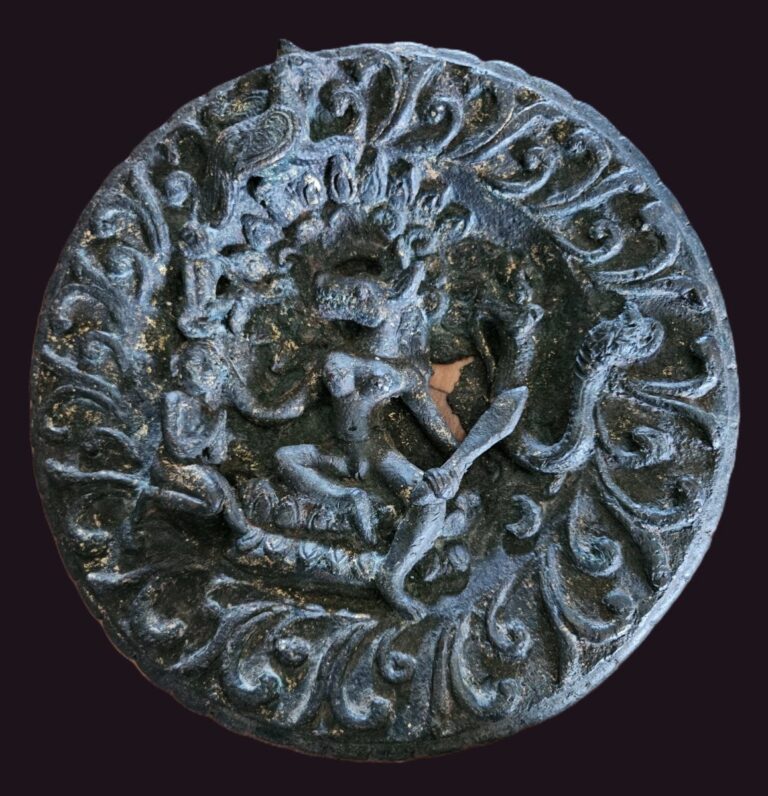
Across Northeast India, the boundary between human life and divine serpent power is blurry; a prominent example of this connection appears in neighbouring Manipur through the Meitei legend of Pakhangba. Both a historical first ruler and an ancient cosmic deity, Pakhangba possessed the power to shape-shift between a human king and a divine serpent-dragon. His sacred emblem, the Papha is a coiled serpent biting its own tail, binding divine protection directly to human political power and clan origins.
This intermingling of human lives and snake spirits is not isolated to the Manipur valley. Throughout the surrounding hills, native stories consistently weave serpents into local cosmology, setting a rich backdrop for understanding regional beliefs, sacred symbols, and the reverence paid to the cobra.
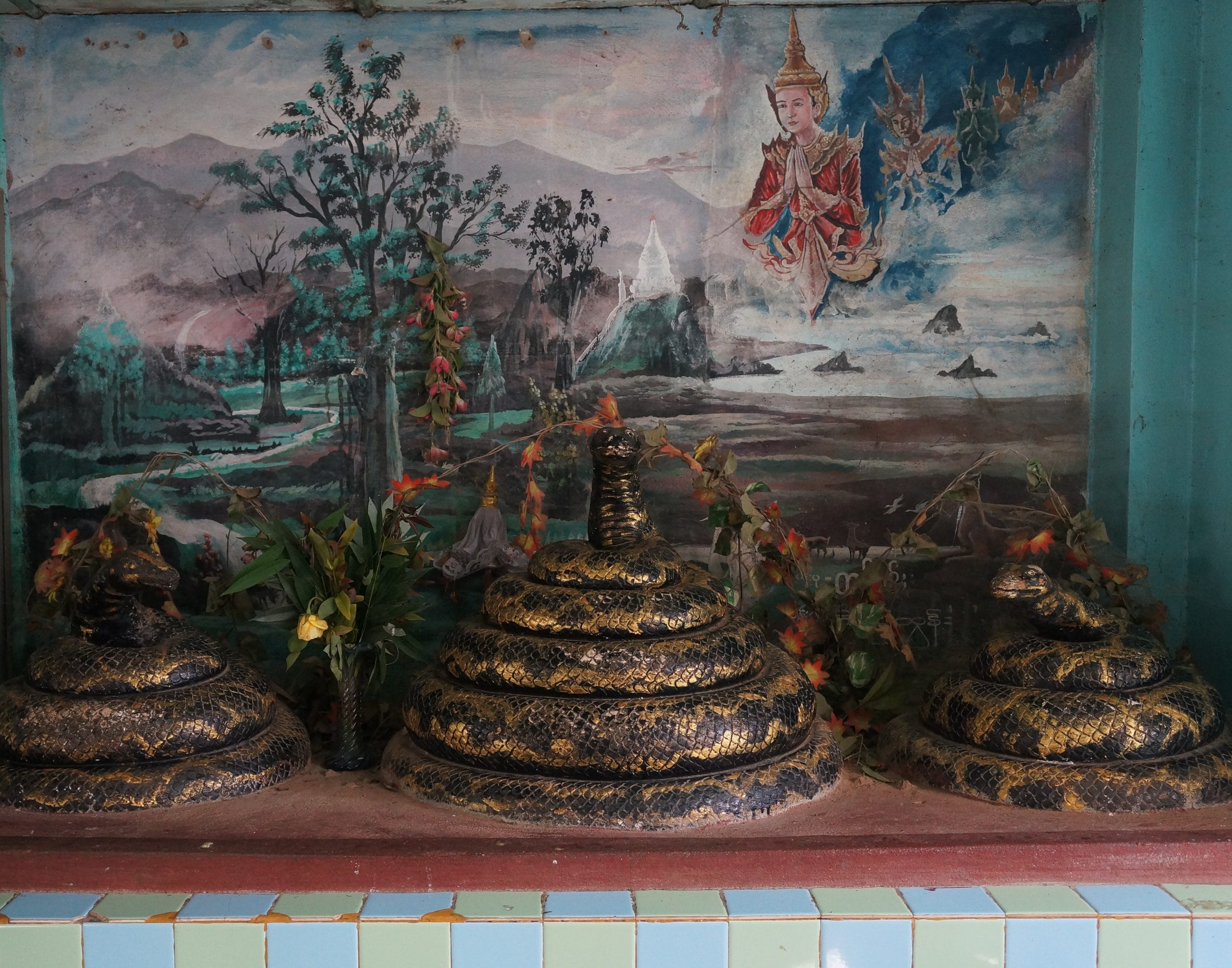
In coastal Karnataka, the tradition takes a direct, physical form. Tuluva communities protect sacred groves known as Nagabanas, which host carved stone cobras. Harming a snake violates a firm cultural rule and requires a specific cleansing ritual. This remains an active daily practice rather than an historical artifact.
These regional customs point to a broader understanding which shows that respect for the snake or dragon like serpent did not originate in Sanskrit texts, instead Vedic traditions gradually adopted serpent reverence from older Adivasi belief systems, where the cobra, along with animals like the elephant and peacock, held sacred value long before those stories were written down.
Thus, the Nagas played a vital role in the history, evolution, myth, and legend in both Hinduism and Buddhism as semi-devatas and are worshiped alongside the foremost gods such as Vishnu, Shiva, and Buddha.
Snake worship in Buddhist Southeast Asia
From 2000 B.C. onward, Tibeto-Burman and Mon-Khmer speaking groups of Mongolian stock migrated from northwestern China down the Yangtze, Yellow, Chindwin, Irrawaddy, and Brahmaputra rivers. These groups later known by distinct regional names, including the Kirata, Garo, Khasi, Kuki, Naga, Meitei, and Ahom settled across the river valleys and mountain ranges of Assam, Manipur, and eastern Bengal. Related migrants, such as the Burmans, Arakanese, Shans, and Chins, settled in Burma.
As Buddhism grew, it drew on existing beliefs and traditions related to the naga and integrated them into some events in the life events of the Buddha. In early Buddhist art the serpent is depicted as a cobralike creature with the male snake kings (Nāgarājas) represented by a wide fan of cobra hoods behind the head of the Buddha, while female Nāgas (Nāginīs) are seen with a single hood.
Early Pali texts even use Naga as an honorific for the Buddha himself and for fully enlightened monks, using the word to describe immense strength and self-control. Canonical stories regularly picture Nagas drawn to the Buddha’s teaching, looking to curb their tempers and hoping for a human rebirth so they could pursue liberation.
In Buddhist cosmology, being born a Naga comes with a heavy karmic debt. Stuck in the animal realm and subject to sudden fits of anger, a Naga was unable to join the monastic order or reach full enlightenment, yet their devotion was obvious. Stories tell of Naga kings feeling the vibration of the Buddha’s steps through the earth, knowing instantly that an enlightened being was nearby. In one famous account from Sri Lanka, the Buddha even steps in to break up a civil war between two rival Naga kings who were at each other’s throats over a jewel-encrusted throne, convincing both sides to make peace.
The bond between the Buddha and the Nagas runs deep through Mahayana history also. In the second century CE, the philosopher Nagarjuna is said to have journeyed to the underwater realm of the Nagarajus to retrieve the Prajnaparamita Sutras the foundational scriptures of the Second “Turning of the Wheel”, which the serpent kings had safeguarded until the world was ready. Whether depicted as formidable adversaries humbled by the Buddha’s compassion or as staunch protectors of his teachings, the Naga remains one of the most enduring symbols of transformation and guardianship in sacred art.
Following the Buddha’s Parinirvana (death), Nāgas claimed a share of his holy relics, establishing themselves as dedicated guardians of the sacred mounds. To atone for past misdeeds, they invited monks and sages to dwell near their shrines to ensure that they remained protected. This protective role migrated directly into temple architecture across South and Southeast Asia, hand-carved Nāgas cascade down temple stairways, balustrades, and entrance archways as eternal guardians.
Among the many episodes involving nagas in Buddhist literature, one of the most striking appears early in the Vinaya Pitaka, in the section known as the Mahavagga. Shortly after his awakening, the Buddha travels to Uruvela and asks Kassapa, the eldest of three ascetic brothers who tend a sacred fire, for permission to spend the night in the fire-hut. Kassapa warns him it’s guarded by a fierce, venomous naga, but the Buddha insists.
The serpent attacked that night, breathing smoke and fire, and the Buddha subdued it not through force but through his own power, the text is specific that he leaves “intact the skin, hide, flesh, ligaments, bones and marrow” of the naga, conquering its fire with his own rather than harming it. By morning, the serpent is coiled peacefully in his alms bowl. Kassapa is astonished, though the text notes he still doesn’t regard the Buddha as truly holy, that recognition comes later, after more miracles bring him and his many followers into the fold.