
Burmese Paysa – Decorative Buddhist Manuscript
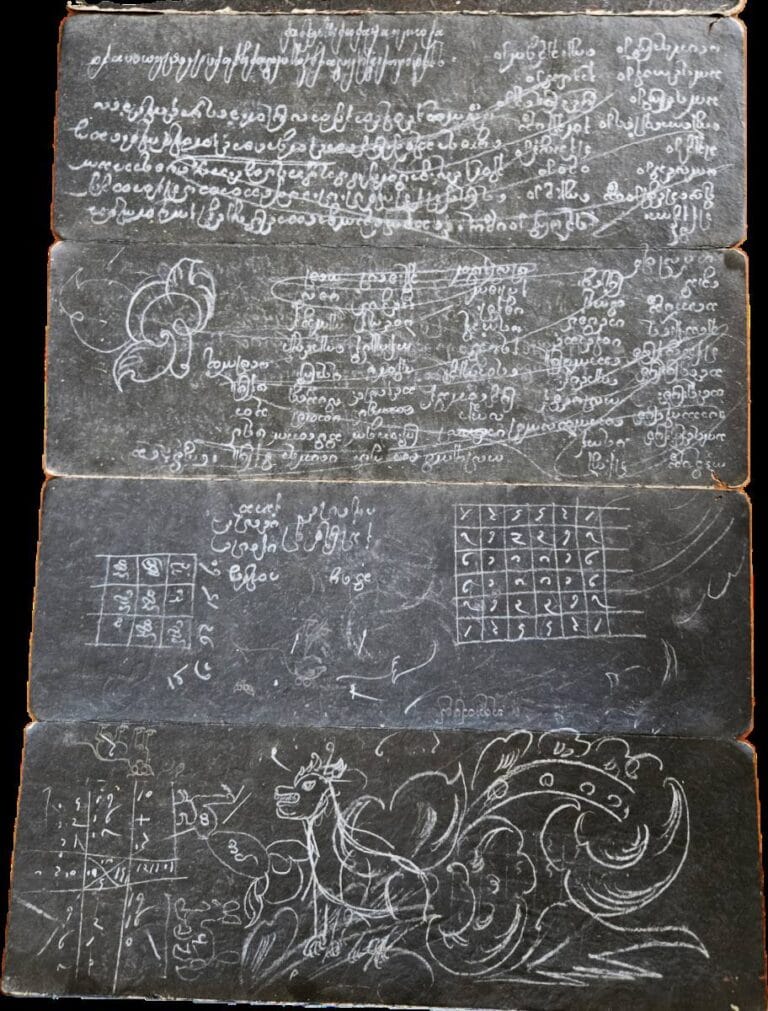
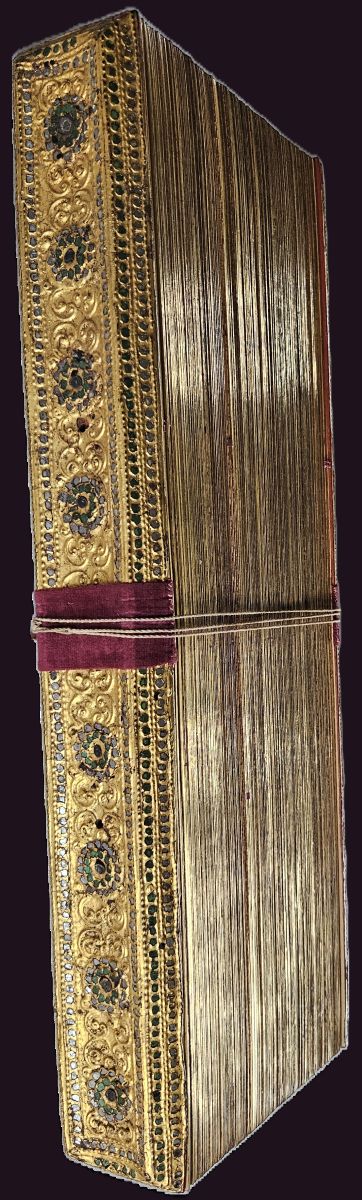
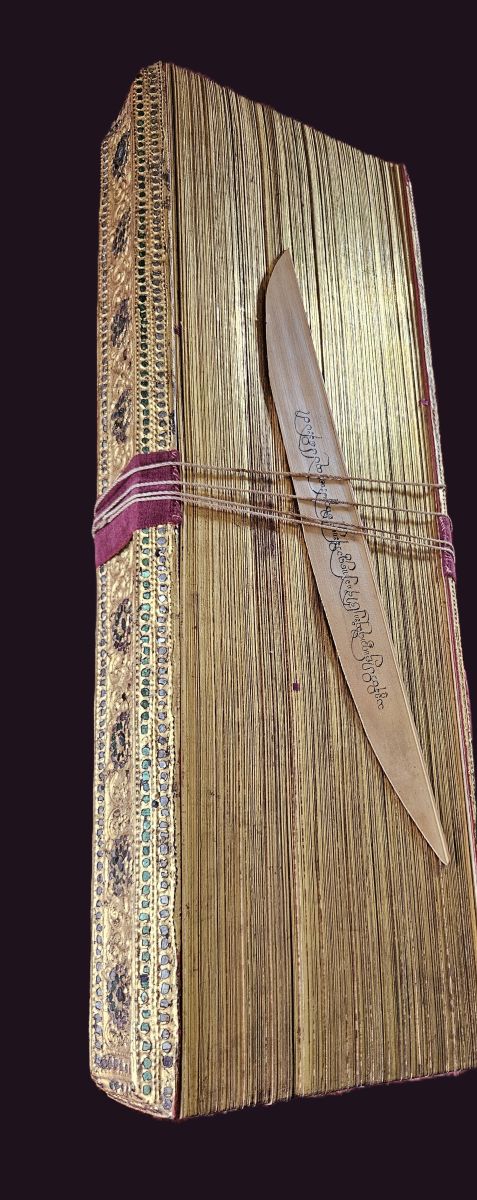
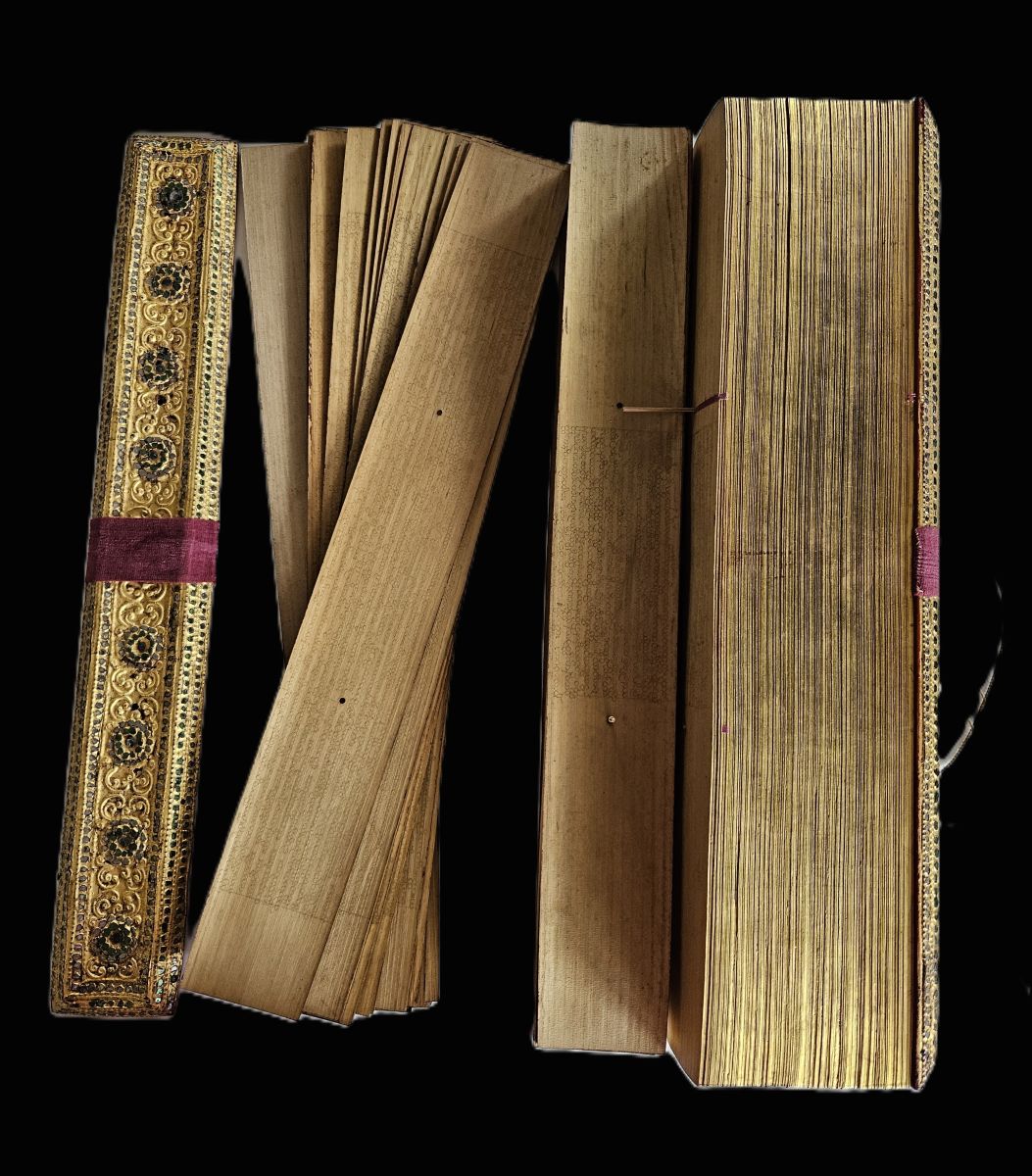
Palm Leaf Burmese Paysa – decorative Buddhist Manuscript features cover embellished with gold leaf, glass mosaics, and intricate thayo lacquer-work. The set remains in its original cloth wrapping and is secured by a hand-woven sasigyo (binding ribbon) featuring Burmese script. It includes a traditional palm-leaf page turner used by monks for recitation.
Like most religions of the world, Buddhist monks depend on written texts for their use as well as the Sangha. The use of palm-leaves as writing material in Myanmar developed with the introduction of Buddhism from India and Sri Lanka.
It is known that the Pyu people (4th – 9th Century) of Myanmar used palm-leaves for writing Buddhist scriptures and although there are no actual surviving palm leaves surviving, gold plates in the shape of palm-leaves with inscriptions have been found in Sriksetra, the ancient city near Pyay (Prome).
SPECIFICATIONS:
- AGE: – Burmese Era 1321 – 1959 CE Gregorian Calendar
- LENGTH: – 50cm
- WIDTH: – 7cm
- HEIGHT: – 18cm
- WEIGHT: 2.55kg
- #374
Burmese Paysa – Decorative Buddhist Manuscript
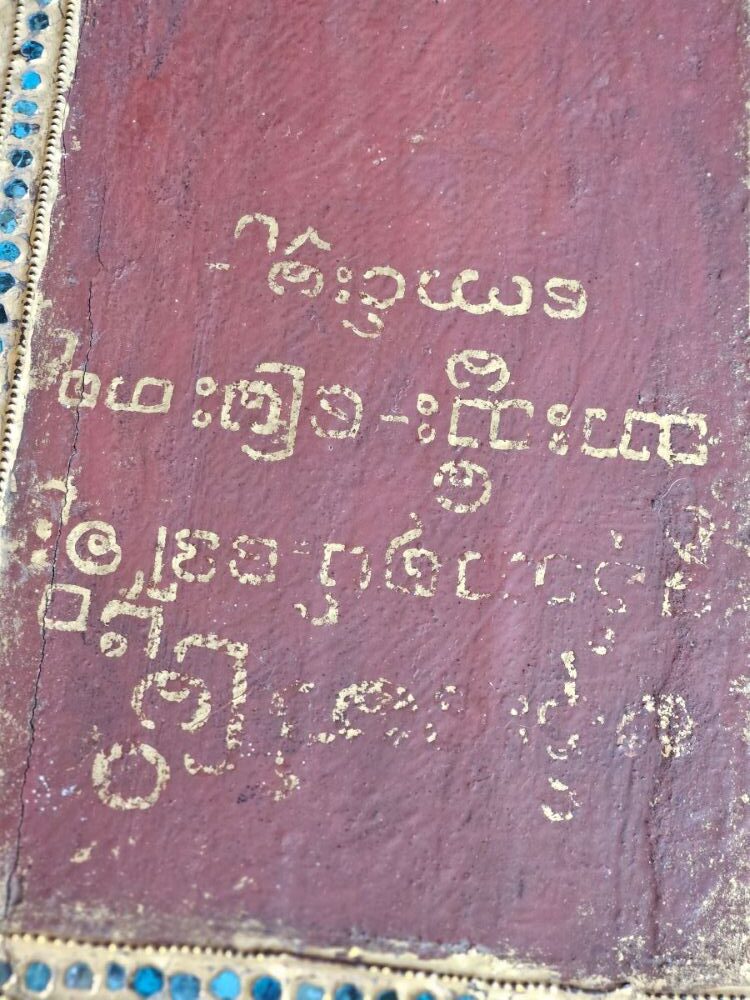
Translation of Burmese script on the Wooden cover:
Date: The 5th day of the waxing moon of Waso, in the Burmese Era (BE) 1321.
Note: This corresponds to approximately July 1959 in the Gregorian calendar.
Location: Bhamo City (ဗန်းမော်မြို့), Khun Thar Ward (ခွန်သာရပ်).
Donors: Daw Po + U Saw Khar and their group of children and grandchildren (သားမြေးတစ်စု).
Purpose: Khaung-hmu (ကောင်းမှု), which translates to “Meritorious Deed” or “Offering.”
Contextual Significance
The style of the lettering and the gilded, mirrored background (known as hman-zi shwe-cha) suggest this Paysa is a dedication to a monastery. In Burmese culture, it is standard practice to record the donor’s family and home village to ensure the “sharing of merit” associated with the gift.
The Bhamo area is located in Kachin State, it was historically a significant trading hub. This palm leaf Burmese Paysa – Decorative Buddhist Manuscript with the names of the donors suggest that they were a family of some local standing.
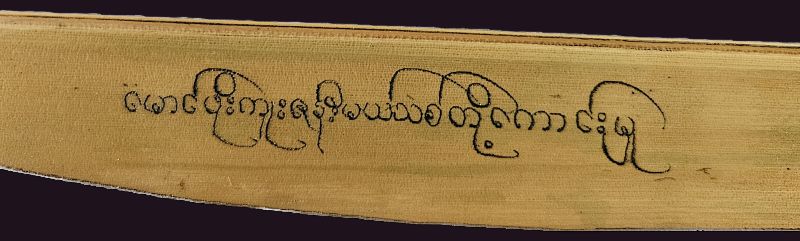
The Script on the Page turner: – Sampayutta Paccaya Tayar Taw, This refers to the Sampayutta Paccaya, which is one of the 24 conditional relations (Paccaya) described in the Patthana, the final book of the Abhidhamma Pitaka. In Buddhist philosophy, Sampayutta refers to “association” or things that arise and cease together (such as consciousness and its mental factors
Labels like this were often placed on the outer “page turner” or the edges of the bundle to help a monk or scholar identify the specific philosophical text within a larger collection of manuscripts.
There are five kinds of palm-leaf manuscripts found in Myanmar. They are differentiated by the colouring or gilding on the edges of the palm-leaf manuscript and those that have no colouring or gilding.
The five kinds of palm-leaf manuscripts are:
1. Shwe-myin or Shwe-byain
2. Kyan-sit
3. Myin-ni
4. Myin-net
5. Pe-gyan, or Myin Phyu
In Myanmar it is generally believed that the life span of the palm-leaf manuscript is a thousand years if the conditions are right, but there is only one known palm leaf manuscript older than 350 year, and this is housed at the University Central Library in Yangon.
The oldest library extant in Myanmar is in Bagan (old name Pagan), built by King Anawratha (1204-1077 AD), the first Myanmar King who embraced and converted to Buddhism.
There appear to be no other record of a palm-leaf manuscript surviving for more than 350 years in Myanmar, due mainly because of the harsh tropical climate and improper storage, insect and rodent damage, fires, fungus and human destruction. The use of palm-leaves as writing material gradually ended with the introduction of printing presses to Yangon in 1816, Innwa (Ava) in 1837 and to Yadanabon (Mandalay) in the1870’s.
In times gone by professional scribes were known as Kyaung-Sa-Ye (monastic scribe). The scribes used a writing table about two feet in height with a cloth cushion knob on the writing table on which to rest the hand. The letters were engraved on the palm-leaves by using a pointed iron or stylus pen.
Information source:
A paper written by Dr. Thaw Kaung “Unearthed Story of Myanmar History: Preserving Myanmar Manuscripts“. Dr. Kaung was born in 1937 and was a university librarian, historian, and leading authority in Asian library studies, specializing in the preservation and archival of traditional documents, including palm leaf manuscripts.