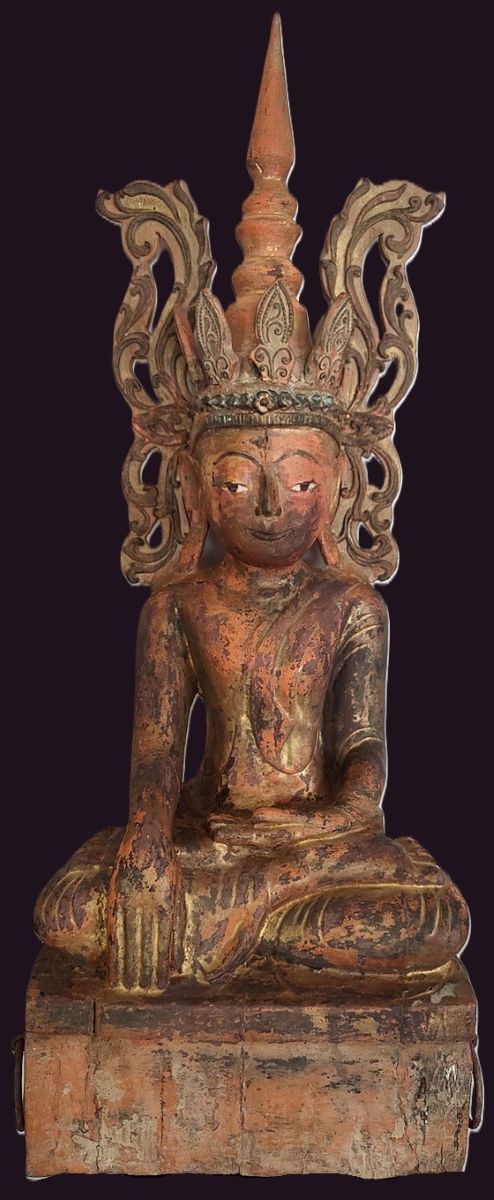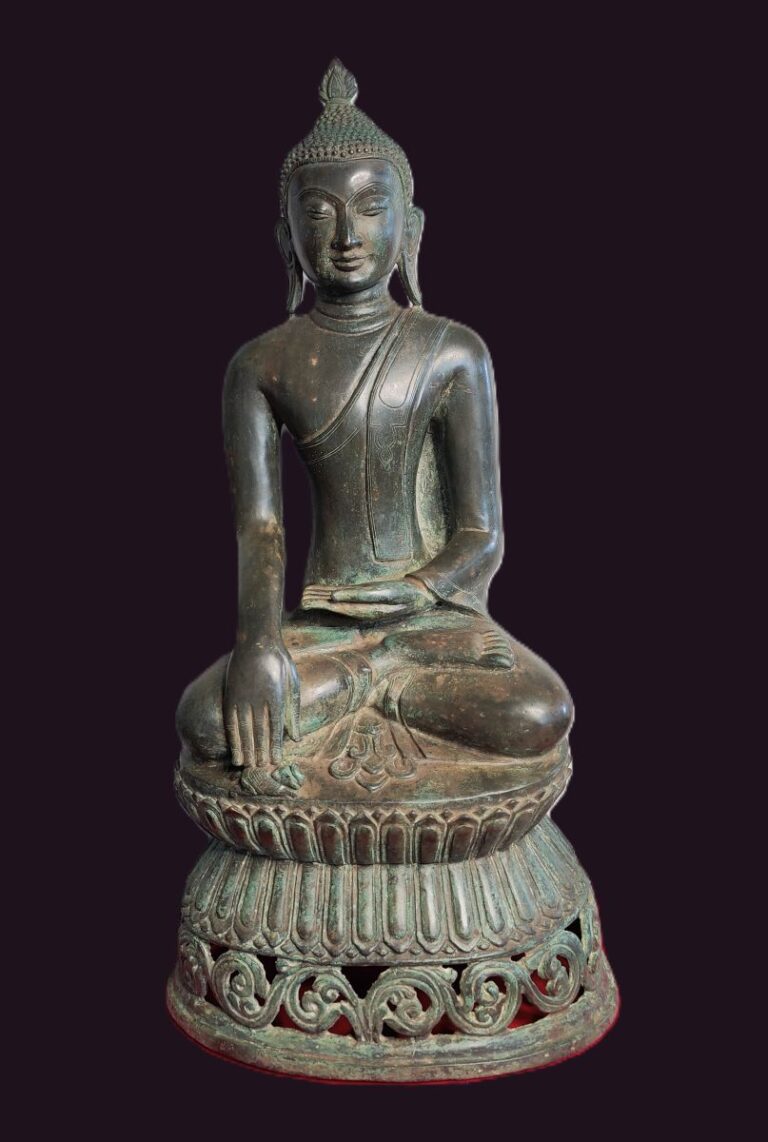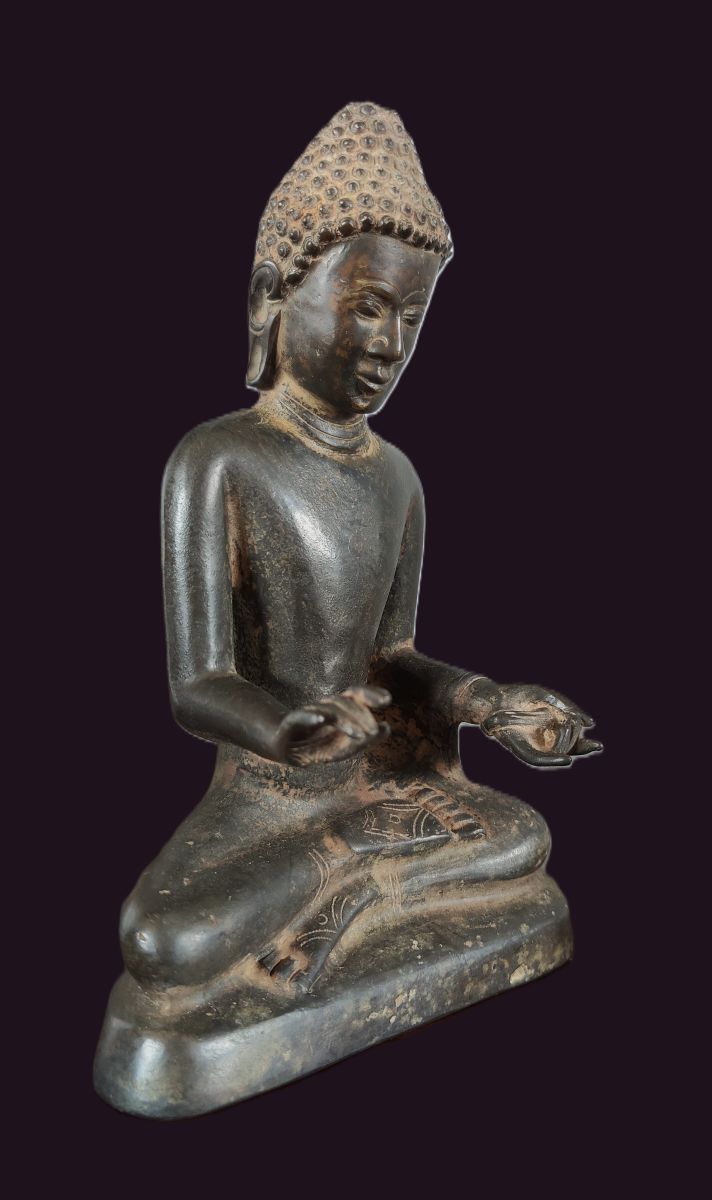
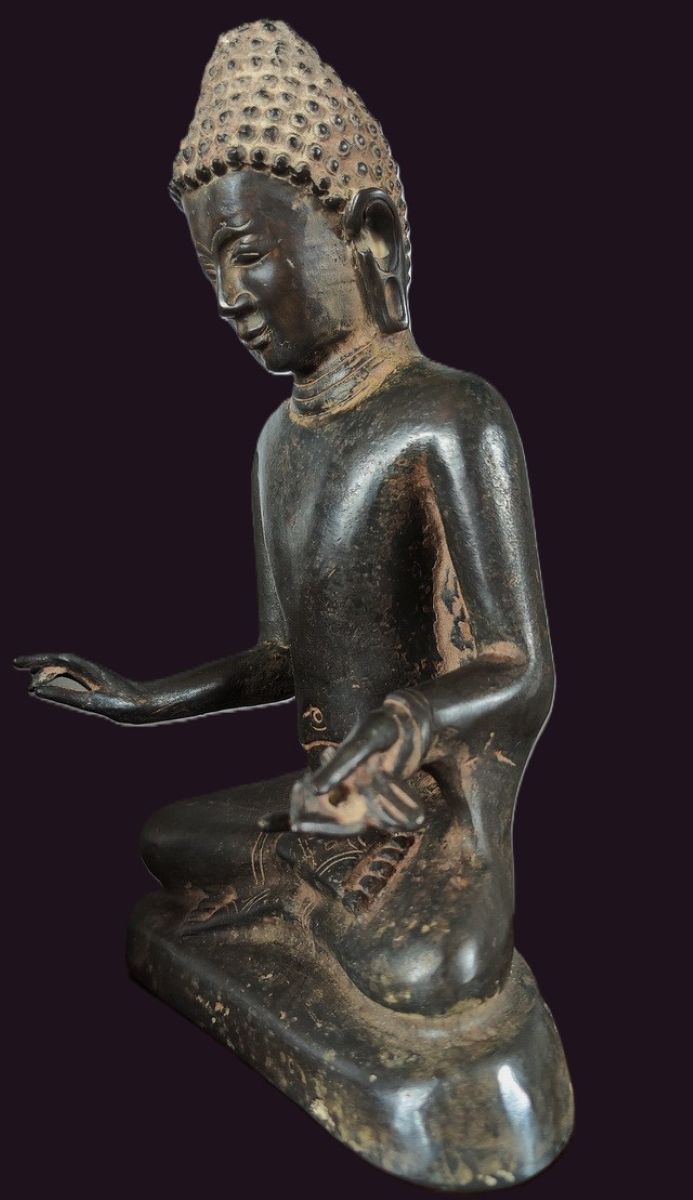


Rare Burmese Bronze Mon-Pyu Buddha statue
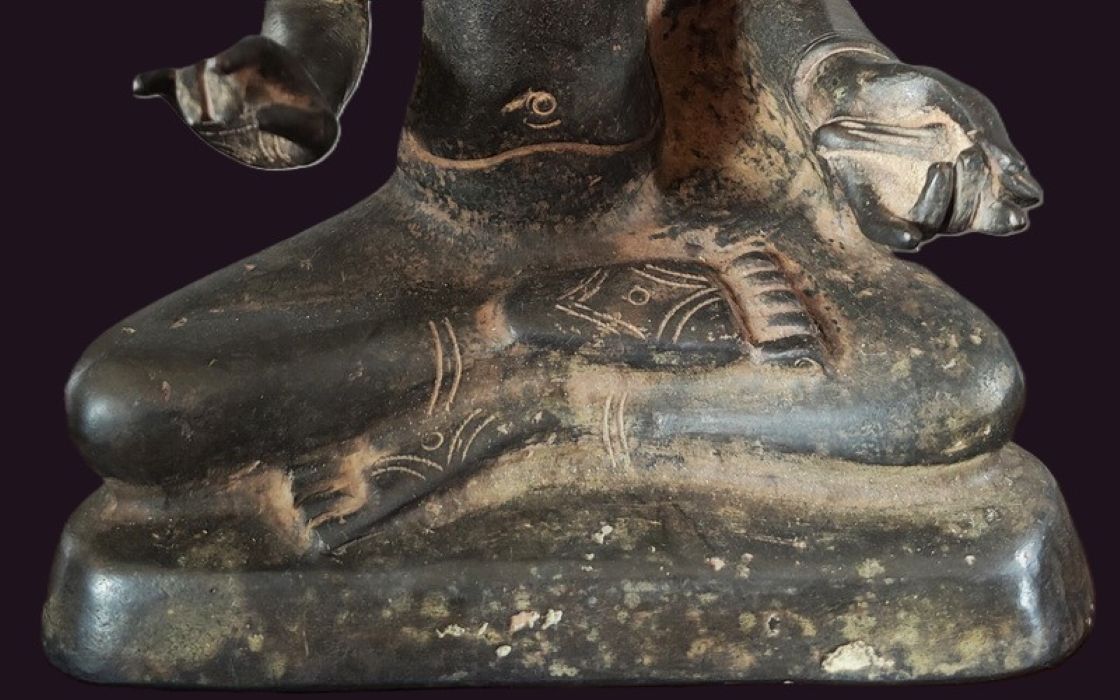
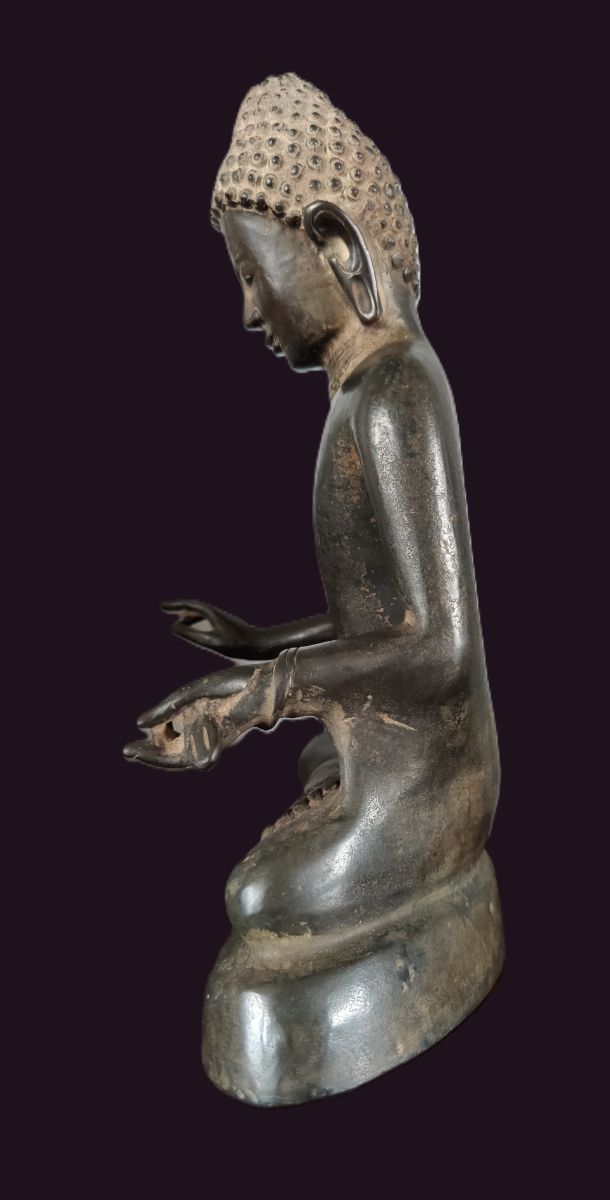
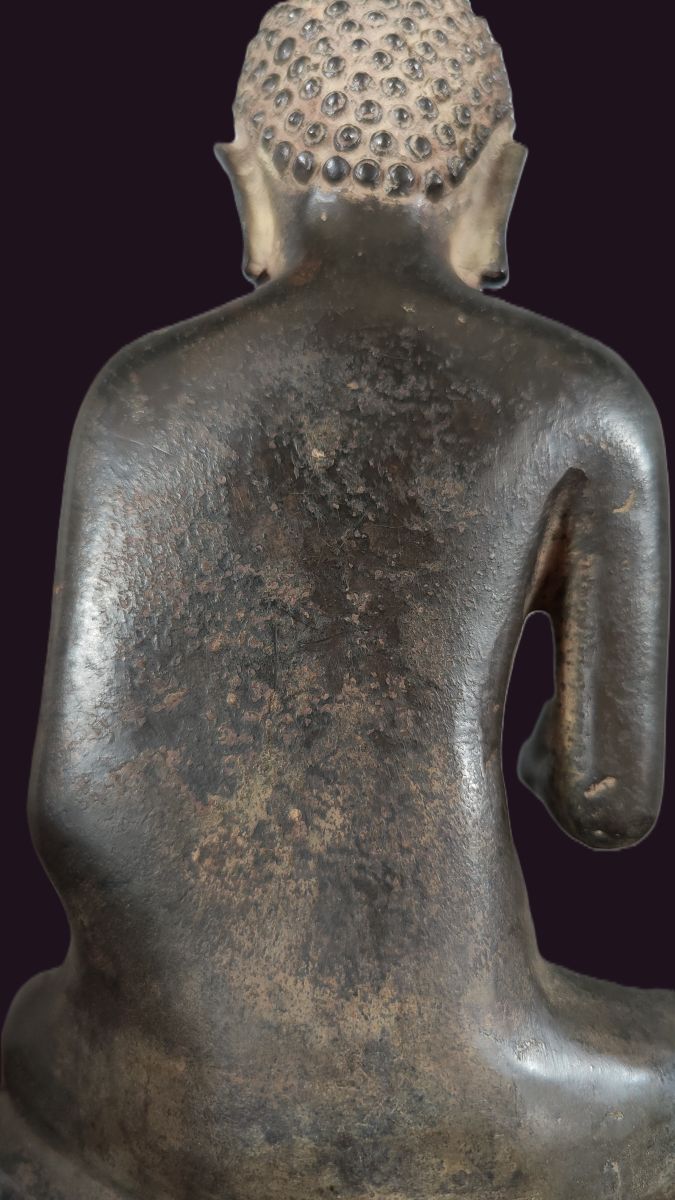
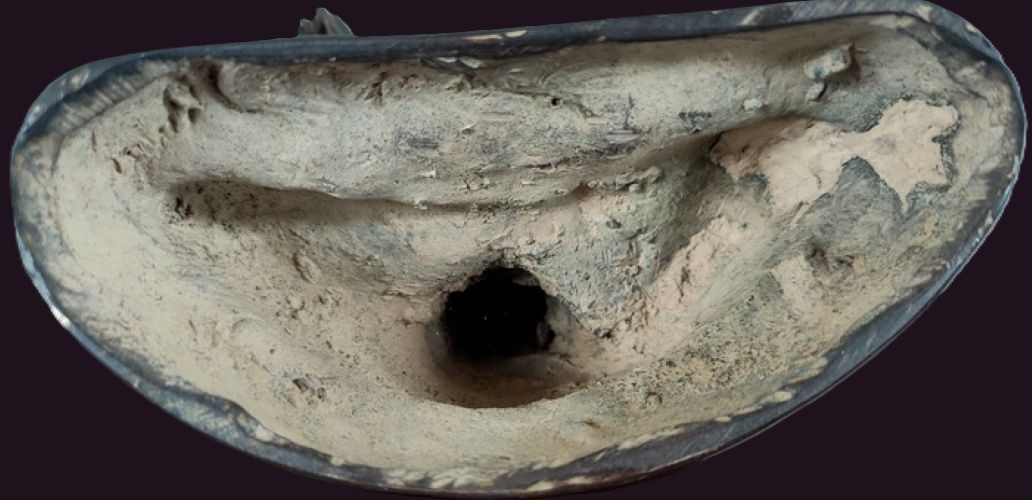
A Rare Burmese Bronze Mon-Pyu Buddha statue with the right hand raised in karana mudra to ward off evil, sickness, and negative energy. The left hand rests palm-upward, holding a distinct fold of the monastic robe that drapes securely across the wrist, palm to fall between the thumb and index finger.
The Pyu culture comprised a network of urbanised city‑states in Upper Burma, including Sri Ksetra, Halin, and Beikthano. Flourishing from around the 2nd century BCE until the early 10th century CE, the Mon and Pyu represent the earliest historically documented Buddhist civilisation in mainland Southeast Asia.
This group of small city-states was established by Tibeto-Burman speaking Pyu populations migrating south from modern Yunnan. Excavations have partially uncovered five major walled cities and several smaller towns. Today, only ancient walls, citadels, and a few Buddhist stupas remain standing to represent this once vibrant and active civilization.
SPECIFICATIONS:
Rare Burmese Bronze Mon-Pyu Buddha statue
- HEIGHT: – 26cm
- WIDTH: – 17cm
- DEPTH: – 7.5cm (excluding protruding arms and hands)
- #19
- WEIGHT: 2.95 kg.
Rare Burmese Bronze Mon-Pyu Buddha statue
Archaeological excavations reveal that the Mon and Pyu people maintained sophisticated burial practices, managed complex waterways for agriculture, and operated dedicated manufacturing sites. Excavated artifacts include glass and gold beads, coins, and small bronze objects, alongside utilitarian storage and cooking vessels. Notably, excavations at Sri Ksetra uncovered a very rare gold Buddhist manuscript inscribed with teachings from the Pali Canon.
Maritime and overland trade with India significantly shaped the Mon and Pyu civilization, leading to the adoption of Buddhism alongside Indian political structures and architectural styles. The Pyu calendar, derived from Buddhist antecedents, was later adopted as the standard Burmese calendar. Similarly, scholars trace the Pyu script back to the Indian Brahmi system, viewing it as the direct precursor to the script used for the Burmese language. The spoken Pyu language ultimately faded into disuse around the twelfth century.
The Nanzhao Raids and Pyu Collapse (832 CE)
The destruction of the early independent kingdoms began with successive invasions by the Nanzhao Kingdom of southern China. In 832 CE, Nanzhao forces systematically attacked the major Pyu urban centres, focusing heavily on the northern stronghold of Halin and the southern capital of Sri Ksetra. Chinese Tang Dynasty records note that Nanzhao warriors plundered these cities and forced more than 3,000 Pyu citizens into captivity in Yunnan to work as artisans and labourers. This devastating raid broke the structural cohesion of the thousand-year-old Pyu civilisation and created a critical political vacuum.
The Rise of Pagan and the Fall of Thaton (1057 CE)
Moving south alongside or shortly after the Nanzhao campaigns, the Burman people (Mranma) filled this vacuum by establishing a garrison town at Pagan. Over the next three hundred years, the surviving Pyu population was gradually absorbed into the expanding Pagan Kingdom. While the Pyu vanished as an independent political power, the Mon kingdom of Thaton in Lower Burma remained sovereign until 1057, when King Anawrahta of Pagan launched an invasion that successfully conquered the Mon capital.
Evolution of Buddhist Iconography
This consolidated Pagan era marked the birth of a distinct Burmese style of Buddhist iconography. As political power shifted through various turbulent dynasties, the costume and facial features of Burmese Buddha statues changed continuously, eventually evolving into the Mandalay style that predominates today.
Excerpt from Charlotte Galloway’s paper – “Ways of seeing a Pyu, Mon and Dvaravati Artistic Continuum”
Pyu, Mon and Dvravati are terms used in the west to describe cultural groups that developed city states in Upper and Lower Burma, and in central Thailand during the first millennium CE. The Pyu, also known in historical records as the P‘iao, Pru, Chu-po, T‘u-lo-chu and Tircel (Luce 1960:309) were the dominant people in Upper Burma. Pyu settlements were centred around the tributaries of Burma‘s great rivers – the Irrawaddy, Sittang, Chindwin, Salween and Mu – with major city sites at Beikthano, Halin, Maingmaw and Sriksetra.
The Pyu are associated with the earliest Buddhist artefacts in Burma. Their artistic repertoire was varied and included stone sculpture in relief as well as in the round, terracotta sculptures, votives and relief tiles, and metalwork. (Guy 1999:14-28)
During the ninth century for reasons still unclear the Pyu ceased being a significant regional polity. The last contemporaneous mention of the Pyu is found at Pagan in the Rajakumar inscription of 1113 CE after which time Pyu script and the Pyu disappear from record (Luce 1969:73-75, 96).