The loss of the Mandalay Palace Manuscripts in 1885
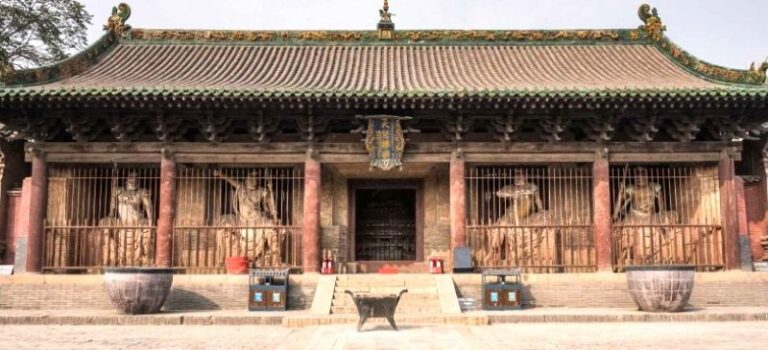
The loss of the Mandalay Palace manuscripts in 1885 cost Myanmar (Burma) and Southeast Asia a central piece of its written heritage. When British forces invaded Upper Burma in November 1885, they dethroned King Thibaw (1878 – 1885) and immediately exiled him to Ratnagiri, an isolated coastal town in western India. As troops occupied the royal residence, chaos erupted, and widespread looting and fires swept through the royal archives. Thousands of administrative records, court chronicles, and gilded palm-leaf manuscripts were burned or scattered across the palace grounds. British officers and institutions carried off a small fraction for overseas collections, but the destruction of the main library erased vast portions of the region’s historical record.
Burmese scholar U Tin – Witness to the destruction
Burmese scholar U Tin, later known as Pagan Wundauk U Tin witnessed the destruction firsthand when British forces occupied Mandalay Palace. Palm-leaf manuscripts and paper parabaik were scattered across the grounds, with troops sweeping some into heaps to burn as refuse. Amid the chaos, U Tin teamed up with a palace servant named U Lwin to salvage what they could. Working frantically across the palace complex and the Hluttaw, they rescued over forty bullock-cart loads of surviving documents, which were then shipped to the Chief Commissioner’s office in Rangoon. Drawing on this massive recovery of more than 21,000 parabaik, U Tin later authored his monumental study on Konbaung royal administration.
A significant portion of the royal library was saved through the efforts of James Colbeck, an S.P.G a missionary who returned to Mandalay in 1885 as chaplain to the British forces and was put in charge of cataloguing the palace collection, Colbeck interceded when official prize agents operating under a Prize Committee appointed by the British military command began selling off the manuscripts for military plunder. Colbeck persuaded the British commander, General Prendergast, to halt the sales and instead preserve the books for university and library collections in Britain. As Colbeck noted in a letter to his former teacher, Dr. Reinhold Rost of the India Office Library, he urged the general to make “a graceful act on the part of the army” rather than letting the collection be destroyed or pieced out for quick cash.
Danish Indologist Viggo Fausbøll assessed the scale of the lost royal collection in his 1896 catalogue of the Mandalay manuscripts for the India Office. Based on royal shelf numbers, Fausbøll estimated that the palace library originally held around 1,150 manuscript volumes. However, he reported that over 800 of those works were missing and that they were highly likely to have been looted during the 1885 British military occupation or lost during their chaotic transfer to London.
Information source: Pali Text Society
After the Fall of the Monarchy in 1885
After the monarchy fell, the surviving royal manuscripts were scattered across several collections instead of being kept together. Key sets ended up in the India Office Library in London and Rangoon’s Bernard Free Library (now part of the National Library of Myanmar). The Mandalay texts in London are especially valuable for their detailed colophons endnotes recording royal patrons, scribal assignments, and court scholars that reveal how the late Konbaung court actually functioned.
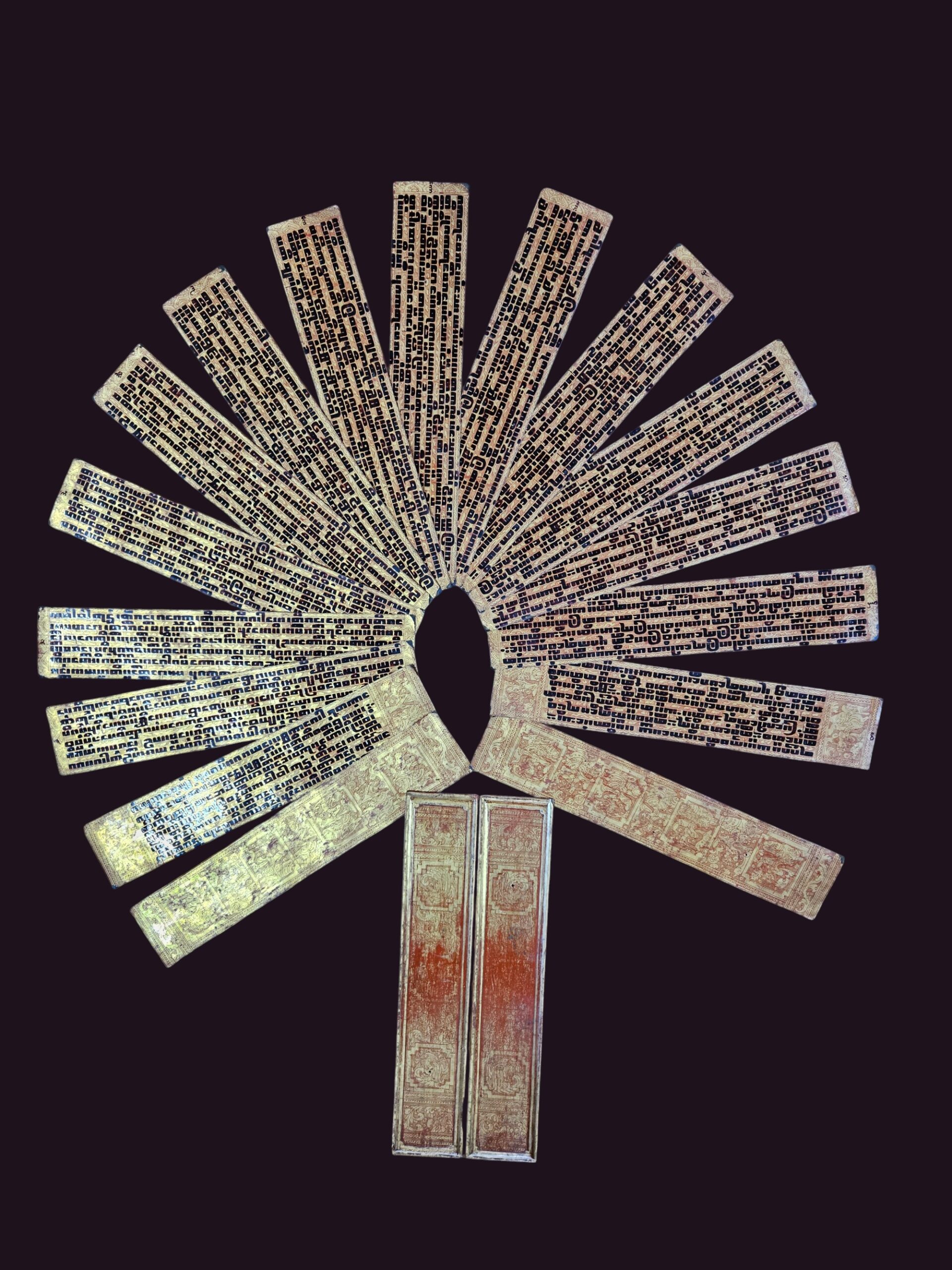
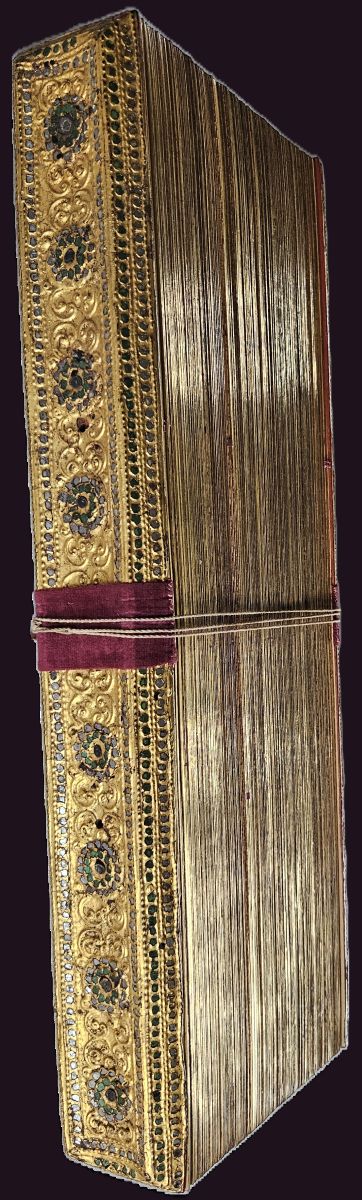
Among these manuscripts were the beautiful gilded kammavaca and the pay sa (palm leaf manuscripts used in monastic rituals). While the routine copies were incised on plain palm leaves the more formal ritual editions (kammavaca) were rendered in thick, square “tamarind-seed” script using a stiffened support to form leaves/folios made from as variety of mediums such as discarded monastic robes, bone ash and lacquer. Scribes and artisans adorned the protective wooden coverings with elaborate borders, gold leaf, vermilion, decorative floral patterns using thayo lacquer, glass mosaics and mother-of-pearl.
The Evolution of Manuscript Ornamentation
While visual embellishment is a recognized hallmark of Burmese manuscript culture, its historical timeline is often misunderstood. The earliest surviving manuscript featuring documented gilding and lacquer decoration was not a monastic ritual text (Kammavaca), but rather a 1683 commentary on the Aṅguttara Nikāya (Pañcanipāta Aṅguttara-Aṭṭhakathā).
First brought to light by scholar J. A. Stewart in 1934, this 17th-century gilt palm-leaf text was later analyzed by art historian Noel F. Singer. Singer pointed out that the decorative borders on its title folios closely mirror the mural designs found in the contemporary Tilokaguru cave temple at Sagaing.
This connection demonstrates a shared artistic style across 17th-century Burmese media. However, because so few securely dated decorated manuscripts survive from this period, it is incorrect to assume that Kammavaca texts originally inspired this decorative style particularly since the oldest verified example belongs to a standard scriptural commentary.
Origins of the “Tamarind-Seed” Script (Magyi-zi)
Uncertainty also surrounds the origin of the square, heavy calligraphic style known as tamarind-seed script (magyi-zi), which became the dominant hand for luxury Kammavācā manuscripts from the 18th through the 20th centuries.
Pinpointing when scribes first adopted this script is challenging because most magyi-zi ritual leaves omit formal colophons and completion dates. However, scholars including Singer and Burmese manuscript authority U Nyunt Maung have noted striking visual similarities between tamarind-seed lettering and the angular epigraphy found on 12th-to-14th-century Pagan stone stelae.
Function, Prestige, and Ritual Practice
Rather than a modern innovation, tamarind-seed script represents a deliberate preservation of an archaic writing style. This archaism endured primarily due to the specific institutional role of Kammavācā texts:
- Monastic Law (Saṅghakamma): These texts contained mandatory formulas for ordination, boundary consecration (sīmā), and monastic discipline.
- Legal and Commemorative Status: Beyond ordination rites, Kammavācā volumes served as formal legal instruments for swearing oaths of truth and were frequently commissioned as prestige gifts to mark a monk’s advancement.
The dense, highly stylized nature of magyi-zi script made it intentionally difficult to read at a glance. This complexity reinforced the specialized expertise required of the monastic order, elevating the sacred status of the manuscript while encouraging monks to memorize the Pali ritual formulas rather than relying solely on sight-reading during ceremonies.
Comparative Evidence and Manuscript Types
Comparative analysis of canonical texts such as the Paṭṭhāna and Dhammacakkapavattana Sutta leaves documented in U Nyunt Maung’s landmark study (Man kyaññ˙ ce. kammavå, 2000) reveals distinct scribal hands across Burmese genres. This calligraphic consistency is equally evident in major royal commissions, such as the Saḷāyatana-vagga manuscripts produced for King Mindon and preserved in the Northern Illinois University Library Pāḷitaw digital archive.
Information Source: Kings College – London
Beyond bound religious and literary treatises, palm leaf served practical administrative functions. Scribes trimmed leaves into long, narrow single- or double-line strips (cā-khyvan) to issue official royal appointments and court decrees.
Processing and Aesthetic Treatment
Commissioning a Kammavaca manuscript was primarily an act of merit-making, designed to generate spiritual merit for the donor, their family, or their ancestors. While everyday editions relied on standard palm leaves, specialized versions incorporated sacred relics directly into their construction. Artisans mixed rice-husk ash into raw lacquer putty (thayo), bound stiffened folios using discarded monastic robes or royal garments (vat la), and occasionally blended the cremated ashes of revered monks or lay donors into the lacquer itself.
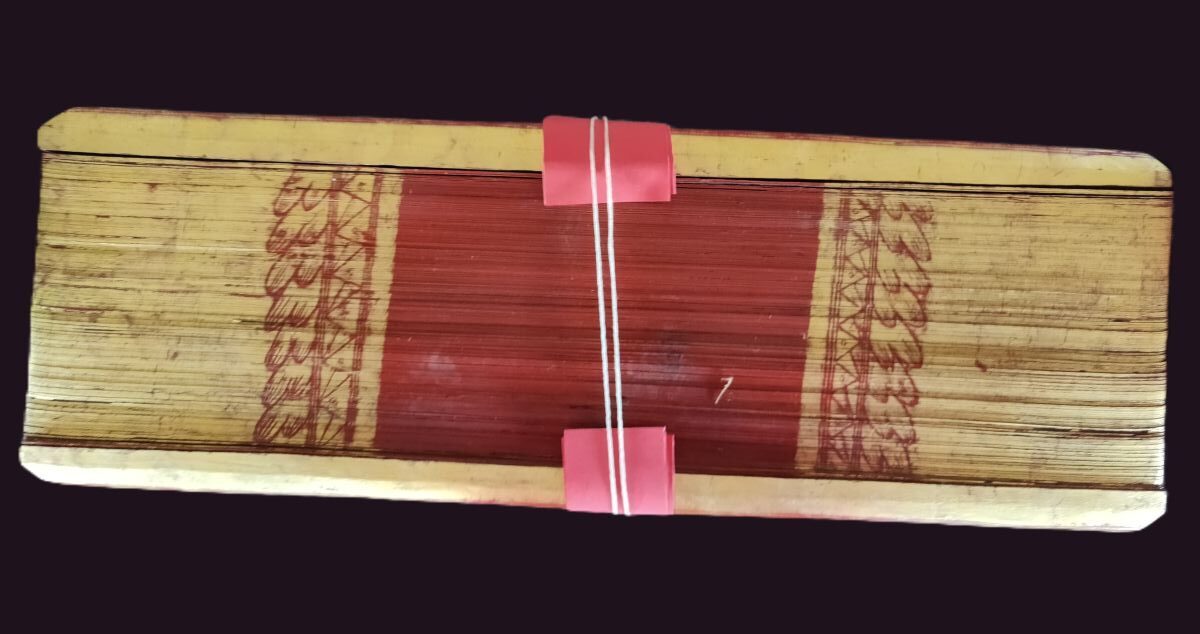
These ornate manuscripts flourished under royal and elite patronage from the seventeenth through nineteenth centuries. Following the end of the Burmese monarchy in 1885, production shifted toward broader commercial markets, where simpler methods gradually replaced the labor-intensive lacquer traditions.detailed motifs in black ink, red, or gold, such intricate edge-painting remains rare compared to standard solid gilding.