Prehistoric Myanmar: Early Peoples, Bronze Age and the Mon
Prehistoric Myanmar and its early peoples are known less from written records than from caves, river terraces and burial grounds, and the story they tell runs from the Stone Age through the Bronze Age to the arrival of the Mon and other early peoples. Human occupation of Myanmar goes back to the Pleistocene. The best-known earliest evidence is the Anyathian stone-tool tradition, named after Anyatha (‘Upper Burma’), which is found along the central Irrawaddy and is traditionally assigned to the Lower and Middle Palaeolithic, although absolute dates are scarce. Its tools are made largely from fossil wood and silicified tuff.
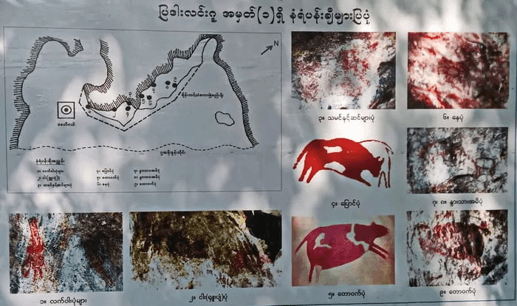
The best-known later site is the Padah-Lin cave complex near Ywangan in southern Shan State, where radiocarbon dates from the 1969 excavation run from about 13,000 to under 2,000 years BP.
The finds include flaked and polished stone tools, a few pottery fragments and red-ochre paintings of animals and hands. The paintings are Myanmar’s earliest known cave art, though they have not been directly dated. The material is comparable to the Hoabinhian of mainland Southeast Asia, and Burmese archaeologists have described it as ‘Neolithic, but it reflects hunter-gatherers using new technologies rather than an agricultural society.
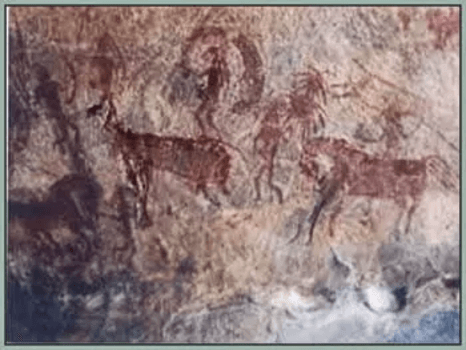
The Padah-Lin caves near Ywangan, in southern Shan State, contain red-ochre paintings of animals, hands and a sun motif. The paintings have not been directly dated, but are assumed to belong to the cave’s occupation, with radiocarbon dates from the excavated deposits beginning around 13,000 years ago.
Polished stone tools appear in this hunter-gatherer setting, although there is no firm evidence of farming or domestication there. Dated Neolithic and early Bronze Age settlement in Myanmar belongs mainly to the second millennium BCE, as at Nyaung’gan in the Sagaing Region on the eastern bank of the Chindwin, adjacent to Oakie 1 in Sagaing Division approximately 35km North, Northwest of Monywa.
Taungthaman, near Mandalay, was occupied from the late Neolithic into the early Iron Age, to about the mid-first millennium BCE, and has produced specialised pottery, polished stone tools, burials and early iron working. “The Irrawaddy” reports that Myanmar’s military authorities have demolished the Taungthaman archaeological site in Mandalay, using the debris as material for a new road. (Referenced: The Irrawaddy)
Taungthaman, which dates to the late Neolithic and early Iron Age, was one of the country’s best-known prehistoric sites. All that survives is a damaged plaque stating that Stone Age artefacts were unearthed there on 17 February 1971. Archaeologists and heritage specialists have reacted with alarm, since the site was important to understanding the country’s early past.
The Bronze–Iron Age and Transregional Networks
Myanmar’s Bronze Age is known mainly from cemeteries and settlements in the central-northern dry zone, notably Nyaung’gan and Oakaie in Sagaing Region. Radiocarbon dates place the Late Neolithic to early Bronze Age phase in the late second to early first millennium BCE.
The communities cast bronze, grew rice and kept cattle, pigs and dogs, and made semi-precious stone beads at local workshops. Secondary jar burials and some pottery forms resemble those of Ban Chiang in Thailand and Samrong Sen in Cambodia. Iron working appears later, probably introduced from India or elsewhere in Southeast Asia.
In the Iron Age cemeteries of the Samon Valley, dated mainly to the mid-to-late first millennium BCE, glass beads made in western and northeastern India show that the region was linked to exchange networks reaching from the Ganges Valley to Thailand and Vietnam.
Early Ethnohistory of Arakan (Rakhine)
Prehistoric Arakan (Rakhine State) is poorly documented archaeologically and is known mainly through chronicle traditions, which were compiled long after the events they describe and blend myth with history. These traditions recall early inhabitants in legends of the Bilu, or ogres.
They also mention hill peoples such as the Mro, whose chief is said to have given his daughter in marriage to Arakan’s legendary first king. Over the centuries, groups from the north, east and northwest settled in the region, including Tibeto-Burman peoples such as the Khami and the Chin, and the Chakma-related Daingnet, sometimes grouped under the general name Sak. Together they shaped the multi-ethnic landscape of what is now Rakhine State.
The Mon and Austroasiatic Migration
The Mon speak a language of the Monic branch of the Austroasiatic family, which is also represented in Thailand by Nyah Kur. Mon is related to Khmer, but only distantly, as the two belong to different branches. Mon speakers are associated with early states such as Dvaravati in central Thailand.
The origin of the Austroasiatic family is debateable, some researchers argue for a southern Chinese homeland and a spread into mainland Southeast Asia with rice farming, others for a homeland within Southeast Asia, perhaps along the Mekong. Other Austroasiatic speakers in Myanmar include the Palaungic peoples, such as the Palaung (Ta’ang) and the Wa. They live in the hills of northern and eastern Myanmar, in contrast to the Mon, who settled the river plains and coast of Lower Burma.
Lower Myanmar and the Mon Kingdoms
Lower Myanmar is traditionally regarded as the homeland of the Mon, whose inscriptions in the Thaton area date from as early as the sixth century. Mon tradition names Thaton as their early capital and identifies it with Suvarnabhumi, but the existence of an independent Thaton kingdom before Pagan is disputed. Some historians regard it as a later legend, and the Pyu were also present in Lower Burma. The Mon are credited with helping transmit Theravada Buddhism and Indian-derived writing to Pagan, though the Pyu played a part as well, and the relationship between Mon and Burmese script is debated.
Tibeto-Burman Migrations
Tibeto-Burman-speaking peoples later settled across Myanmar at different times, probably moving south from the Tibetan plateau and southwest China and, for some western groups, through Assam. They include the Bamar, the Chin, the Kachin, the Rakhine and the Kadu. Groups such as the Lisu, Lahu and Akha are generally thought to have arrived much later from Yunnan.
Various Sources: